Late Devonian polar tetrapods and estuarine lagerstätte of Waterloo Farm
South Africa
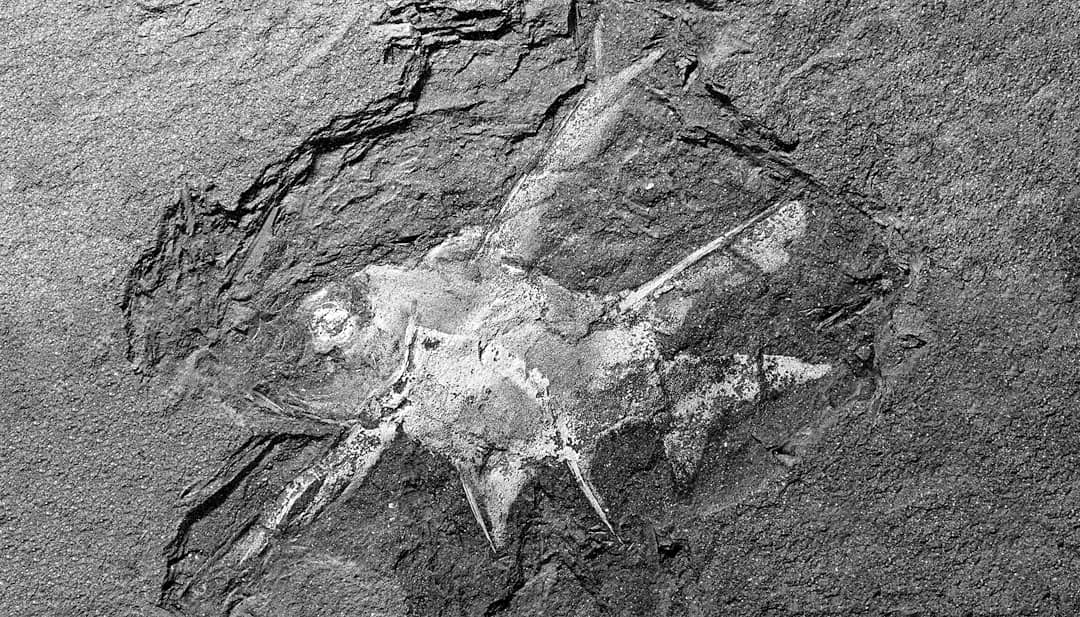
Holotype of the acanthodian ‘Angelacanthus acus’ from Waterloo Farm demonstrating exquisite soft tissue preservation.
Geological Period
Devonian (Upper Devonian)
Main geological interest
Paleontology
Location
Makhanda, Eastern Cape, South Africa
33°19’24” S, 26°32’14” E
Holotype of the acanthodian ‘Angelacanthus acus’ from Waterloo Farm demonstrating exquisite soft tissue preservation.
The only known Famennian polar estuarine lagerstätte, which includes the only non-tropical Devonian tetrapods and an ontogenetic series of the oldest lampreys.
Waterloo Farm provides the only comprehensive window into vertebrate and plant diversity at polar palaeolatitudes during the Late Devonian – all other significant sites represent the palaeotropics. The rich fauna and flora have overturned many palaeogeographic assumptions, including belief that the earliest tetrapods (four-legged-animals) were exclusively tropical and that the earliest woody trees were tropical to warm-temperate in distribution.
Furthermore soft-tissue preservation continues to provide unique insights into anatomy and ontogeny of many organisms. For example, publication of a complete ontogeny of the oldest known lampreys challenged long-held evolutionary scenarios by demonstrating lack of larvae in described Palaeozoic taxa.
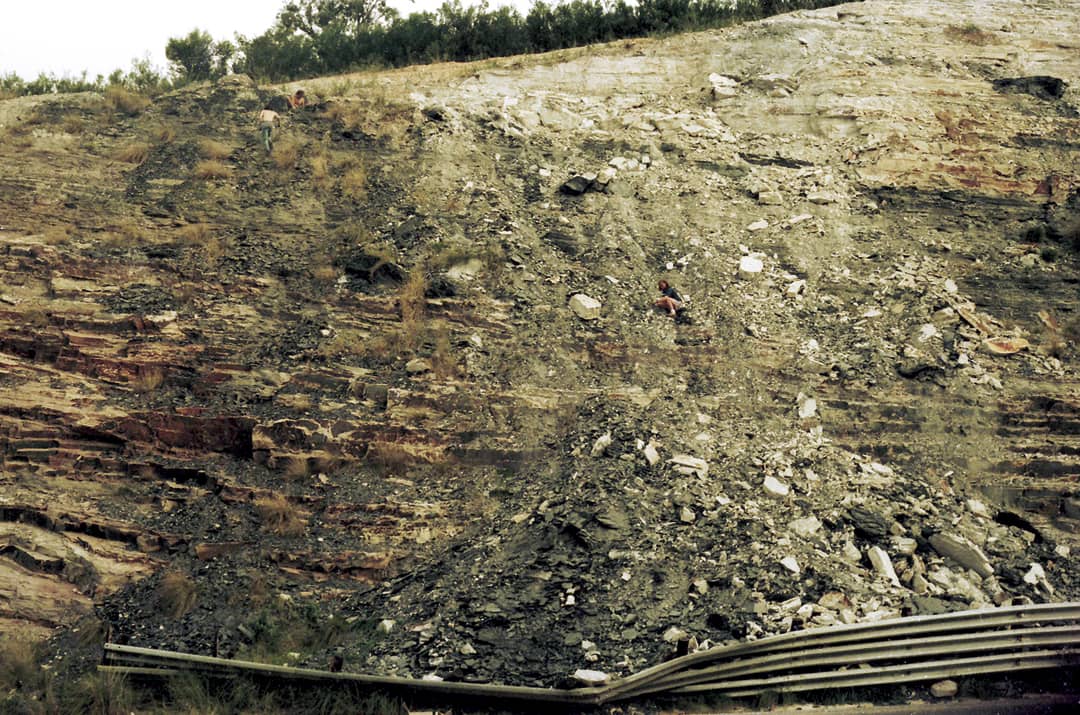
Waterloo Farm in 1990 showing channel sandstones overlain by estuarine black shale lenses, overlain by sand-flat deposits. Vertebrate bearing lens, at top left.
Geological description
Fine black anoxic metashale at Waterloo Farm is interbedded within quartzitic sandstone of the Famennian Witpoort Formation (Witteberg Group, Cape Supergroup), which was deposited along a sandy coastline and on the adjacent continental margin. Horizons of black shale lenses occur at intervals through the formation, and represent estuarine and coastal lagoonal sediments.
Such deposits formed during continental margin flooding when short lived rises in global sea level were precipitated by global warming and ice melt. Anoxic bottom waters periodically developed in depressions within coastal lake floors, which resulted in episodes of exceptional soft-tissue preservation at Waterloo Farm. Accumulated estuarine muds were buried beneath estuarine sand bars and flats.
Locateed along the southern shoreline of Gondwana, the site has provided the only record of a Famennian vertebrate fauna from high palaeolatitudes and is one of very few to exhibit soft tissue preservation. Fossils include tetrapods, lampreys, diverse placoderms (armour-plated-fish), acanthodians, sharks, ray-finned fish and lobe-finned fish (including coelacanths and tristichopterids). These are preserved alongside a comprehensive ecological record that includes abundant seaweeds and stoneworts, bivalves, eurypterids and trace fossils. The adjacent terrestrial environment is represented by a diverse fossil flora and remains of Gondwana’s earliest terrestrial invertebrates (Gess and Whitfield, 2020 and refs therein).
Scientific research and tradition
Since its discovery in 1985 ongoing research on the site has resulted in more than 30 publications, including diagnosis of 28 new plants and animals. These have included two tetrapods published in Science (Gess and Ahlberg, 2018) and two publications on lampreys in Nature (Gess et al., 2006; Miyashita et al., 2021).
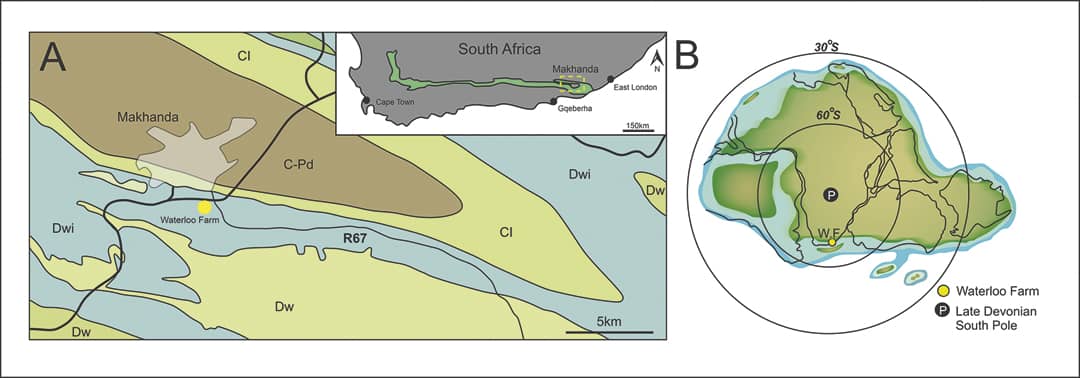
A. Map showing geology around Makhanda;
Dw = Weltevrede Formation (Frasnian), Dwi = Witpoort Formation (Famennian), Cl = Lake Mentz Subgroup (early Carboniferous), C-Pd = Dwyka Group (Carboniferous – Early Permian). Inset map showing distribution of Witteberg Group (comprising, Weltevrede Formation, Witpoort Formation and Lake Mentz Subgroup). B. Current position of Waterloo Farm superimposed on late Devonian map.
Reference
Gess, R. and Ahlberg, P.E. (2018) “A tetrapod fauna from within the Devonian Antarctic Circle,” Science, 360(6393), pp. 1120–1124. Available at: https://doi.org/10.1126/science.aaq1645.
Gess, R.W., Coates, M.I. and Rubidge, B.S. (2006) “A lamprey from the Devonian period of South Africa,” Nature, 443(7114), pp. 981–984. Available at: https://doi.org/10.1038/nature05150.
Gess, R.W. and Whitfield, A.K. (2020) “Estuarine fish and tetrapod evolution: insights from a Late Devonian (Famennian) Gondwanan estuarine lake and a southern African Holocene equivalent,” Biological Reviews of the Cambridge Philosophical Society, 95(4), pp. 865–888. Available at: https://doi.org/10.1111/brv.12590.
Miyashita, T. et al. (2021) “Non-ammocoete larvae of Palaeozoic stem lampreys,” Nature, 591(7850), pp. 408–412. Available at: https://doi.org/10.1038/s41586-021-03305-9.
Author(s)
Robert W Gess.
Rhodes University and Albany Museum, Makhanda, South Africa
Shawn D Johnstone.
Rhodes University, Makhanda, South Africa.