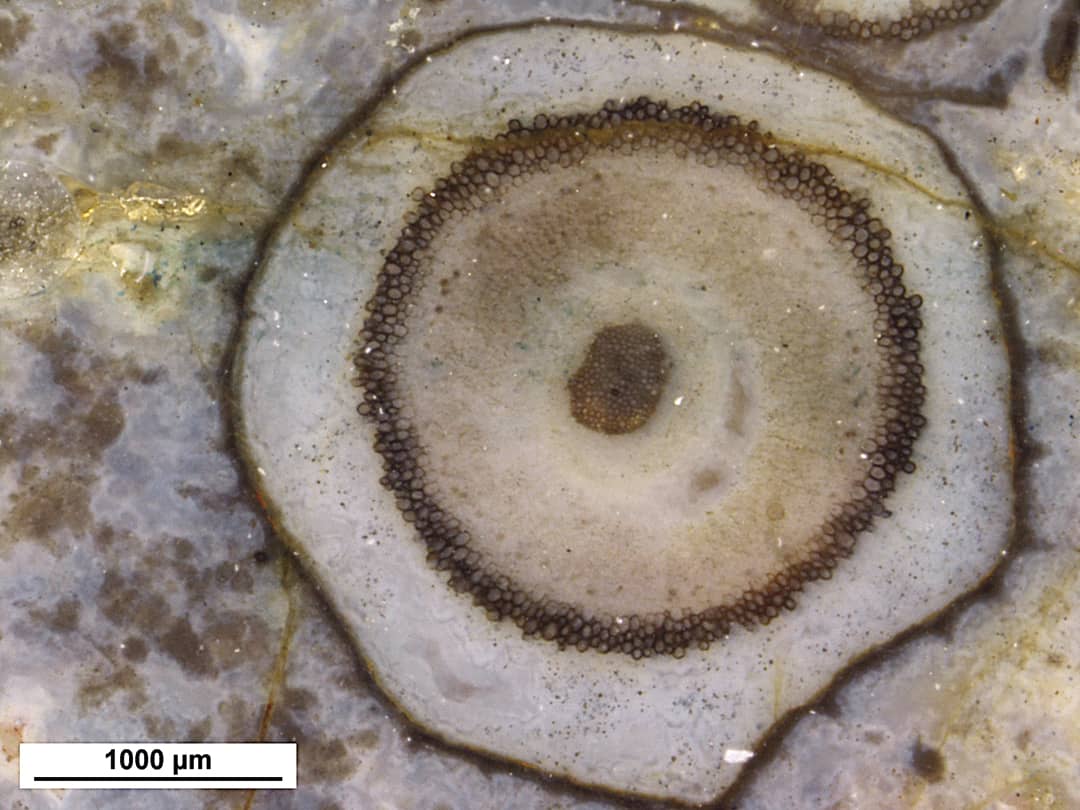
‘Ventarura lyonii’ from the Windyfield Chert, showing the exceptional cellular preservation that the chert provides. (Photo: Alex Brasier / University of Aberdeen).
Devonian (Lower Devonian)
Paleontology
Stratigraphy and sedimentology
Rhynie, Aberdeenshire, Scotland, United Kingdom
57°20’13” N, 2°50’27” W
‘Ventarura lyonii’ from the Windyfield Chert, showing the exceptional cellular preservation that the chert provides. (Photo: Alex Brasier / University of Aberdeen).
The Rhynie cherts are undoubtedly amongst the most important fossil sites in the world; there are no other comparable sites for this key time interval. Because of the exceptional preservation that this unique ancient hot-spring site provides, Rhynie continues to be the global reference site for studies of diversity and complexity of early terrestrial ecosystems. The site is globally important for its exceptional preservation and for the scarcity of any other known equivalent ancient fossil hot-spring deposits. It uniquely provides insights into processes of “terrestrialisation” –life beginning to spread across the land– that was in progress when the deposit formed.
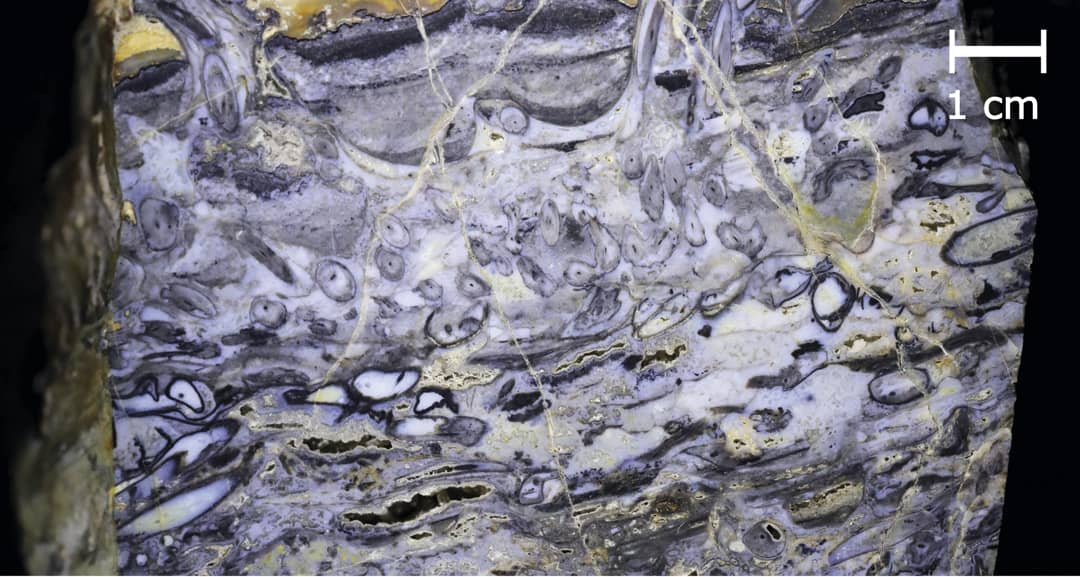
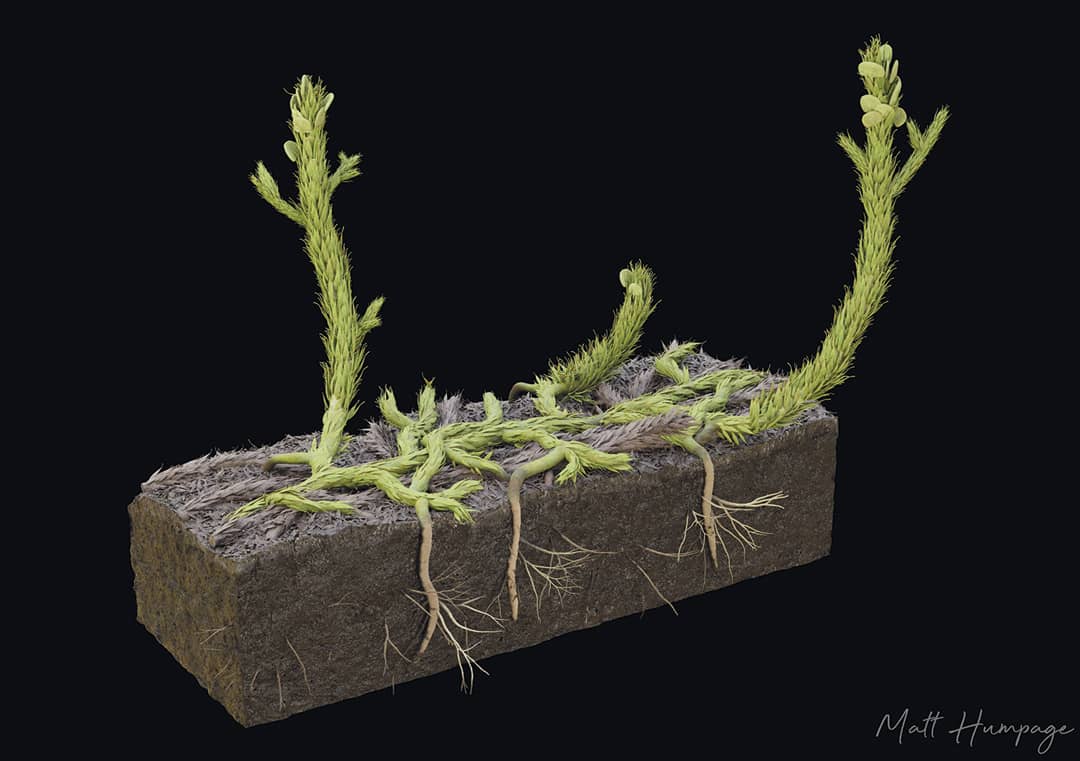
The Early Devonian Rhynie Basin is a 3 by 21 kilometer half-graben that includes lenses of chert within lacustrine and alluvial shale and muddy sandstone of the Dryden Flags Formation (Rice et al., 2002). Radio-isotope dating and spores both yield Pragian to Emsian ages. The cherts were precipitated from meteoric fluids that had interacted with contemporaneous volcanics at depth before rising up faults, forming hot-springs at the surface. Plants, fungi and invertebrates that had colonised land surfaces and pools around the springs were mineralised with exceptional preservation. The fact the fossils are found in situ in the ecosystem, the remarkable cellular level of preservation and the early Devonian age, a key time during the rise to dominance of land plants, makes the Rhynie cherts globally unique and despite a century of research fossils from this site are still proving transformative. Key findings so far (reviewed in Strullu-Derrien et al., 2019 and Garwood et al., 2020) include the oldest known insect, exceptionally preserved arachnids, direct evidence of plant-fungal symbiosis, Devonian terrestrial amoebae and unicellular eukaryotes and prokaryotes, and six genera of land plants that have transformed our understanding of plant leaves, roots and lifecycles.
Discovered in 1912, and since explored through several trenching and drilling campaigns, work on the Rhynie Chert has illuminated our understanding of early terrestrial ecosystems, terrestrialisation, and ancient hot-springs (reviewed in Garwood et al., 2020). Through ongoing international collaborative investigations (e.g. Turner et al., 2023), it continues to do so.
Garwood, R.J., Oliver, H. and Spencer, A.R.T. (2020) “An introduction to the Rhynie chert,” Geological Magazine, 157, pp. 47–64. Available at: https://doi.org/10.1017/S0016756819000670.
Hetherington, A.J. et al. (2021) “An evidence-based 3D reconstruction of Asteroxylon mackiei, the most complex plant preserved from the Rhynie chert,” eLife. Edited by J. Kleine-Vehn et al., 10, p. e69447. Available at: https://doi.org/10.7554/eLife.69447.
Kidston, R. and Lang, W.H. (1917) “On Old Red Sandstone Plants showing Structure, from the Rhynie Chert Bed, Aberdeenshire Part I. Rhynia Gwynne-Vaughani,” Earth and Environmental Science Transactions of The Royal Society of Edinburgh, 51(3), pp. 761–784. Available at: https://doi.org/10.1017/S0080456800008991.
Rice, C.M., Trewin, N.H. and Anderson, L.I. (2002) “Geological setting of the Early Devonian Rhynie Cherts, Aberdeenshire, Scotland: An early terrestrial hot spring system,” Journal of the Geological Society, 159, pp. 203–214.
Strullu-Derrien, C., Kenrick, P. and Knoll, A.H. (2019) “The Rhynie chert,” Current biology: CB, 29(23), pp. R1218–R1223. Available at: https://doi.org/10.1016/j.cub.2019.10.030.
Turner, H.-A. et al. (2023) “Leaves and sporangia developed in rare non-Fibonacci spirals in early leafy plants,” Science, 380(6650), pp. 1188–1192. Available at: https://doi.org/10.1126/science.adg4014.
Alex Brasier.
IAS / University of Aberdeen
Sandy Hetherington.
University of Edinburgh