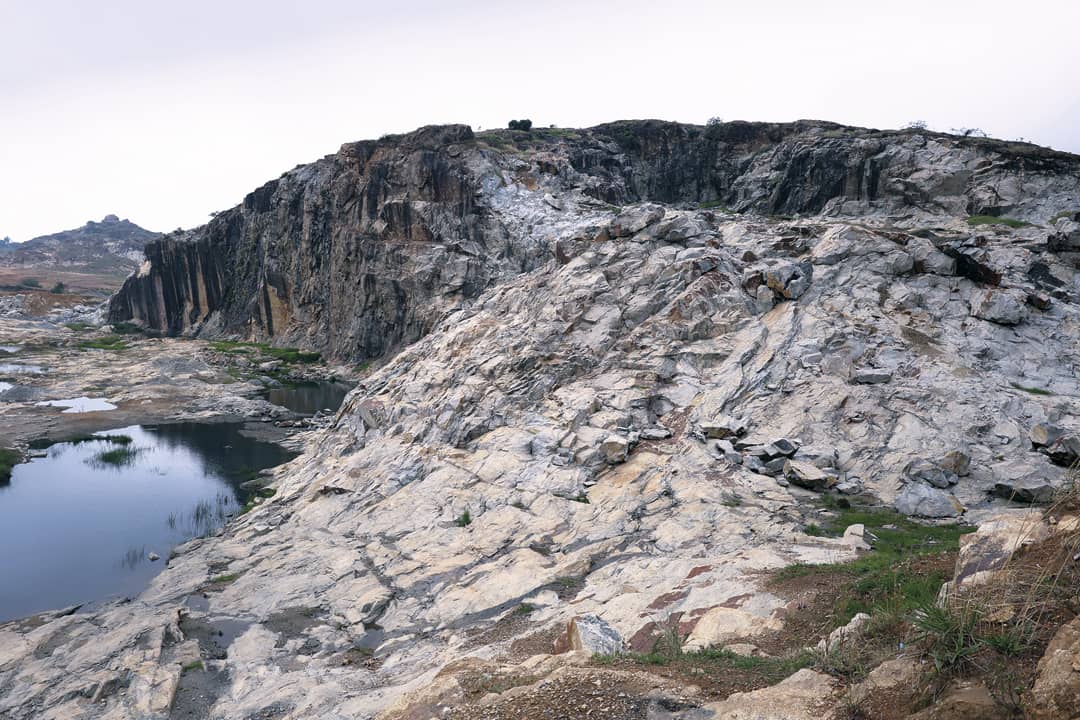
Photograph showing excellent exposure of late stage extrusive rhyolite and ignibrite at the southern fringe of the Jos-Bukuru Complex.
Geological Period
Jurassic
Main geological interest
Igneous and Metamorphic petrology
Geomorphology and active geological processes
Location
Jos Plateau, Nigeria
9°54’11” N, 8°52’55” E
Photograph showing excellent exposure of late stage extrusive rhyolite and ignibrite at the southern fringe of the Jos-Bukuru Complex.
The best classical example of Ring Dykes in the world.
The Jos Younger Granite holds major international geological significance because it represents the world’s most classical and best‑preserved example of ring‑dyke complexes, making it a global reference for studying these intrusive structures. Its clear north–south age progression provides a natural laboratory for examining mantle‑plume dynamics within plate‑tectonic frameworks. Petrographically, it offers exceptional insights into anorogenic magmatism, magma differentiation, and the architecture of long‑lived magma reservoirs. Added to this scientific value, the striking geomorphology of the Jos Plateau —together with its unusually cold climate, the coldest in Nigeria— creates a distinctive environment that enhances its appeal for geotourism and geoeducation.
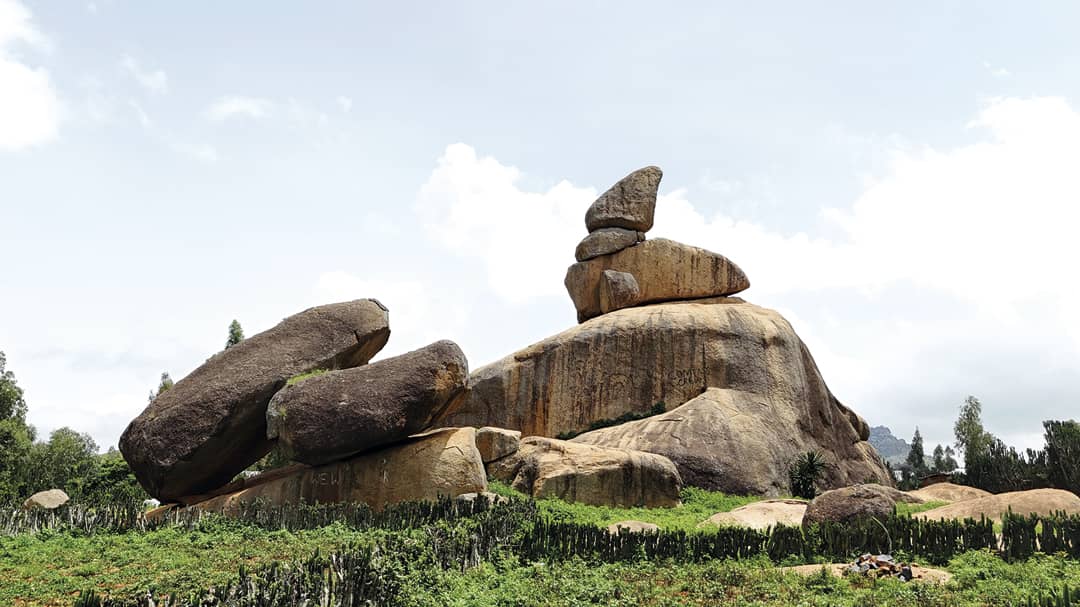
Photograph of a classic Riyom rock pile showing classic and scenic beauty of the Younger Granite exposures around the Jos Bukuru Complex.
Geological description
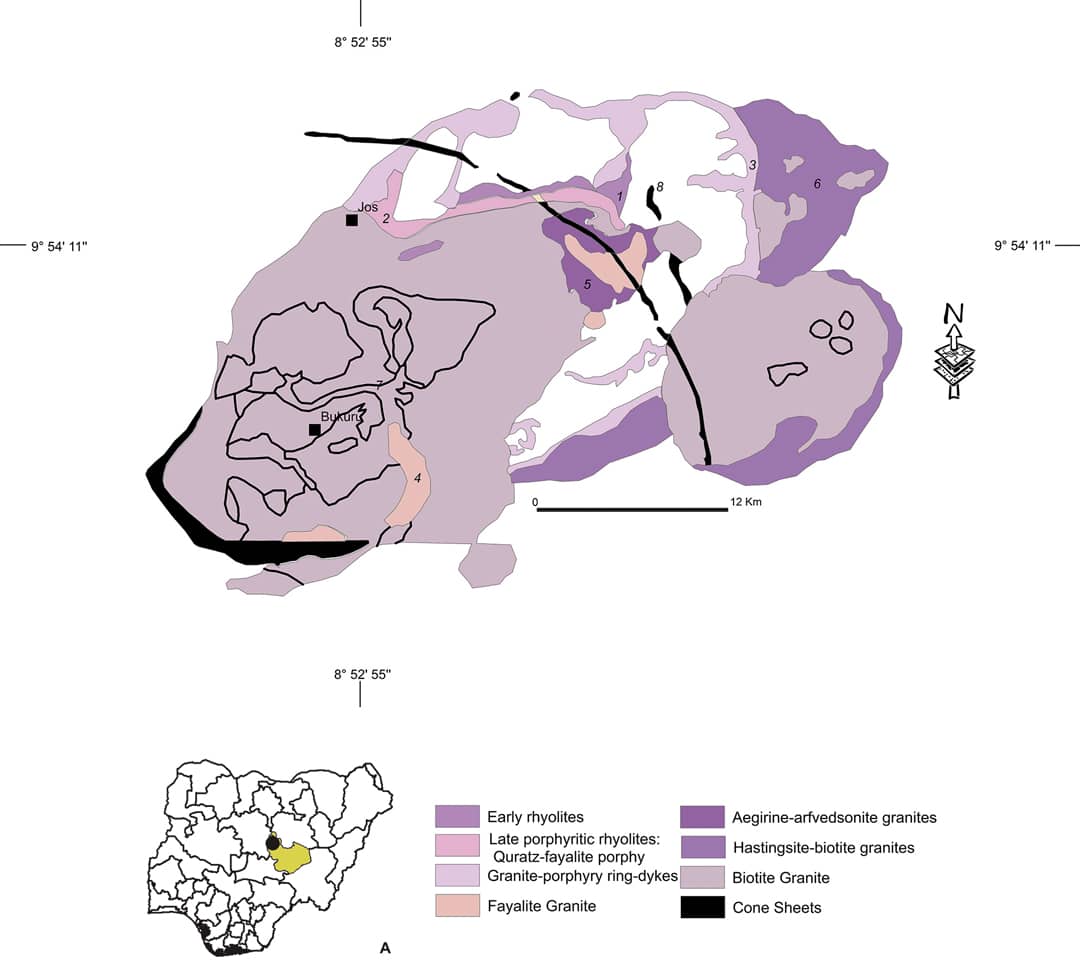
The Jos-Bukuru complex, the focal point of magmatic activity among over fifty granite complexes in the Jos Plateau Younger Granite Province, is a prime example of anorogenic ring-dyke complexes. Formed during the Jurassic Period (160–170 million years ago), it features well-preserved geological structures, including ring dykes, fractures, cone sheets, cauldron subsidence, and related volcanic phenomena. Spanning approximately 430 square kilometers and grades radially into adjoining complexes such as in the Ganawuri and Riyom to the west, its exceptional exposure and accessibility let geologists directly observe magmatic processes that are usually concealed elsewhere. The complex contains a diverse array of rocks –granite, rhyolite, syenite, and alkaline rocks– making it an important natural laboratory for studying anorogenic magmatism, crustal evolution, and rare-metal mineralization. Its arcuate intrusive bodies are emplaced along ring fractures from roof collapse above shallow magma chambers, and cone sheets and associated volcanic rocks result from fault-bounded rhyolite, ignimbrite, tuff, and volcanic breccia extrusion. Beyond scientific importance, the province is economically significant for producing tin, niobium, tantalum, and other strategic minerals. Its scientific integrity, educational value, and global relevance establish it as a benchmark for geological heritage and ring-dyke magmatism.
Scientific research and tradition
Many of the rocks of the Jos Bukuru complex have been extensively studied petrographically and geochemically because of its tin mineralization. It was the main export commodity during the colonial era (pre-1960s).
Geological Map of the Jurassic Jos-Bukuru Younger Granite Complex.
Reference
Ajakaiye, D.E. (1970) “Gravity Measurements over the Nigerian Younger Granite Province,” Nature, 225(5227), pp. 50–52. Available at: https://doi.org/10.1038/225050b0.
Goki, N., Iyakwari, S. and Umbugadi, A. (2018) “Geotourism and Mining Heritage: a Potential Gold Mine for Central Nigeria,” Acta Geoturistica, 9(1), pp. 9–22. Available at: https://doi.org/10.1515/agta-2018-0002.
Goki, N., Marcus, N.D. and Umbugadu, A.A. (2016) “Preliminary assessment of the post – mining geotourism potential of the Plateau tin fields, Nigeria,” Acta Geoturistica, 7(1), pp. 21–30.
Wright, J.B. (1976) “Origin of the Jos Plateau Tinfield – Evidence and Hypotheses,” in C.A. Kogbe (ed.) Geology of Nigeria. Elizabethan Publishing Company, p. 446.
Author(s)
Nathaniel Goter Goki.
Department of Geology, Nasarawa State University, Keffi, Nigeria
Olugbenga Akindeji Okunlola.
Department of Geology, University of Ibadan, Nigeria