Ultrahigh-pressure metamorphic rocks of the Western Gneiss Region
Norway
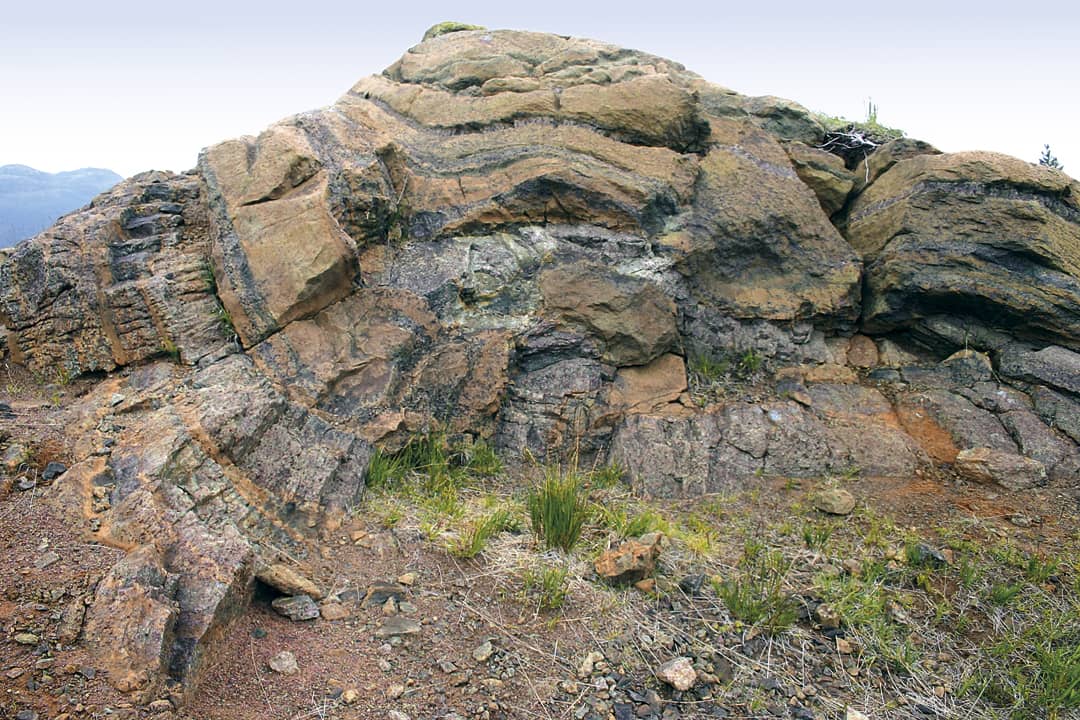
Garnet peridotite and dunite (pale brown) with garnet pyroxenite layers (green and pink), Lien, Almklovdalen. Depleted mantle “refertilised” along mafic magma conduits.
Geological Period
Silurian to Devonian
Main geological interest
Igneous and Metamorphic petrology
Tectonics
Location
Vestland and Møre & Romsdal, Norway
62°0’11” N, 5°36’33” E
Garnet peridotite and dunite (pale brown) with garnet pyroxenite layers (green and pink), Lien, Almklovdalen. Depleted mantle “refertilised” along mafic magma conduits.
The archetypal giant ultrahigh-pressure metamorphic terrain demonstrating the process of continental subduction through numerous superb, accessible exposures.
The Western Gneiss Region is easily accessible, offering superb exposures of spectacularly beautiful high- and ultrahigh-pressure rocks including eclogite, garnet peridotite and pyroxenite. Several were studied by Eskola in his classic 1920’s works on metamorphic facies. These rocks have since yielded formative contributions to understanding mantle evolution, collision tectonics, continental subduction, crust-mantle interactions, metamorphic transformations under extreme conditions and exhumation of subducted crust. The region continues to attract researchers as a natural laboratory for new methods and concepts. Set in dramatic glacial and post-glacial scenery, it is a popular destination for geo-tourism (e.g. UNESCO Fjordkjysten Geopark) and university field teaching.
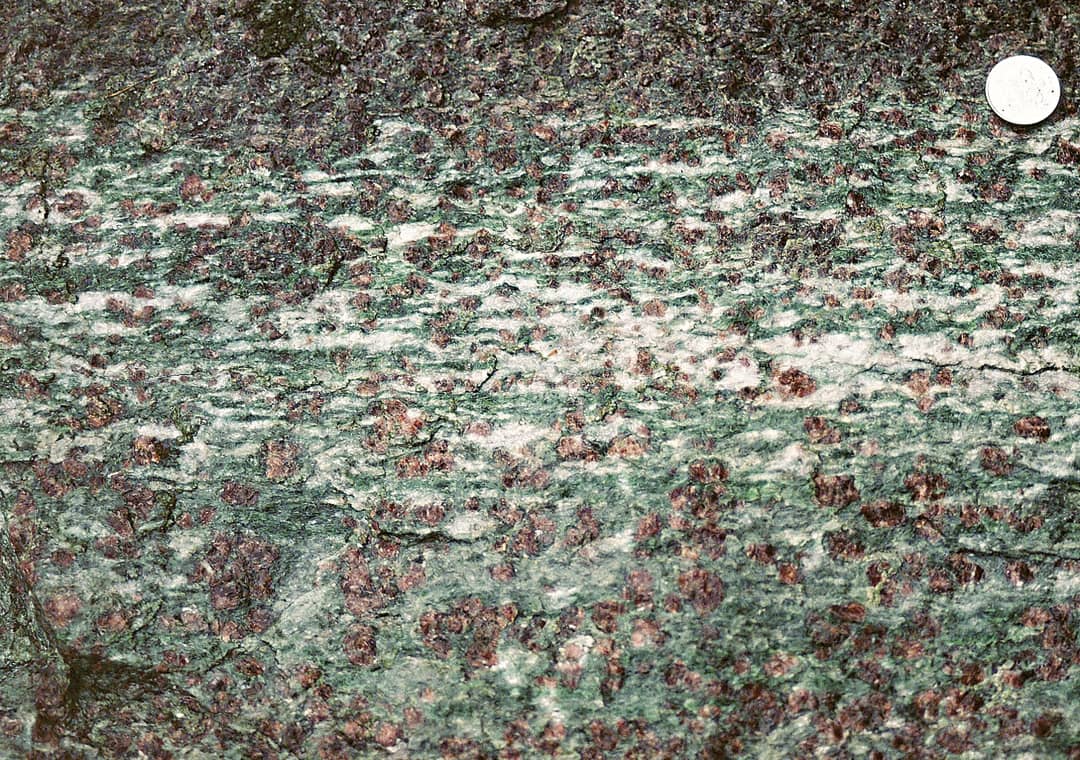
Kyanite coesite eclogite, Verpeneset, outer Nordfjord. Darker red cores of garnets record an older amphibolite stage predating Silurian subduction.
Geological description
Set within the dramatic fjordland scenery of west Norway, the Western Gneiss Region is an extensive area of Precambrian crystalline basement that re-emerges through a window in the Caledonian orogen. Within the dominant gneissic rocks lie bodies of spectacularly beautiful eclogite and garnetiferous ultramafic rocks. In the northern half of the region such rocks host coesite and even diamond indicating the imposition of “ultrahigh” pressures that resulted from transient subduction of this continental crust into the mantle during the late Silurian collision with Laurentia. Pre-existing mafic rocks were transformed into eclogite, and the descending crust entrained ultramafic rocks from the adjacent lithospheric mantle. The region is bounded by shear zones against the overlying nappe pile and Devonian intramontane sedimentary rocks, which accommodated the descent and re-emergence of this enormous mass of buoyant rock. A selection of the iconic eclogites and ultramafics can be explored in the seaboard region between Nordfjord and Molde, including the stunning kyanite eclogite at Verpeneset, Nordfjord; Eskola’s “pegmatitic” enstatite eclogite by Selje; the mantle dunite and pyroxenites in Almklovdalen; the coesite eclogite at Ulsteinvik, Hareidlandet; a “frozen” gabbro to eclogite transformation at Flem, Flemsøya, and the deep mantle garnet peridotites of Oterøya.
Scientific research and tradition
Since Eskola’s classic studies in the 1920’s recognised their deep origins, the eclogites and garnet peridotites of western Norway have yielded a dramatic, dynamic picture of continental subduction, crust-mantle interaction and exhumation that continues to attract a worldwide community of petrologists, geochronologists and tectonicists.
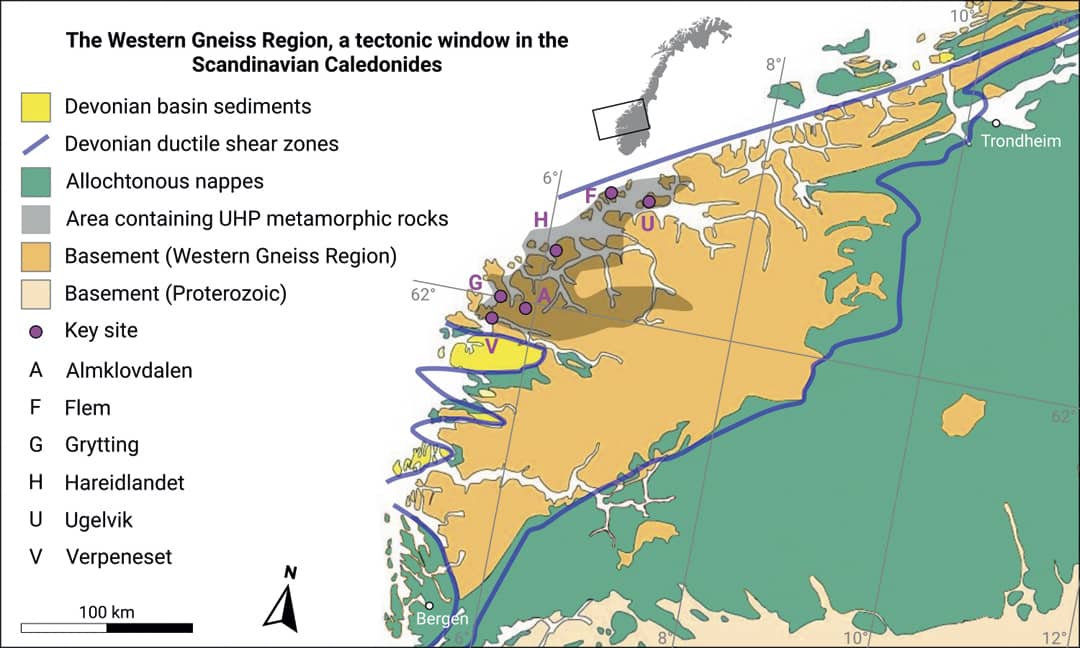
Tectonic and metamorphic map of the Western Gneiss Region in the Caledonian orogen of western Norway showing the ultrahigh-pressure domain and key localities.
Reference
Brueckner, H.K. et al. (2010) “The mantle and crustal evolution of two garnet peridotite suites from the Western Gneiss Region, Norwegian Caledonides: An isotopic investigation,” Lithos, 117(1), pp. 1–19. Available at: https://doi.org/10.1016/j.lithos.2010.01.011.
Bryhni, I. and Griffin, W.L. (1971) “Zoning in eclogite garnets from Nordfjord, West Norway,” Contributions to Mineralogy and Petrology, 32(2), pp. 112–125. Available at: https://doi.org/10.1007/BF00383054.
Eskola, P. (1921) On the eclogites of Norway. Kristiania : I kommission hos J. Dybwad (VlDENSKAPSSELSKAPETJ SKRIFTER. I. MAT.-NATURV. KLASSE., No. 8). Available at: http://archive.org/details/oneclogitesofnor00eskoiala.
Griffin, W.L. and Brueckner, H.K. (1985) “REE, Rb-Sr and Sm-Nd studies of Norwegian eclogites,” Chemical Geology: Isotope Geoscience section, 52(2), pp. 249–271. Available at: https://doi.org/10.1016/0168-9622(85)90021-1.
Krogh, E.J. (1977) “Evidence of Precambrian continent–continent collision in Western Norway,” Nature, 267(5606), pp. 17–19. Available at: https://doi.org/10.1038/267017a0.
Smith, D.C. (1984) “Coesite in clinopyroxene in the Caledonides and its implications for geodynamics,” Nature, 310(5979), pp. 641–644. Available at: https://doi.org/10.1038/310641a0.
Author(s)
Simon J. Cuthbert.
AGH University of Krakow, Poland
Ane K. Engvik.
Geological Survey of Norway, Trondheim, Norway
Liu Penglei.
China University of Geosciences, Wuhan, China
Charlotte Möller.
Lund University, Sweden
Dirk Spengler.
University of Potsdam, Germany
David J. Young.
University of Texas at El Paso, USA