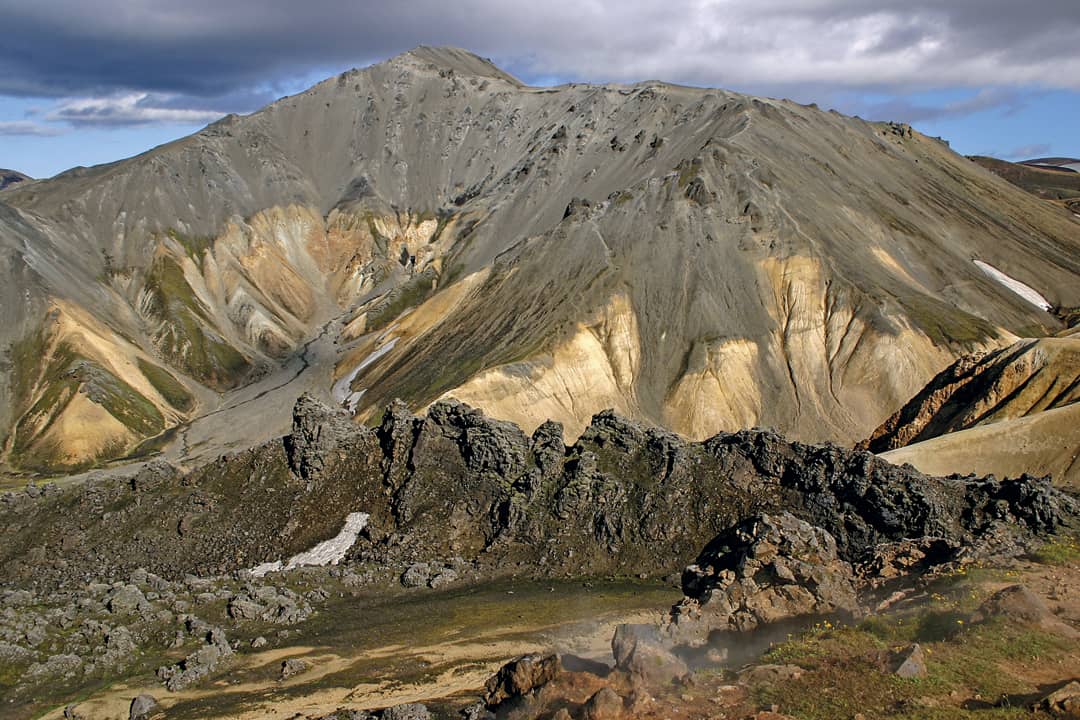
Bláhnjúkur. Greyish, subglacially formed, silicic hyaloclastite with coherent lava lobes overlying faulted and intensely geothermally altered rocks. Subaerial rhyolite lava in foreground. (Photo: Kristján Jónasson).
Geological Period
Quaternary (Pleistocene) to Quaternary (Holocene)
Main geological interest
Volcanology
Igneous and Metamorphic petrology
Location
Fjallabak Nature Reserve, Southern Highlands, Iceland
63°59’29” N, 19°3’37” W
Bláhnjúkur. Greyish, subglacially formed, silicic hyaloclastite with coherent lava lobes overlying faulted and intensely geothermally altered rocks. Subaerial rhyolite lava in foreground. (Photo: Kristján Jónasson).
Active volcano with diverse and abundant subglacially formed rhyolite and a caldera hosting a large geothermal area.
Torfajökull is the largest active rhyolite volcano in Iceland. The abundance and diversity of rhyolitic formations produced during volcano-ice interactions is unmatched by any other volcanic province, and the area displays exceptionally diverse geothermal surface features.
The Torfajökull volcano is located in a flank zone where there is no clear indication of rifting. However, during the Holocene, the fissure swarm of the Bárðarbunga volcanic system in the rift zone propagated into the northernmost part of the Torfajökull caldera where it has triggered eruptions of mixed magma several times.
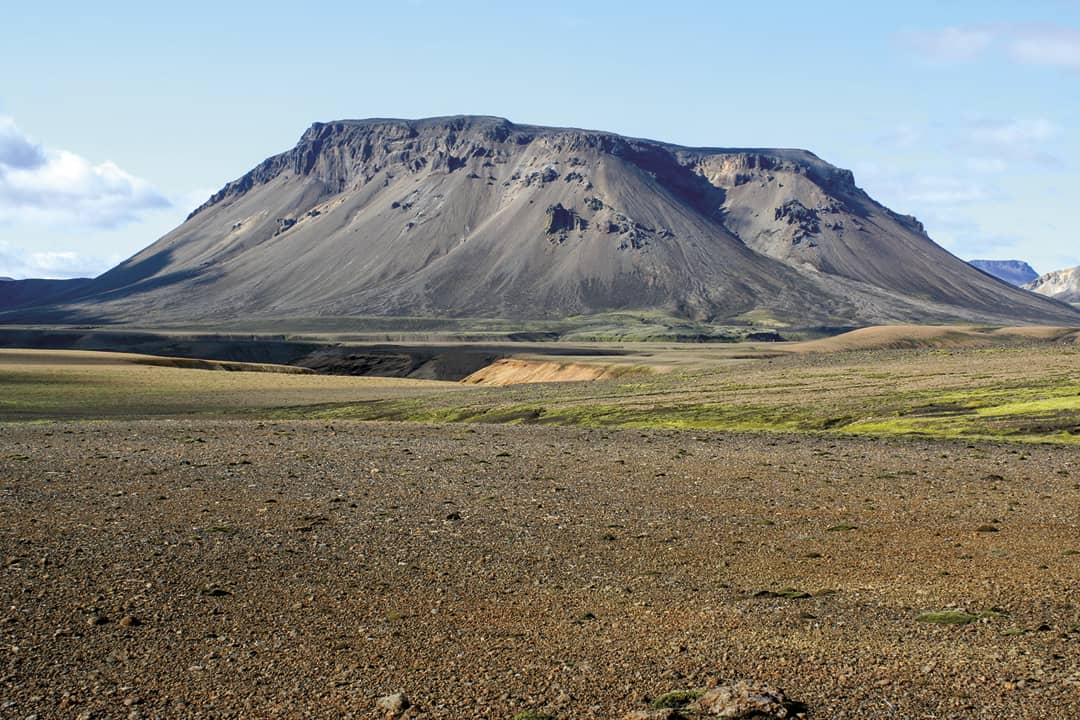
The 2 cubic kilometer Laufafell rhyolite tuya with lava overlying hyaloclastite. It was formed subglacially during the late Pleistocene. (Photo: Kristján Jónasson).
Geological description
The Torfajökull volcano is an approximately 600 square kilometer rhyolite massif at an altitude of 600–1200 meters above sea level. At its center is a large Pleistocene caldera, 16 kilometers in diameter from west to east and about 12 kilometers from north to south. The majority of rhyolite formations are subglacially formed and several of them erupted through the glacier, forming rhyolite tuyas.
The high-temperature geothermal field associated with Torfajökull is the largest and most powerful in the country, and the terrain inside the caldera is typified by immense and diverse geothermal activity.
In the northern part of the Torfajökull volcano, exceptional volcanic phenomena can be observed. The basaltic Bárðarbunga volcanic system to the northeast has propagated southwest into the silicic Torfajökull volcano. During rifting events, basaltic dykes from Bárðarbunga have intersected the silicic magma of Torfajökull at the caldera edge and erupted mixed lavas containing both silicic and mafic magma (Larsen, 1984; Zellmer et al., 2008).
Up to eleven Holocene eruptions have occurred in the Torfajökull area, all in the western and northern parts. At least six of them have been induced by rifting and eruptions in the Bárðarbunga system, including the latest eruptions in the years 871 and 1477.
Scientific research and tradition
The area is an important research site for understanding the mixing of silicic and mafic magmas during eruption (Zellmer et al., 2008), and it continues to be an important site to understand the production of silicic magma at an oceanic ridge (Gunnarsson et al., 1998; Martin and Sigmarsson, 2007).
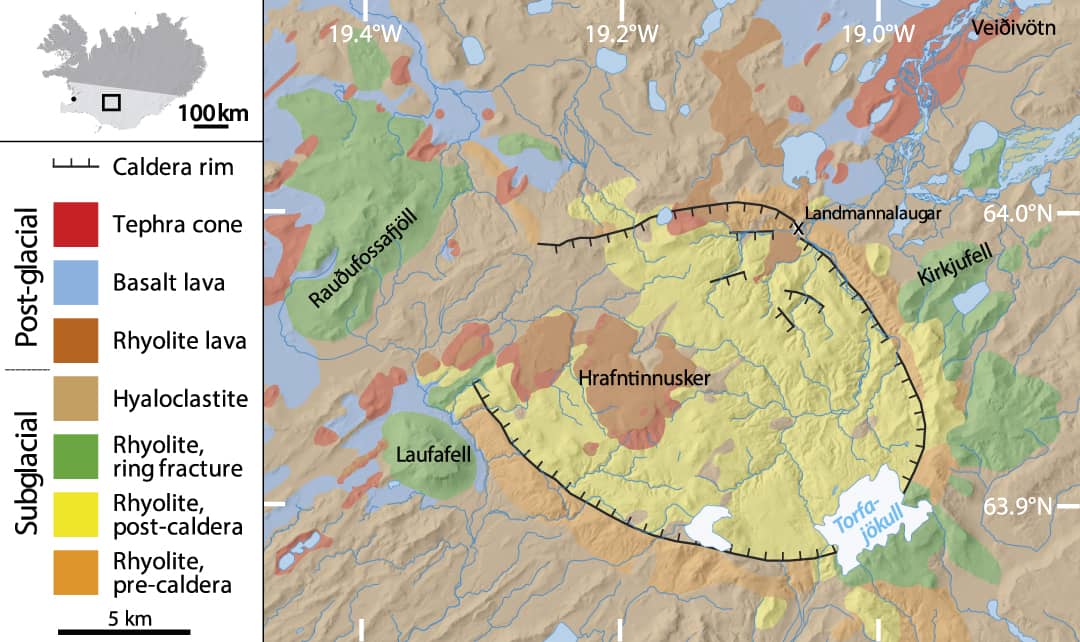
Geological map of Torfajökull volcano (Simplified after Sæmundsson and Friðleifsson, 2001). Inset is an overview map of Iceland, black point indicates the location of Reykjavík.
Reference
Gunnarsson, B., Marsh, B.D. and Taylor, H.P. (1998) “Generation of Icelandic rhyolites: silicic lavas from the Torfajökull central volcano,” Journal of Volcanology and Geothermal Research, 83(1), pp. 1–45. Available at: https://doi.org/10.1016/S0377-0273(98)00017-1.
Larsen, G. (1984) “Recent volcanic history of the Veidivötn fissure swarm, southern Iceland — an approach to volcanic risk assessment,” Journal of Volcanology and Geothermal Research, 22(1), pp. 33–58. Available at: https://doi.org/10.1016/0377-0273(84)90034-9.
Martin, E. and Sigmarsson, O. (2007) “Crustal thermal state and origin of silicic magma in Iceland: the case of Torfajökull, Ljósufjöll and Snæfellsjökull volcanoes,” Contributions to Mineralogy and Petrology, 153(5), pp. 593–605. Available at: https://doi.org/10.1007/s00410-006-0165-5.
McGarvie, D. (2009) “Rhyolitic volcano–ice interactions in Iceland,” Journal of Volcanology and Geothermal Research, 185(4), pp. 367–389. Available at: https://doi.org/10.1016/j.jvolgeores.2008.11.019.
Sæmundsson, K. and Friðleifsson, Ó. (2001) Í Torfajökli: Jarðfræði- og jarðhitakort af Torfajökulssvæðinu (In Icelandic). Orkustofnun, OS-2001/036. Reykjavík: Orkustofnun.
Zellmer, G.F. et al. (2008) “On the recent bimodal magmatic processes and their rates in the Torfajökull–Veidivötn area, Iceland,” Earth and Planetary Science Letters, 269(3), pp. 388–398. Available at: https://doi.org/10.1016/j.epsl.2008.02.026.
Author(s)
Kristján Jónasson.
Natural Science Institute of Iceland
Robert A. Askew.
Natural Science Institute of Iceland
Lovísa Ásbjörnsdóttir.
Natural Science Institute of Iceland