Fernando de Noronha Archipelago Alkaline Magmatic Province
Brazil
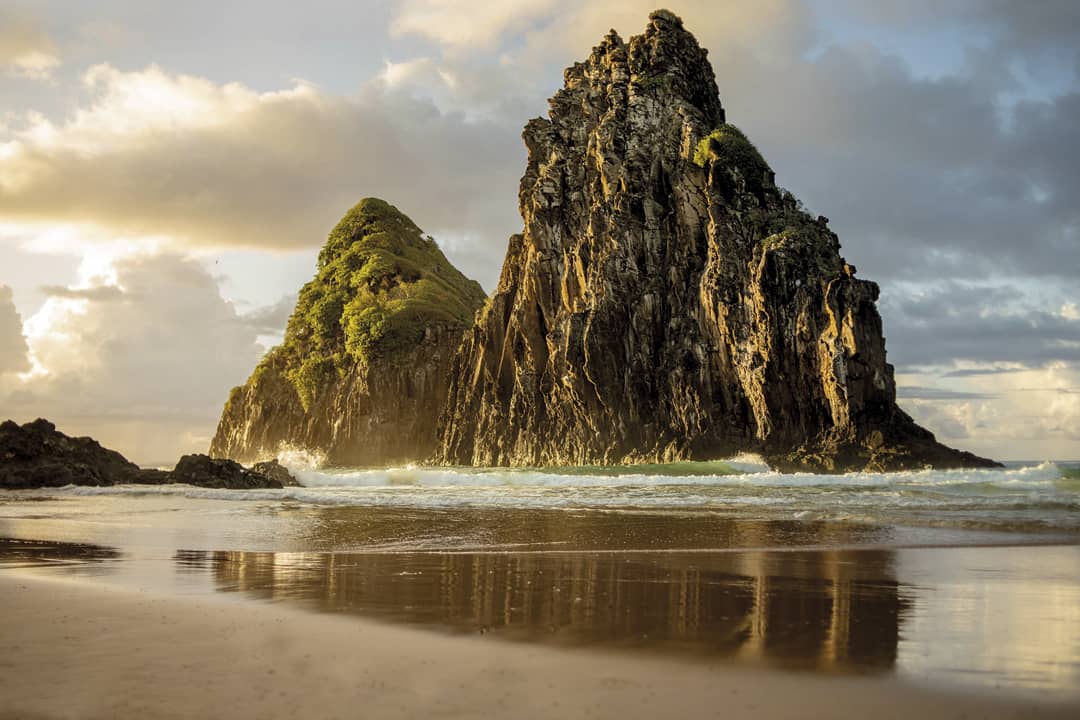
Dois Irmãos Islands, Quixaba Formation. (Photo: Bruna Roveri).
Geological Period
Neogene (Miocene) to Quaternary (Holocene)
Main geological interest
Volcanology
History of geosciences
Location
South American Ocean, Brazil
3°51’03” S, 32°25’12” W
Dois Irmãos Islands, Quixaba Formation. (Photo: Bruna Roveri).
One of the most notable alkaline volcanic provinces among oceanic islands worldwide.
Fernando de Noronha has been a UNESCO World Natural Heritage Site since 2001. As Brazil’s fifth most visited national park, it stands as one of the country’s premier tourist destinations. The archipelago boasts an extraordinary geoheritage, characterized by a geodiversity of volcanic structures and lithotypes associated with one of the world’s most alkaline oceanic volcanic provinces. Together with a preserved sedimentary record, including rare aeolianite with only 88 known occurrences worldwide (Brooke, 2001), the archipelago provides a geological window into everything from deep mantle volcanic processes to recent subaerial surface dynamics.
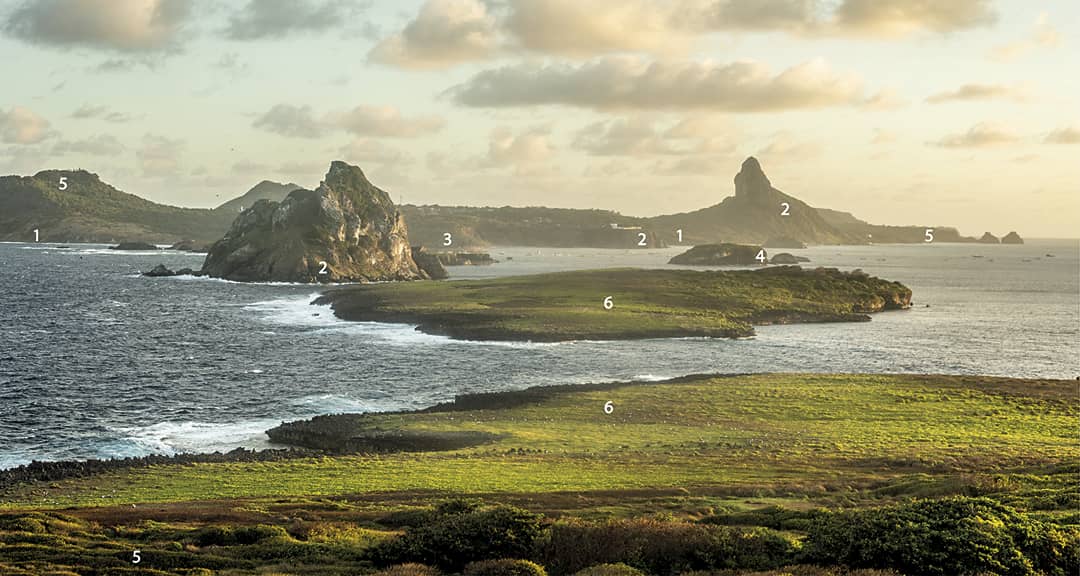
View of the archipelago from Rata Island, showing: (1) Volcanic Breccia; (2) Phonolite; (3) Trachyte; (4) Basanite; (5) Melanephelinite; (6) Aeolianite. (Photo: Bruna Roveri).
Geological description
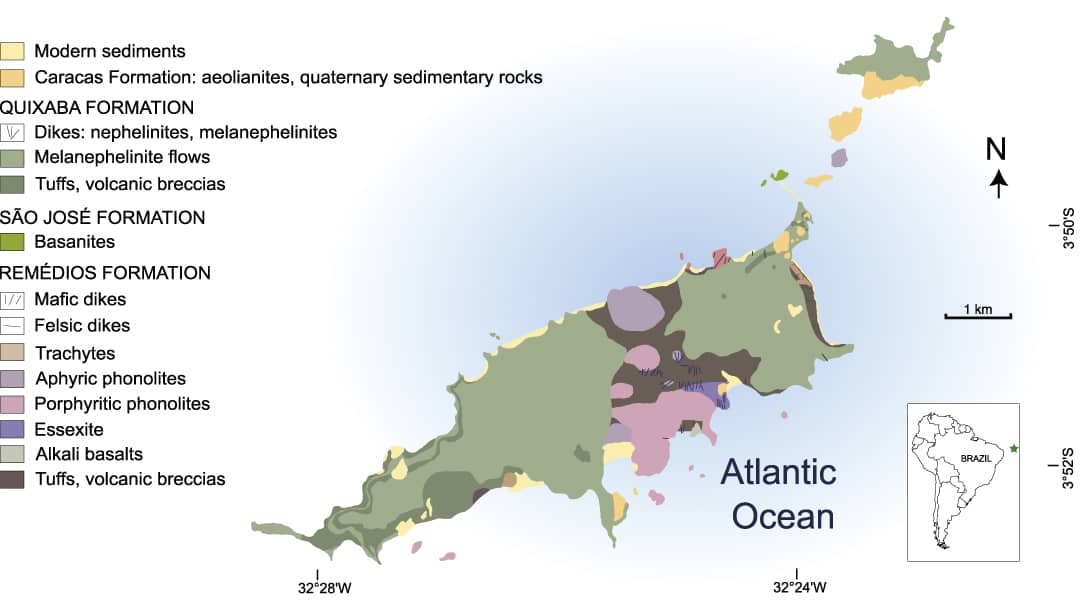
The Fernando de Noronha Archipelago comprises a main island and twenty islets, which represent the emergent remnants of a massive and extinct volcanic edifice. Across the landscape, effusive and explosive volcanic rocks, alongside subvolcanic intrusive formations and a complex system of feeder dikes, are distinctly exposed. These lithotypes include phonolite, alkali-trachyte, alkali-basalt, alkali-gabbro, basanite containing mantle xenoliths, melanephelinite, variably welded agglomerate, lapilli-tuff, and lamprophyre, among others. These units are grouped into the Remédios, São José, and Quixaba formations (Almeida, 1955), which span a Pliocene to Pleistocene eruptive history from approximately 13 to 1 Ma (Cordani, 1970; Perlingeiro et al., 2013). Characterized by distinctive chemical signatures and rare minerals such as nosean and melilite-group minerals, these rocks constitute one of the most alkaline volcanic provinces among oceanic islands worldwide (Almeida, 1955; Wildner and Ferreira, 2012; Lopes and Ulbrich, 2015). Furthermore, the sedimentary record of the archipelago preserves ancient dune systems composed of bioclastic sand, known as aeolianite, a geologically rare rock type. These Late Pleistocene to Holocene deposits (Angulo et al., 2013) are represented by the Caracas Formation. Therefore, Fernando de Noronha holds outstanding global geological significance, serving as an exceptional and accessible natural laboratory for field observations.
Scientific research and tradition
Interest in Fernando de Noronha’s geodiversity began with the French in 1736. Darwin identified its volcanic origin in 1832, followed by research conducted by the Challenger expedition, Branner, Derby, and the British Museum. Almeida’s 1955 geological map and subsequent research laid the foundation for modern geological understanding of the archipelago.
Simplified geological map of the Fernando de Noronha Archipelago after Fernando Flávio Marques de Almeida (1955).
Reference
Almeida, F.F.M. de (1955) Geologia e petrologia do arquipélago de Fernando de Noronha. Universidade de São Paulo. Available at: https://repositorio.usp.br/item/000712811.
Angulo, R.J. et al. (2013) “Quaternary sea-level changes and aeolianites in the Fernando de Noronha archipelago, northeastern Brazil,” Quaternary International, 305, pp. 15–30. Available at: https://doi.org/10.1016/j.quaint.2012.12.029.
Lopes, R.P. and Ulbrich, M.N.C. (2015) “Geochemistry of the alkaline volcanicsubvolcanic rocks of the Fernando de Noronha Archipelago, southern Atlantic Ocean,” Brazilian Journal of Geology, 45, pp. 307–333. Available at: https://doi.org/10.1590/23174889201500020009.
Perlingeiro, G. et al. (2013) “40Ar/39Ar geochronology of the Fernando de Noronha Archipelago and implications for the origin of alkaline volcanism in the NE Brazil,” Journal of Volcanology and Geothermal Research, 249, pp. 140–154. Available at: https://doi.org/10.1016/j.jvolgeores.2012.08.017.