Jeju Island, South Korea
33°33’23” N, 126°47’10” E
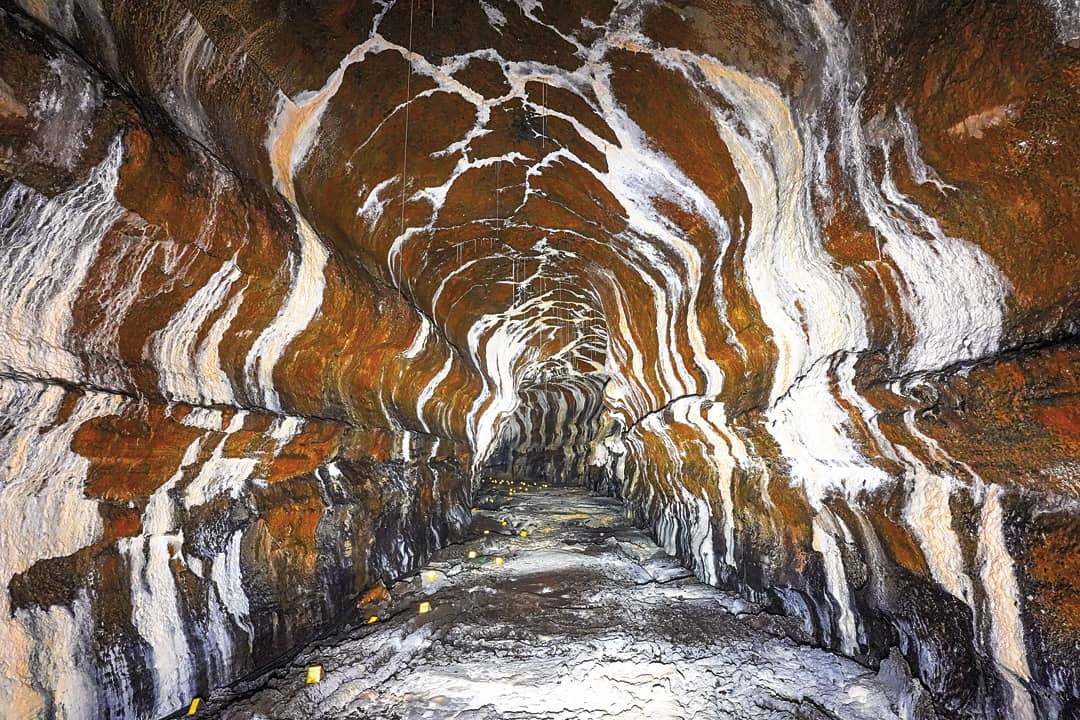
Internal scenery of Yongcheondonggul lava tube.
One of the most beautiful and scientifically valuable lava tubes in the world.
The most significant and distinctive feature of Jeju Island is the lava tube system. Such caves are like those in limestone karst in scale, shape and internal decoration, but they are completely different in origin. Lava tube caves are known from basaltic terrain in most of the world’s volcanic regions. The lava tube caves of the Geomunoreum system are, however, regarded as internationally important due to their length, massive volume, intricate passage configuration, well preserved internal lava features, abundant and spectacular secondary carbonate formations, ease of access, and their scientific and educational values.
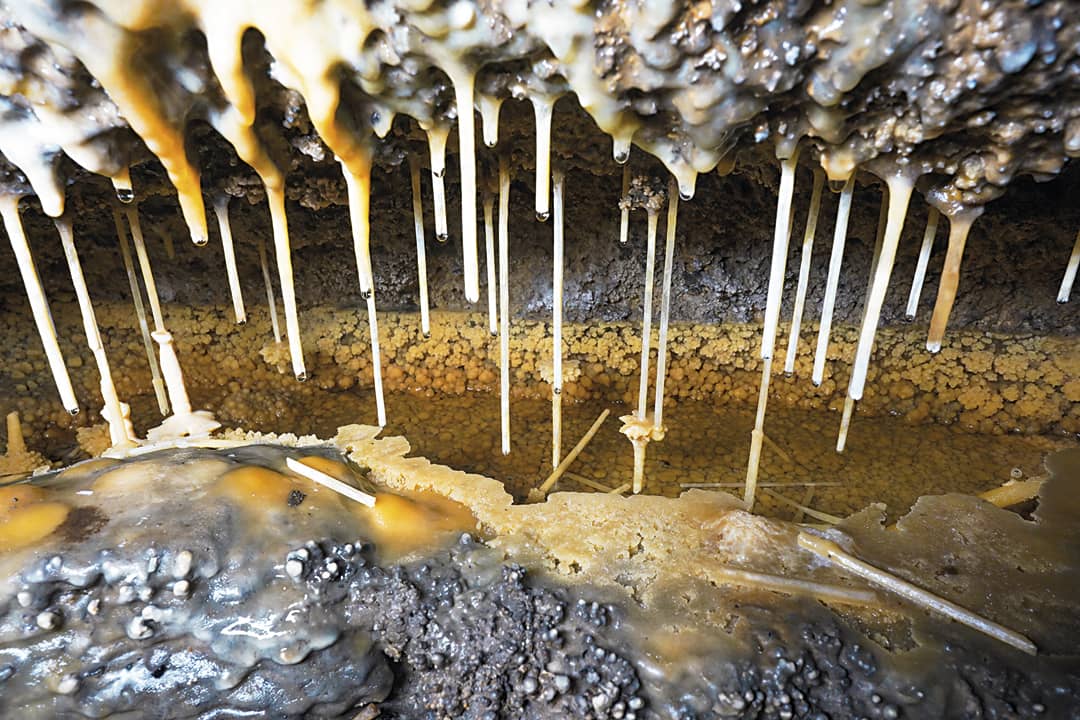
Carbonate speleothems of the Yongcheondonggul lava tube.
Geological description
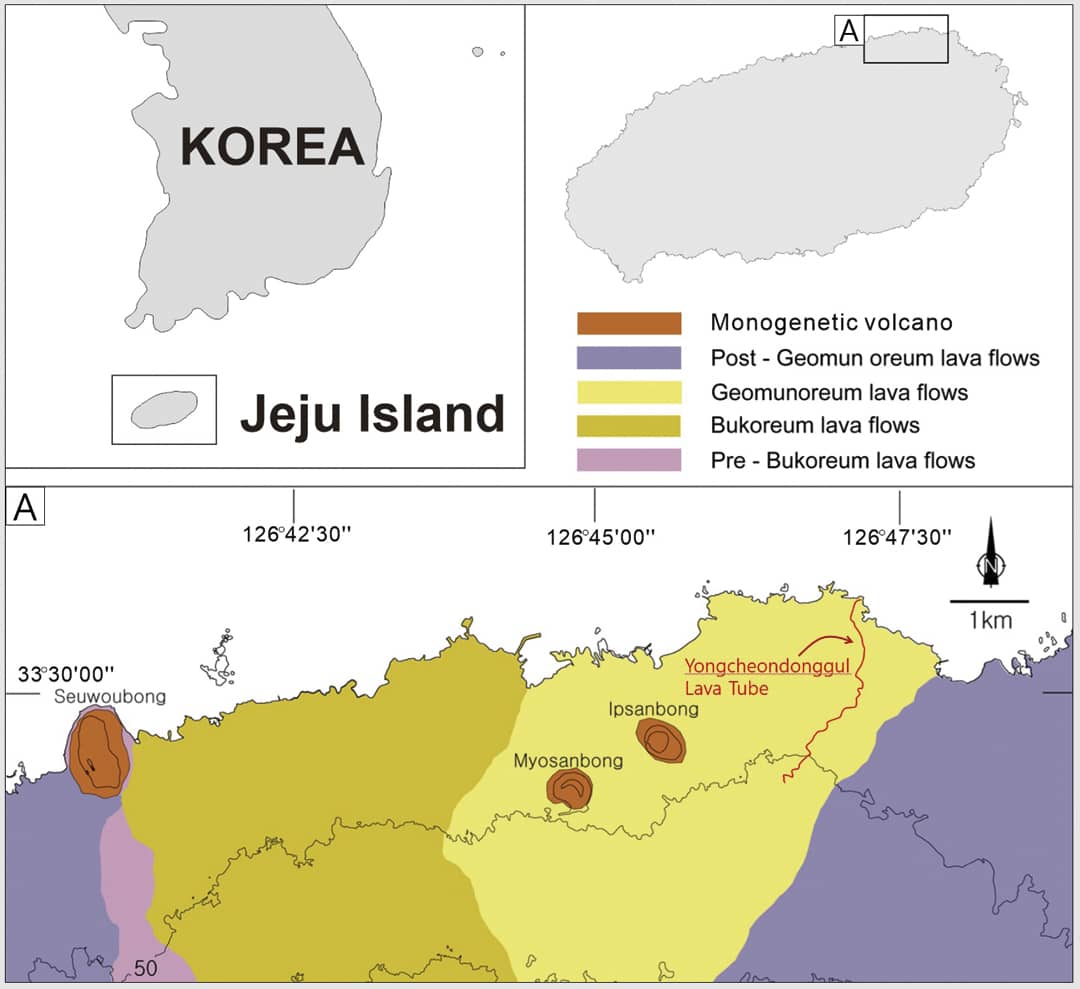
Yongcheondonggul Lava Tube is situated in Weoljeong-ri, Gujwa-eup, Bukjeju-gun, Jeju-do. It is adjacent to Dangcheomuldonggul Lava Tube. The tube lies across on the gentle northeastern slope of Mt. Hallasan, where a large area of basalt lava plains developed.
This tube formed between 300,000-100,000 years ago, largely in alkaline olivine basaltic lava. On the surface of the tube and around its vicinity, seasonal northwesterly winds have blow inland, depositing sand dunes ranging from one to seven meters in height. Most of the carbonate sand particles are composed of carbonate shells originating from mollusk and red algae, echinoderms, foraminifera, and bryozoans. Approximately 5% of the particles are volcanic and clastic rock fragments. The carbonate deposits infiltrated the interior of the lava tube, contributing to the creation of secondary carbonate speleothems. Thielava tube is situated between Gimnyeong and Dangcheomul. It is more than 3.4 kilometers long, 7-15 meters wide, and 1.5 – 20 meters high and includes an underground lake 800 meters long. Inside the tube, a majestic arched ceiling is met by vertical walls, creating a shield shape cross section. The microtopography and lava features of this tube are diverse and include lava shelves, lava terraces, lava stalactites or lava stalagmites.
Scientific research and tradition
Yongcheondonggul was discovered by chance in May 2005 during the installation of telephone poles, while efforts were underway to apply for the area’s designation as a UNESCO World Natural Heritage site.
Geological map around Yongcheondonggul lava tube.
Reference
Dong Lee, S. et al. (2020) “Antrihabitans stalactiti gen. nov., sp. nov., a new member of the family Nocardiaceae isolated from a cave,” International Journal of Systematic and Evolutionary Microbiology, 70(10), pp. 5503–5511. Available at: https://doi.org/10.1099/ijsem.0.004444.
Kim, Y.B. (2008) “Geoheritage of Korea,” in M. S. Leman, Geoheritage of East and Southeast Asia. Lestari, pp. 115–147.
Song, J.-Y. et al. (2020) “Experimental Study of the Effect of Vibration on the Geomunoreum Lava Tube System in Jeju,” The Journal of Engineering Geology, 30(3), pp. 327–345. Available at: https://doi.org/10.9720/kseg.2020.3.327.
Woo, K.S. et al. (2013) Jeju Island Geopark – A Volcanic Wonder of Korea. Berlin, Heidelberg: Springer (Geoparks of the World (closed)). Available at: https://doi.org/10.1007/978-3-642-20564-4.
Woo, K.S. et al. (2019) “Geological Heritage Values of the Yongcheon Cave (Lava Tube Cave), Jeju Island, Korea,” Geoheritage, 11(2), pp. 615–628. Available at: https://doi.org/10.1007/s12371-018-0315-y.