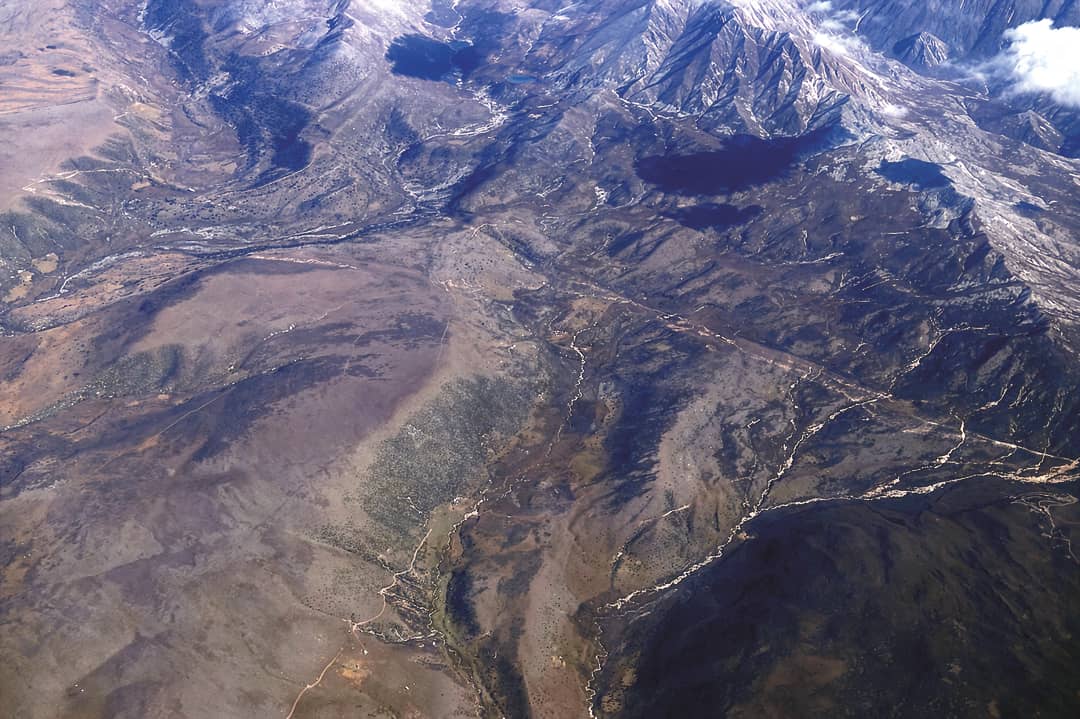
The sinistral Xianshuihe Fault cuts across the Gongga granite batholith; its trace and offset geomorphic markers are clearly visible from the right-center edge to the upper-left corner.
Geological Period
Neogene (Miocene)
Main geological interest
Tectonics
Geomorphology and active geological processes
Location
Eastern Tibetan Plateau, China
30°39’20” N, 101°24’34” E
The sinistral Xianshuihe Fault cuts across the Gongga granite batholith; its trace and offset geomorphic markers are clearly visible from the right-center edge to the upper-left corner.
Among the world’s most active intracontinental faults with one large earthquake occurring every ca. 30 years.
The Xianshuihe fault is among the world’s most active intracontinental faults. It has a slip rate of 8–15 millimeters per year over the last 10 Ma and frequent large earthquakes (M > 7 every ~30 years). It offers an exceptional, easily accessible, natural laboratory for studying active continental deformation, fault processes, and seismic hazards. Its dramatic landscape, shaped by tectonics and erosion –featuring earthquake surface ruptures, fault gouge, glaciers, lakes, and peaks like Gongga Shan (7,556 meters)– is enriched by national parks, geoparks, and Tibetan cultural heritage.
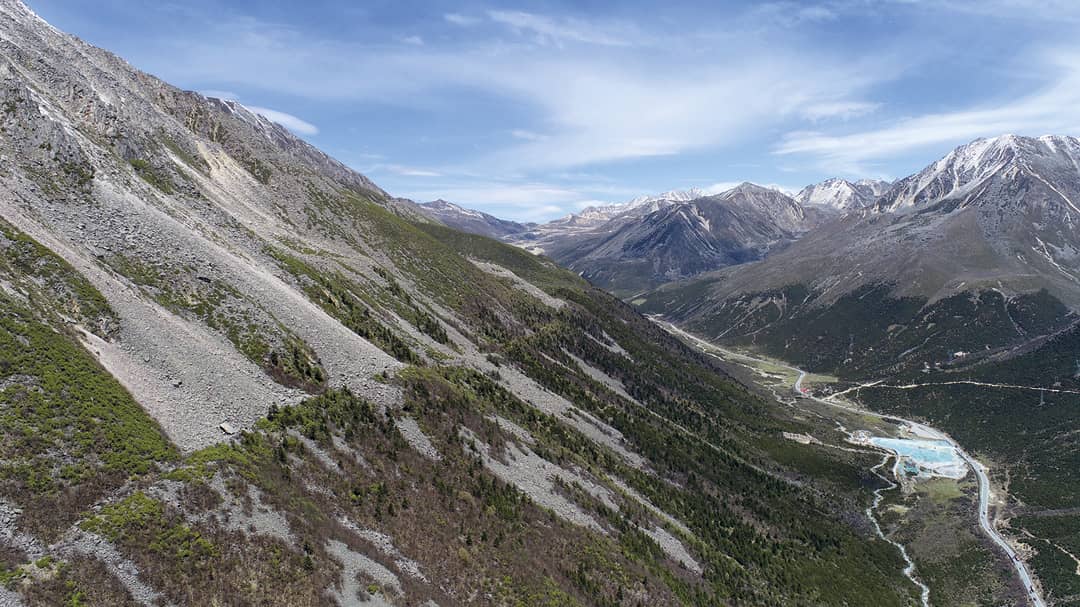
Close-up of the Xianshuihe fault across the Gongga mountain slopes exhibiting clear horizontal offsets of moraines and rockfalls.
Geological description
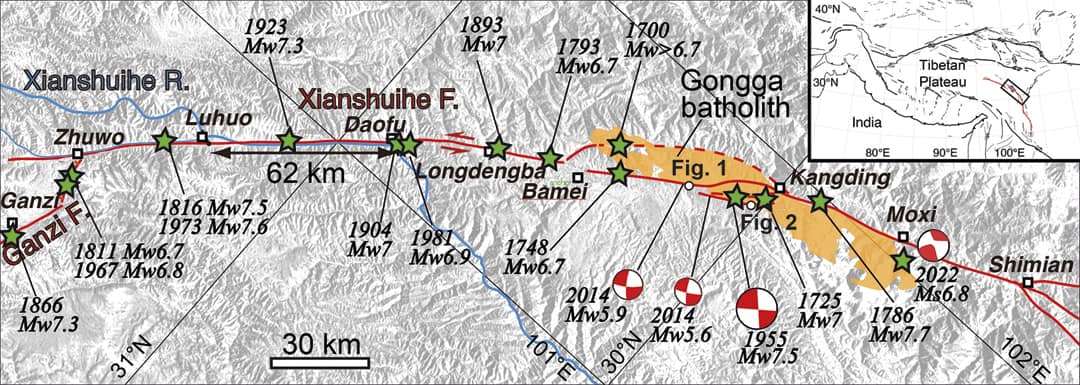
The sinistral Xianshuihe fault is 350 kilometers long and cuts through the eastern Tibetan Plateau. It accommodates convergence between the Indian and Eurasian plates and the southeastward escape of Plateau material at a high slip rate (~8-15 millimeters per year, e.g., Allen et al., 1991; Chevalier et al., 2018; Bai et al., 2018, 2021). Its northwest segment is linear and continuous; the southeast portion is more complex, with four right-stepping branches –Yalahe, Selaha, Mugecuo South, and Zheduotang– between Bamei and Kangding. These merge into the Moxi fault southeast of Kangding, where the 2022 Ms6.8 Luding earthquake occurred. Farther southeast, the strike of the fault from northwest to south, aligning with increasing topographic relief along the plateau margin and culminating at Gongga Mountain (7,556 meters). Lithology varies along strike from limestone in the northwest (Luhuo, Daofu) to clastic sedimentary rocks and granite in the southeast (Bamei, Kangding). The fault has produced 29 M>6.5 and 17 M>7 earthquakes since 1700, about one large event every 30 years. Despite this activity, some segments are creeping (Qiao and Zhou, 2021; Wu et al., 2023), and continuous surface movement is visible, such as at the 1973 Luhuo earthquake memorial site.
Scientific research and tradition
The Xianshuihe fault has long attracted the interests of geologists because of its frequent large earthquakes. Since 1980, more than 1000 research articles have been published on that fault. In the last two decades, more than 100 publications containing the words “Xianshuihe fault” in their titles have been published in high ranking geological journals.
M > 7 earthquakes along the Xianshuihe fault since 1700 (modified from Bai et al., 2018).
Bai, M. et al. (2018) “Southeastward increase of the late Quaternary slip-rate of the Xianshuihe fault, eastern Tibet. Geodynamic and seismic hazard implications,” Earth and Planetary Science Letters, 485, pp. 19–31. Available at: https://doi.org/10.1016/j.epsl.2017.12.045.
Bai, M. et al. (2021) “Spatial Slip Rate Distribution Along the SE Xianshuihe Fault, Eastern Tibet, and Earthquake Hazard Assessment,” Tectonics, 40(11), p. e2021TC006985. Available at: https://doi.org/10.1029/2021TC006985.
Chevalier, M.-L. et al. (2018) “Temporally constant slip rate along the Ganzi fault, NW Xianshuihe fault system, eastern Tibet,” GSA Bulletin, 130(3–4), pp. 396–410. Available at: https://doi.org/10.1130/B31691.1.
Qiao, X. and Zhou, Y. (2021) “Geodetic imaging of shallow creep along the Xianshuihe fault and its frictional properties,” Earth and Planetary Science Letters, 567, p. 117001. Available at: https://doi.org/10.1016/j.epsl.2021.117001.
Wu, Q. et al. (2023) “Fluid Influx Promotes Local Strengthening of the Creeping Xianshuihe Fault, Eastern Tibet,” Journal of Geophysical Research: Solid Earth, 128(7), p. e2023JB026682. Available at: https://doi.org/10.1029/2023JB026682.
Author(s)
Marie-Luce Chevalier.
Institute of Geology, Chinese Academy of Geological Sciences
Haibing Li.
Institute of Geology, Chinese Academy of Geological Sciences
Zhongbao Zhao.
Institute of Geology, Chinese Academy of Geological Sciences
Mingkun Bai.
Institute of Geology, Chinese Academy of Geological Sciences
Qiong Wu.
Institute of Geology, Chinese Academy of Geological Sciences