Mount Olympus tectonic window

Greece

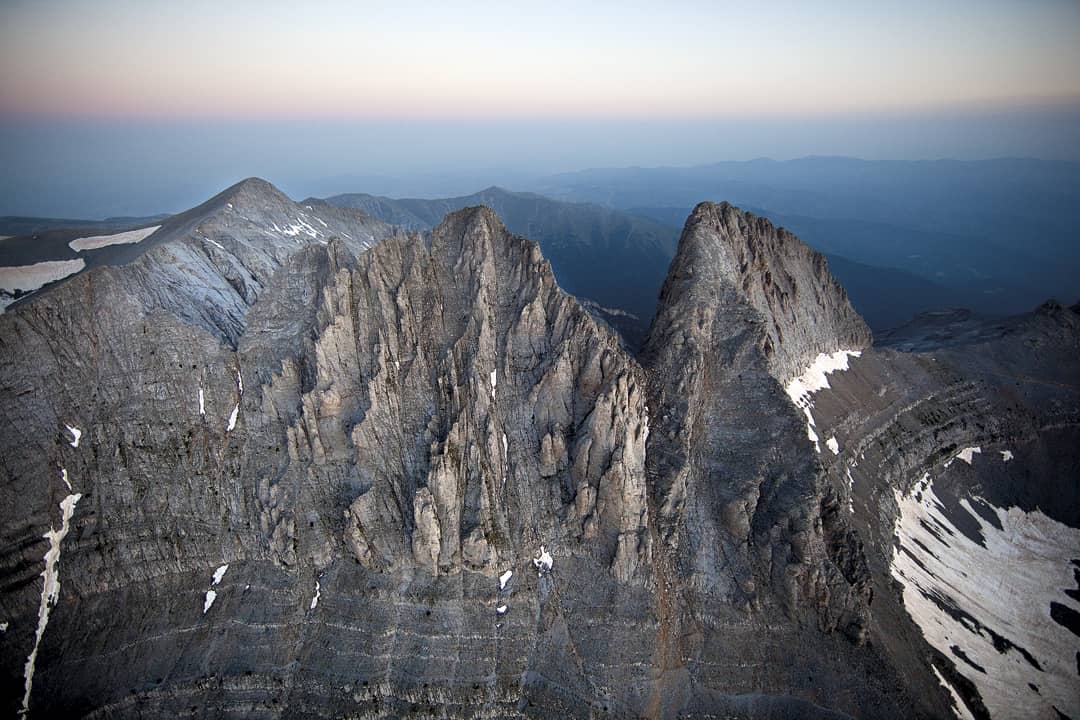
View of Mytikas, the Olympus peak and the Thrones of the Ancient Greek Gods, a topography shaped by the Pleistocene glacial activity. (Photo: Penelope Matsouka, Anavasi editions).

Geological Period

Triassic to Neogene (Miocene)

Main geological interest

Tectonics
Geomorphology and active geological processes

Location

Regions of Thessaly and Central Macedonia, Greece
40°05’09” N, 22°21’32” E

View of Mytikas, the Olympus peak and the Thrones of the Ancient Greek Gods, a topography shaped by the Pleistocene glacial activity. (Photo: Penelope Matsouka, Anavasi editions).

A tectonic window in the mountain that shaped western civilization.

The discovery of the Mount Olympus tectonic window in 1968 marked a milestone in Greek geology, providing key evidence for east-to-west thrusting of the Hellenic tectonic zones. Following continental collision, carbonate rocks were exhumed by 6–8 km along major ductile detachment faults defining the tectonic window (Kilias, 1995), while later Pleistocene uplift was accommodated by brittle normal faulting along its eastern margin (Nance, 2010). As Greece’s highest mountain (2,918 m), Olympus records subduction of the Apulian margin beneath Europe and rapid buoyancy-driven exhumation, producing a landscape of glacial horns and pinnacles, one of Greece’s most spectacular geological monuments; the proper place to host ancient Greek’s gods.

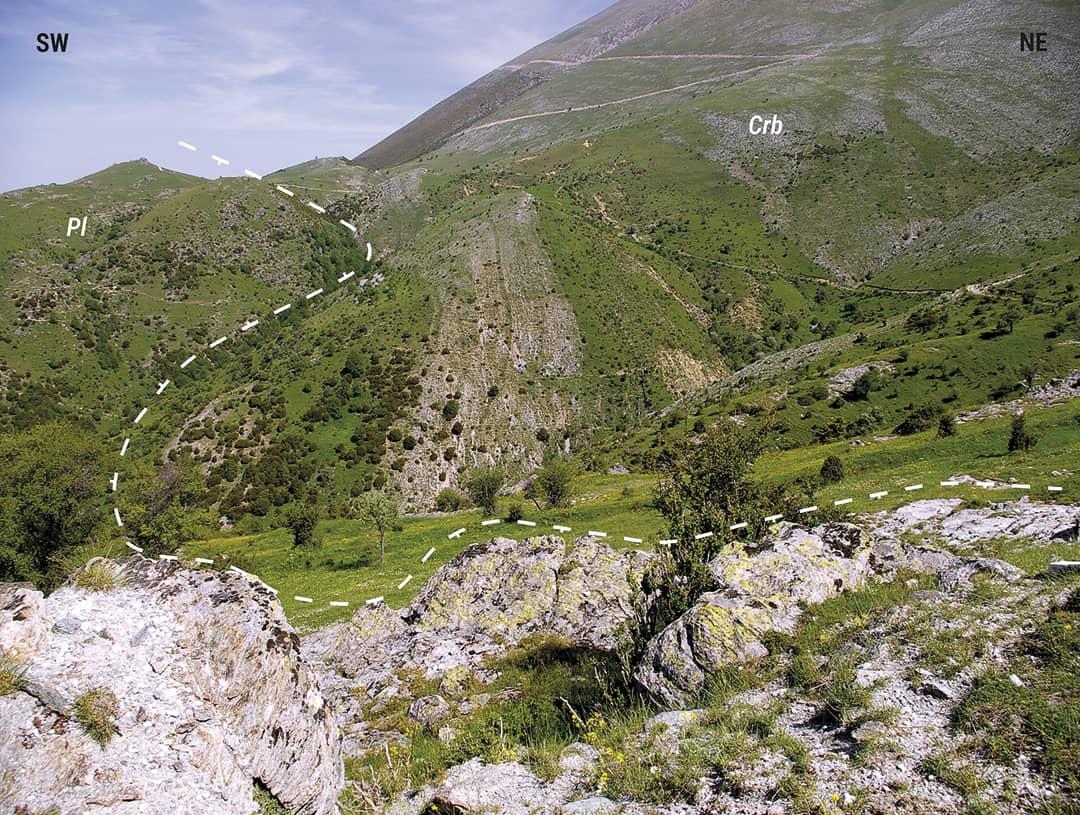
The normal, towards the SW, detachment fault zone (dashed) between the Olympus meta-carbonates (Crb) forming the core of the tectonic window and the Pelagonian cover rocks (Pl). (Photo: Anne Ewing-Rassios†).

The geology of Mount Olympus is as remarkable as the mythology associated with it. The mountain records the evolution of a Triassic–Eocene carbonate platform deposited on the Apulian margin and subsequently involved in Alpine convergence and Tethys ocean closure (Godfriaux, 1968; Barton, 1975). During the Late Eocene, these rocks were subducted beneath approximately 25 km of crust, comprising the high-pressure metamorphic Ampelakia Formation (6–7 kbar; 400–480 °C) and the Paleozoic–Jurassic basement and cover sequences of the Pelagonian zone (Schermer, 1993). Rapid exhumation during the Miocene produced the present-day Olympus tectonic window, exposing major exhumation contacts, a ring of blueschist-facies rocks, and remnants of oceanic lithosphere. The metamorphic carbonate platform forming the core of the window preserves structures that record the mechanisms of rapid exhumation, while the overlying Pelagonian rocks contain kinematic indicators documenting exhumation rates of 0.4–1 km/Myr (Nance, 2010). Sediments derived from the exhuming complex contributed clasts to the Miocene conglomerates of the Meteora World Heritage Site. Continued uplift during the Pleistocene, combined with glacial activity (Stylas et al., 2018), shaped the regional drainage network and influenced the late-Pleistocene drainage of the Thessaly Basin through the Vale of Tempe between Mount Olympus of the Olympian gods and Mount Ossa of the Titans (Rassios et al., 2022).

Geological investigations of Mount Olympus began in the early 1950s, focusing on the stratigraphy and metamorphism of its tectonic window (Godfriaux, 1968). With the emergence of plate-tectonic and exhumation theories, Olympus became a key natural laboratory for tectonic research and continues to inspire studies that refine and expand earlier interpretations.

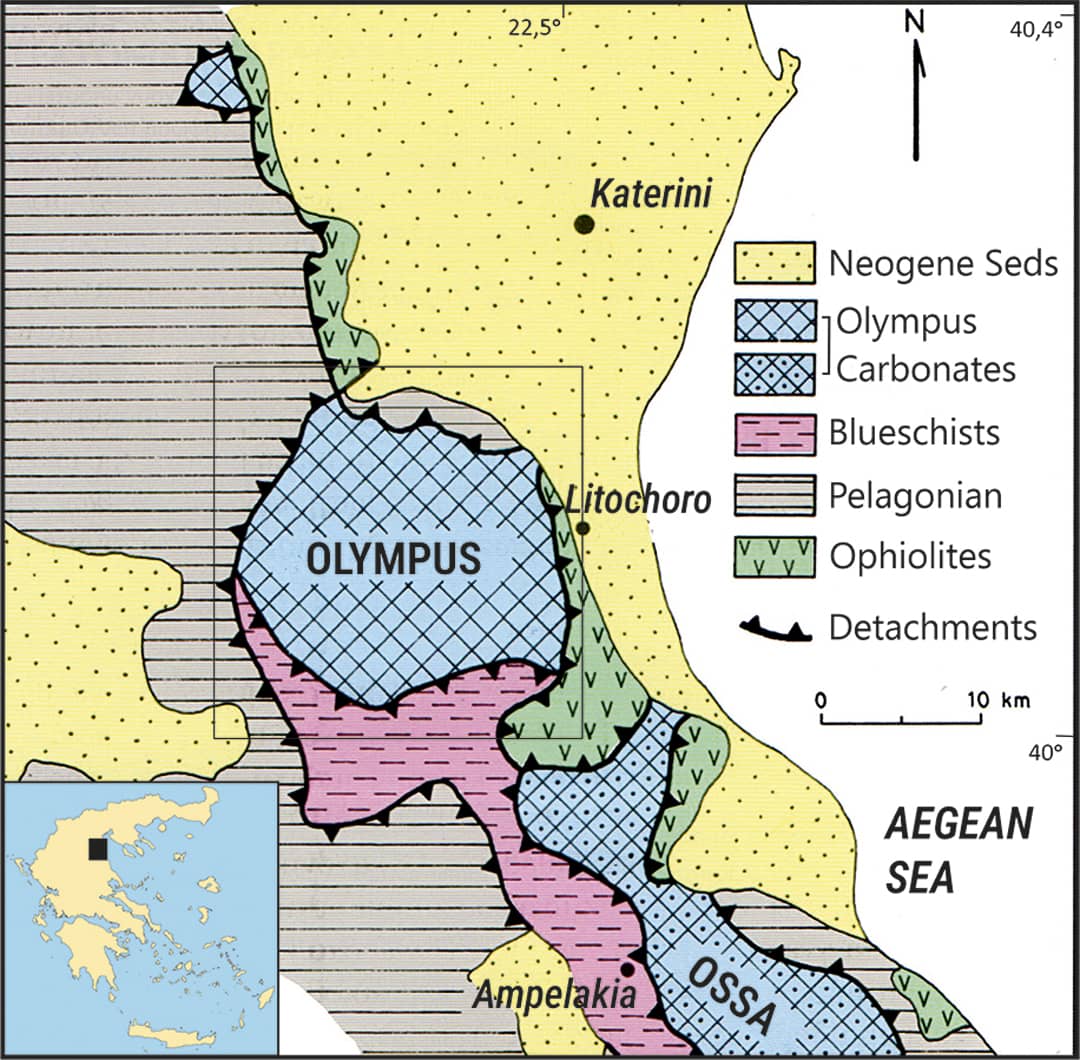
Sketch map of the main geological units in the broader area of Olympus mts. Black-filled square in embedded map is the diagram area; thin square, the Olympus tectonic window. Modified after Mountrakis (2020), Geology of of Greece, University Studio Press.

Barton, C.M. (1975) “Mount Olympos, Greece: new light on an old window,” Journal of the Geological Society, 131(4), pp. 389–396. Available at: https://doi.org/10.1144/gsjgs.131.4.0389.

Godfriaux, I. (1968) “Etude géologique de la région de I’ Olympe (Grèce),” Annales Géologiques des Pays Hélléniques, 19, pp. 1–282.

Kilias, A. (1995) “Tectonic evolution of Olympos-Ossa Mountains: emplacement of the blue-shists of eastern Thessaly and exhumation of Olympos-Ossa carbonate dome as a result of tertiary extension,” Mineral Whealt, 96, pp. 7–22.

Mountrakis, D. (2020) Geology and geotectonic evolution of Greece (in Greek). Thessaloniki: University Studio Press.

Nance, R.D. (2010) “Neogene–Recent extension on the eastern flank of Mount Olympus, Greece,” Tectonophysics, 488(1), pp. 282–292. Available at: https://doi.org/10.1016/j.tecto.2009.05.011.

Rassios, A.E. et al. (2022) “The Geoheritage of Mount Olympus: Ancient Mythology and Modern Geology,” Geoheritage, 14(1), p. 15. Available at: https://doi.org/10.1007/s12371-022-00649-0.

Schermer, E.R. (1993) “Geometry and kinematics of continental basement deformation during the Alpine orogeny, Mt. Olympos region, Greece,” Journal of Structural Geology, 15(3), pp. 571–591. Available at: https://doi.org/10.1016/0191-8141(93)90149-5.

Styllas, M.N. et al. (2018) “Late-glacial and Holocene history of the northeast Mediterranean mountain glaciers – New insights from in situ-produced 36Cl-based cosmic ray exposure dating of paleo-glacier deposits on Mount Olympus, Greece,” Quaternary Science Reviews, 193, pp. 244–265. Available at: https://doi.org/10.1016/j.quascirev.2018.06.020.

Annie Ewing-Rassios (†).
Scientific Director of UNESCO Geopark Grevena-Kozani (Passed away)

Charalampos Fassoulas.
Curator of Geological Collections Natural History Museum of Uni. Crete, Coordinator of Hellenic Global Geoparks Network

Nikolaos Zouros.
Director of the Natural History Museum of the Lesvos Petrified Forest, Professor in the Department of Geography, University of the Aegean

The Third 100 IUGS Geological Heritage Sites have been officially announced!
Privacy overview

This website uses cookies so that we can offer you the best possible user experience. Cookie information is stored in your browser and performs functions such as recognizing you when you return to our website or helping our team to understand which sections of the website you find most interesting and useful.