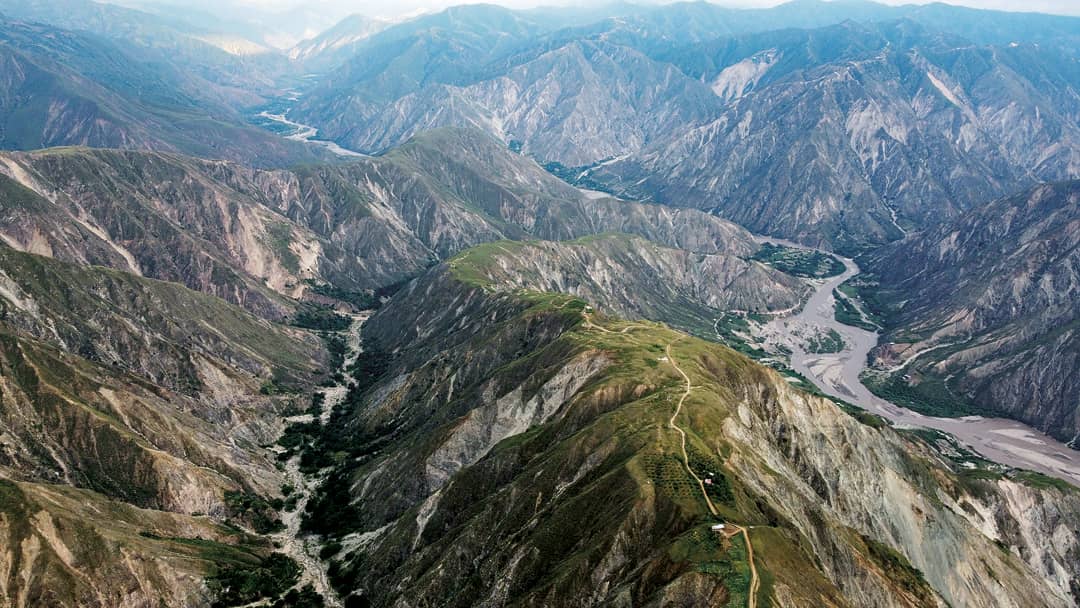
Confluence of the Talarcuta creek with the Chicamocha river revealing pressure ridges and fault bend structures within the damage zone of Bucaramanga Fault. Azimuth 140°.
Geological Period
Paleogene (Oligocene) to Quaternary (Holocene)
Main geological interest
Tectonics
Geomorphology and active geological processes
Location
Santander, Colombia
6°45’11” N, 72°58’13” W
Confluence of the Talarcuta creek with the Chicamocha river revealing pressure ridges and fault bend structures within the damage zone of Bucaramanga Fault. Azimuth 140°.
A key site for studying transpressional tectonics–surface process interactions at intraplate block boundaries and their associated morphostructures.
Chicamocha Canyon is a key site for studying transpressive tectonic–surface process interactions at intraplate block boundaries, unlike the San Andreas Fault (plate boundary), the New Madrid Seismic-Zone (intraplate, limited surface expression), or the Gobi-Altai (intraplate, far-field).
Located in a region where ductile–brittle deformation patterns support indentation-style transpressive orogenic models, the canyon is associated with regional thermochronological data that reveal 25 Ma of differential exhumation by deep crustal faults, exhuming rocks from a depth of more than 20 kilometers (Villamizar-Escalante et al., 2024). This structural and thermal evidence provides comprehensive insights into continental deformation processes and coincides spatially with the Bucaramanga Seismic Nest, offering opportunities to explore links between deep and surface processes.
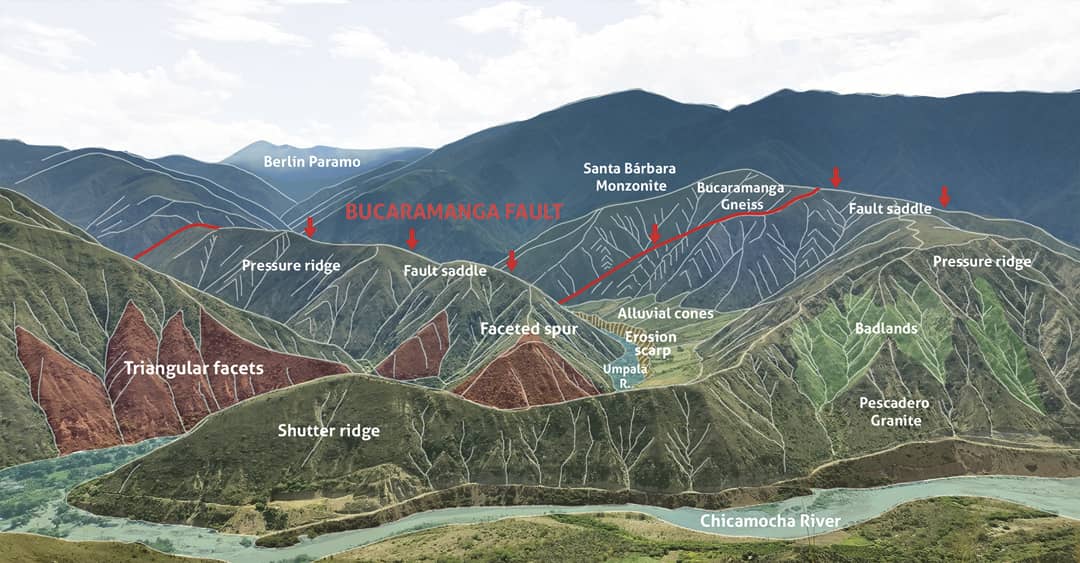
Pescadero sector morphostructures: triangular facets, pressure ridges and fault bends showing local dextral motion opposing the sinistral kinematics of the Bucaramanga Fault. Azimuth 050°.
Geological description
TChicamocha Canyon is approximately 180 kilometers long where the river descends from 2,350 to 332 meters elevation, reaching depths of 2,000 meters. Its most representative section between Pescadero and Ricaurte spans 60 kilometers and overlaps with the Bucaramanga Seismic Nest, one of the world’s zones with highest intermediate-magnitude seismicity concentration at depths of 145-165 kilometers (Prieto et al., 2012).
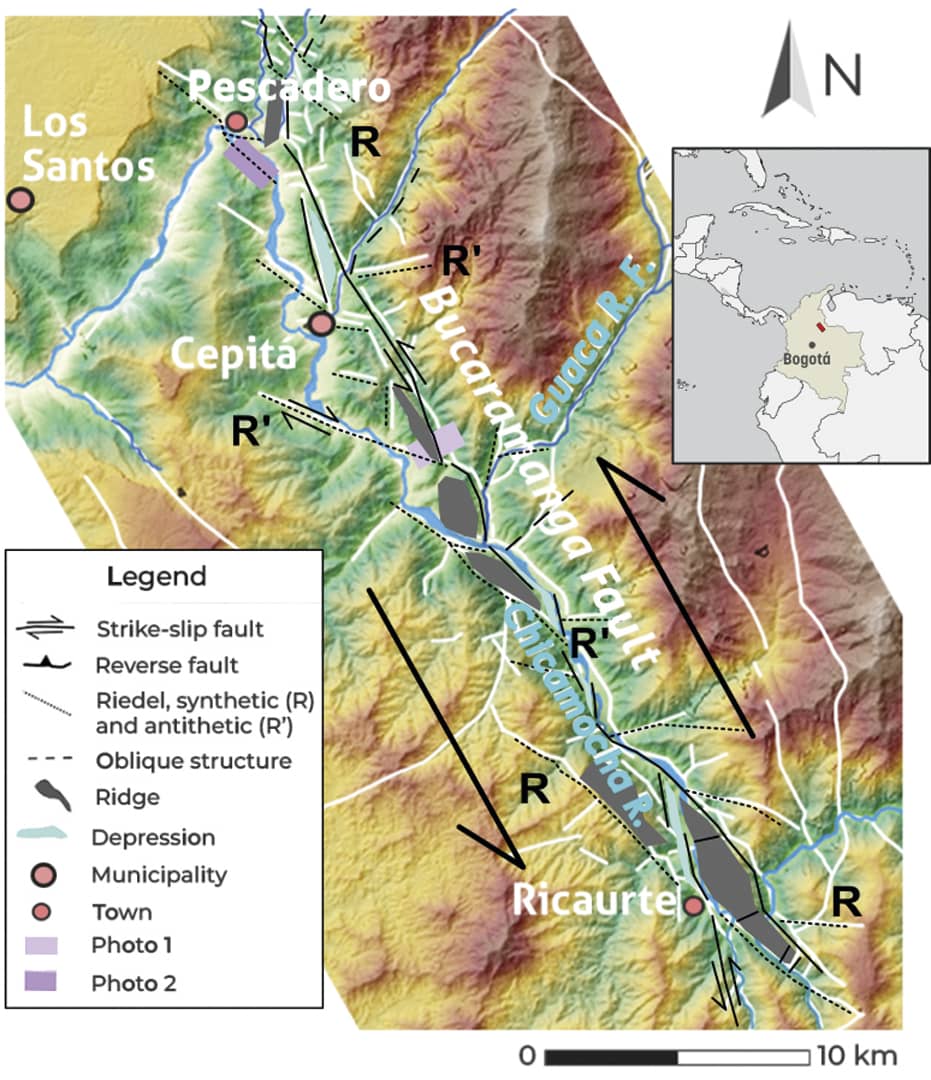
The formation of the Canyon is controlled by the Bucaramanga Fault, a transpressive structure between the Norandean and Maracaibo blocks (Cediel et al., 2003). The fault exhibits sinistral and reverse displacement components within a damage zone 5-8 kilometers wide and regional tilting evidence of active deformation: triangular facets, pressure ridges, shutter ridges, fault scarps and saddles, elevated terraces, alluvial fans and deflected drainage. The fault shows an anastomosed pattern with Riedel faults (synthetic R and antithetic R’), terminates southward in a transpressive restraining bend (Velandia and Bermúdez, 2018), and it exhumes deep crustal rocks (Villamizar-Escalante et al., 2024).
The site offers exceptional exposure, produced by erosion and a semiarid microclimate that limits vegetation cover, revealing twelve rock types spanning eight geological periods: Precambrian gneiss contemporaneous with the Grenvillian orogeny; Paleozoic metamorphic rocks (schist, phyllite) associated with the Famatinian orogenic event; Triassic-Jurassic intrusive rocks; a Jurassic–Cretaceous sedimentary succession; and Quaternary deposits related to the ongoing Andean orogeny (UIS, 2020).
Scientific research and tradition
Hettner (1892) initiated geological documentation of Chicamocha Canyon. Since then, over 150 publications have analyzed its structures, stratigraphy, paleontology, petrology, geomorphology, crustal evolution, and seismic dynamics. Modern research applies morphometric analysis, thermochronology, and geodetic monitoring, positioning it as a reference for understanding transpressive systems and crustal deformation mechanisms.
Detailed Bucaramanga Fault mapping, Riedel systems and sinistral transpressive morphostructures in Pescadero-Ricaurte sector.
Reference
Cediel, F., Shaw, R.P. and Cáceres, C. (2003) “Tectonic Assembly of the Northern Andean Block,” in C. Bartolini, R.T. Buffler, and J.F. Blickwede (eds.) The Circum-Gulf of Mexico and the Caribbean: Hydrocarbon Habitats, Basin Formation and Plate Tectonics. American Association of Petroleum Geologists (AAPG Memoir, 79), pp. 815–848. Available at: https://doi.org/10.1306/M79877C37.
Prieto, G.A. et al. (2012) “Earthquake nests as natural laboratories for the study of intermediate-depth earthquake mechanics,” Tectonophysics, 570–571, pp. 42–56. Available at: https://doi.org/10.1016/j.tecto.2012.07.019.
Velandia, F. and Bermúdez, M.A. (2018) “The transpressive southern termination of the Bucaramanga fault (Colombia): Insights from geological mapping, stress tensors, and fractal analysis,” Journal of Structural Geology, 115, pp. 190–207. Available at: https://doi.org/10.1016/j.jsg.2018.07.020.
Villamizar-Escalante, N. et al. (2024) “Deep-seated crustal faults and their role in the thermo-tectonic evolution of an active mountain belt: New evidence from the Northern Andes,” Journal of Structural Geology, 185, p. 105177. Available at: https://doi.org/10.1016/j.jsg.2024.105177.
Author(s)
Manuel Eduardo Gómez Guerrero.
Servicio Geológico Colombiano