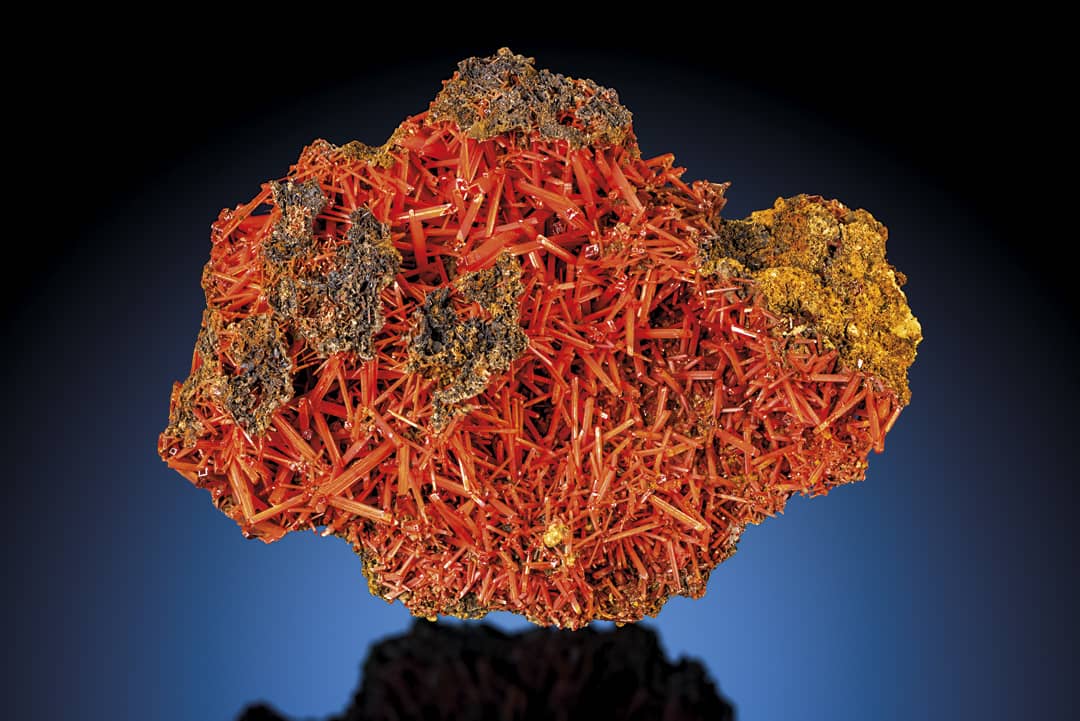
Crocoite from the Adelaide Mine, Dundas, Tasmania (12.5 x 10 centimeters; photo: H. Meyer).
Geological Period
Quaternary (Pleistocene) to Quaternary (Holocene)
Main geological interest
Mineralogy
Location
Northwestern Tasmania, Australia
41°52’31” S, 145°25’15” E
Crocoite from the Adelaide Mine, Dundas, Tasmania (12.5 x 10 centimeters; photo: H. Meyer).
Source of the world’s finest crocoite (lead chromate) specimens.
Fortunate geological processes led to the formation of the most spectacular deposits of crocoite (Pb[CrO4]) on Earth. Because of its occurrence in a gossan environment, and since its primary ores contain many precious elements, a wealth of rare interesting secondary minerals formed including the type-locality specimens of dundasite (a complex Pb–Al–carbonate) from the Adelaide Mine and petterdite and reynoldsite from the Red Lead Mine.
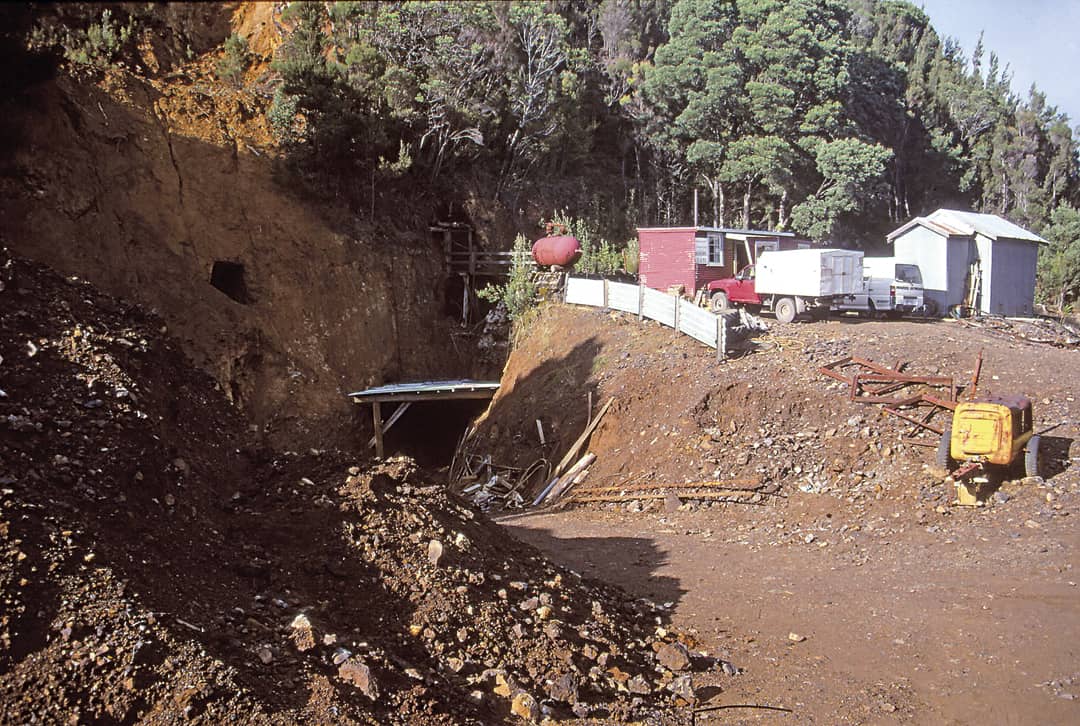
Entrance area of the Adelaide Mine (photo: J. Haupt).
Geological description
The northwestern part of Tasmania is rich in precious elements such as silver, gold, tin, copper, and lead. The tin deposit at Mt Bishop was discovered in 1871; most of the closely related Zeehan and Dundas lead–silver deposits located about 50 kilometers south were discovered in the mid-1880s. The key crocoite deposits are located close to Dundas (about 10 kilometers east of Zeehan), a booming mining town at the end of the 18th century.
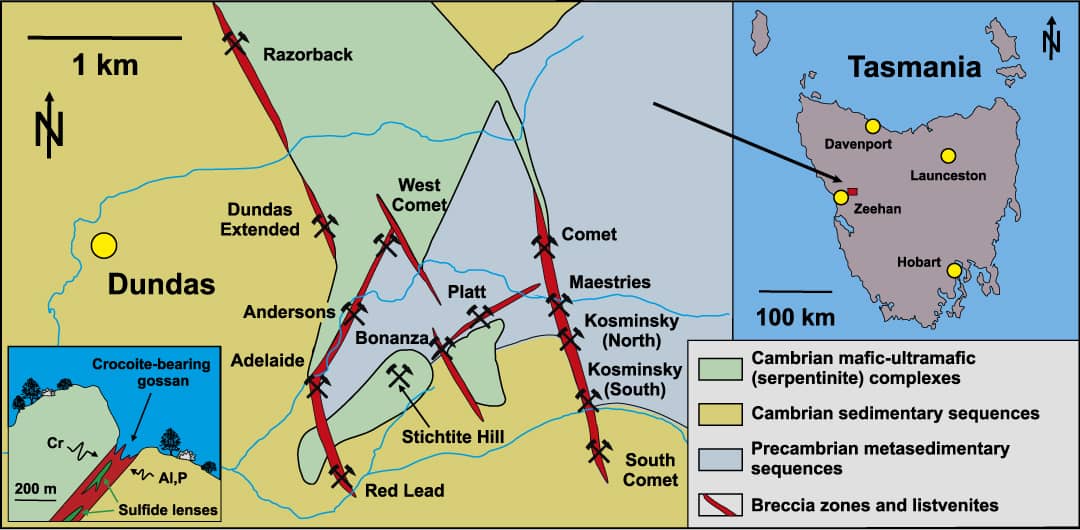
The mining area is dominated by Precambrian metasedimentary rocks, Cambrian sedimentary rocks, and mafic to ultramafic rocks. Chromium spinel in serpentinites delivered the Cr necessary for the formation of crocoite. In the Devonian, due to tectonic activities and granite intrusions, extensive, generally north-striking shear zones formed accompanied by corresponding brecciation. These zones of weakness acted as pathways for hydrothermal fluids. Massive introduction of CO2 led to the formation of listvenite, a metasomatic rock rich in Mg- and Ca-carbonates, quartz, fuchsite (Cr-rich muscovite) and to the precipitation of sulfide ores (including Ag-bearing galena, sphalerite, arsenopyrite, pyrite and antimony sulfosalts). Finally, due to intense weathering, a gossan formed, and it hosts the world’s most exceptional samples of crocoite (Bottrill et al., 2006).
Scientific research and tradition
The Dundas area provides important insight into gossan-forming processes and is type-locality of Dundasite, occasionally accompanying crocoite. In ancient times crocoite was used as a pigment (Edwards et al., 2004; Lee et al., 2023) and is thus of archaeological interest. It was detected in atmospheric dust where it is considered hazardous (Meza-Figueroa et al., 2018).
Geological overview of the Dundas mining area and a schematic cross section (lower left) through crocoite-bearing veins (modified after Bottrill and Baker, 2008).
Reference
Bottrill, R.S. et al. (2006) “Crocoite and associated minerals from Tasmania,” Australian Journal of Mineralogy, 12. Available at: http://handle.uws.edu.au:8081/1959.7/34190.
Bottrill, R.S. and Baker, W.E. (2008) A Catalogue of the Minerals of Tasmania. Mineral Resources Tasmania (Tasmanian geological survey bulletin, 73).
Edwards, H.G.M., Jorge Villar, S.E. and Eremin, K.A. (2004) “Raman spectroscopic analysis of pigments from dynastic Egyptian funerary artefacts,” Journal of Raman Spectroscopy, 35(8–9), pp. 786–795. Available at: https://doi.org/10.1002/jrs.1193.
Lee, N.R., Kim, S.J. and Moon, D.H. (2023) “Non-invasive mineral analysis of pigments of wall paintings in the Sungseonjeon Hall,” Geosciences Journal, 27(2), pp. 161–176. Available at: https://doi.org/10.1007/s12303-022-0027-9.
Meza-Figueroa, D. et al. (2018) “Source apportionment and environmental fate of lead chromates in atmospheric dust in arid environments,” Science of The Total Environment, 630, pp. 1596–1607. Available at: https://doi.org/10.1016/j.scitotenv.2018.02.285.