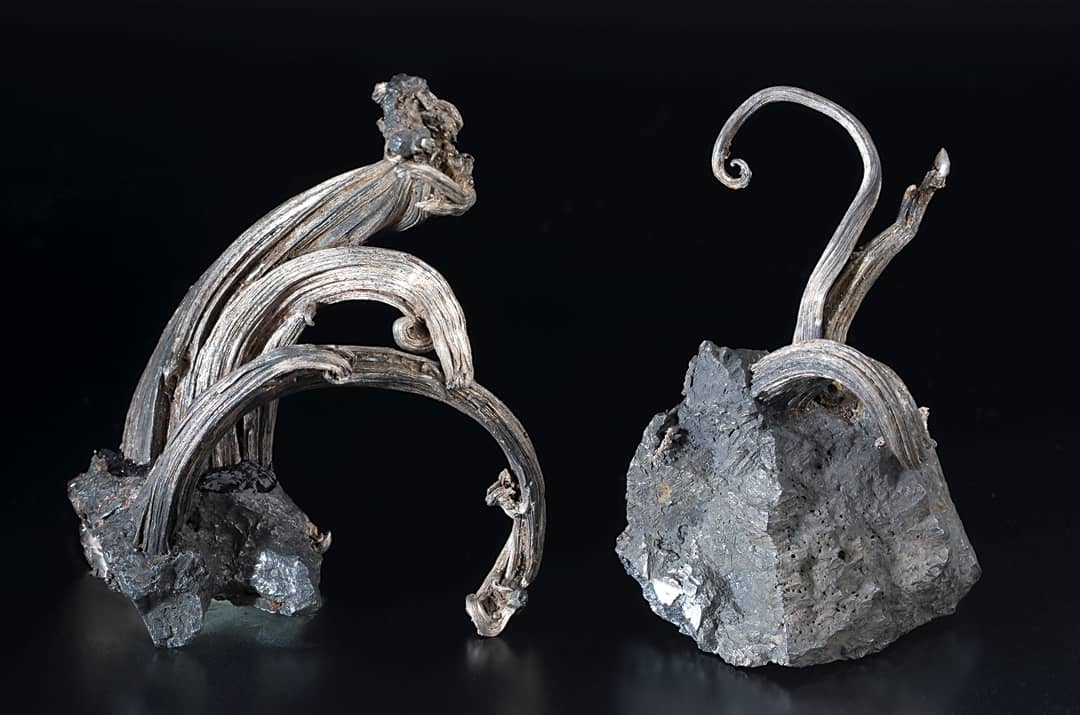
Two native silver specimens from Gottes Hülfe in der Noth Mine (ca. 7 centimeters high; photo: C. Berg).
Geological Period
Carboniferous (Pennsylvanian) to Triassic (Early Triassic)
Main geological interest
Mineralogy
Location
Southeastern Norway, Norway
59°39’04” N, 9°35’37” E
Two native silver specimens from Gottes Hülfe in der Noth Mine (ca. 7 centimeters high; photo: C. Berg).
Renowned worldwide for its exceptional silver wire specimens, including an outstanding 375 kilogram single sample discovered in 1867.
King Christian IV of Denmark-Norway, visiting the Kongsberg Mining area in 1624, was fascinated by the unique samples of wire silver. He collected many pieces that he brought back to his hometown of Copenhagen. Since then, silver from Kongsberg has found its way to many museums, university collections and other mineral collections around the world. More than 130 different minerals have been reported from the silver mines. These include three type-locality species, anthophyllite – a Mg-rich ortho-amphibole, armenite – a barium-bearing cyclosilicate, and heulandite-(Ba) which is rich in water and belongs to the zeolite group.
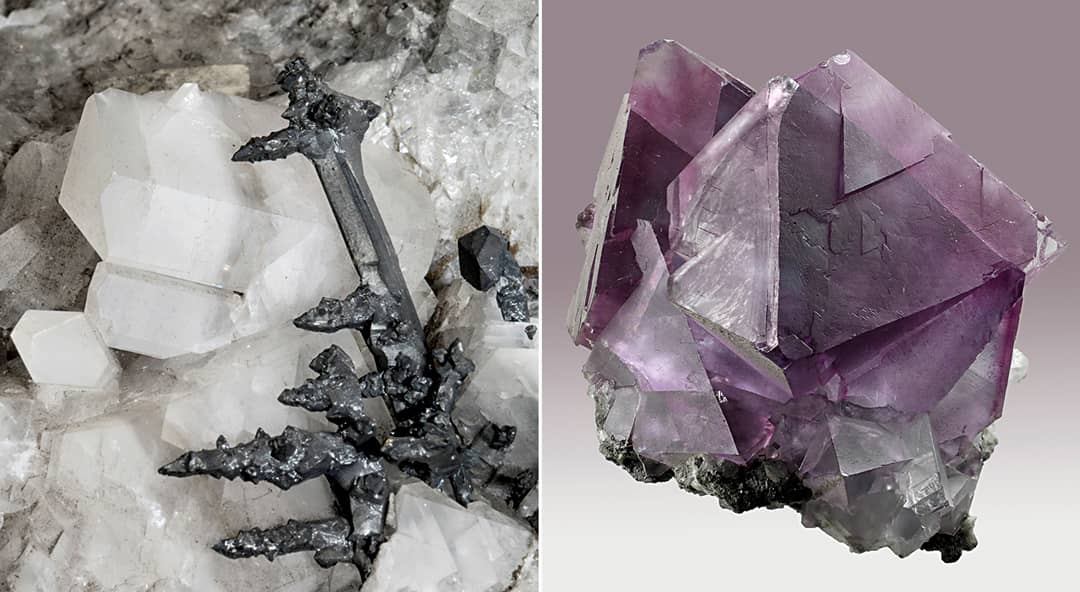
Acanthite (left, 4 centimeter wide, Gottes Hülfe in der Noth Mine; photo: C. Berg) and fluorite (right, 10 centimeters wide, King´s Mine, photo: Ø. Thoresen).
Geological description
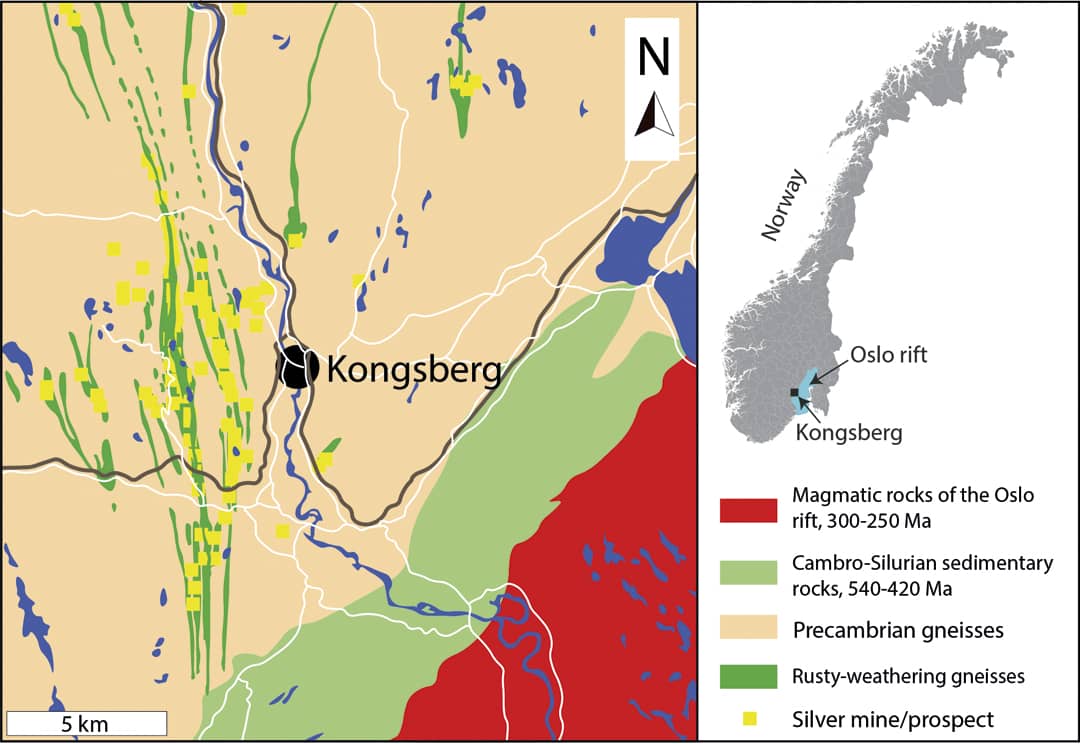
The Kongsberg mining area is located about 80 kilometers southwest of Oslo and is dominated by 1,100 million year old gneiss, which belongs to the Precambrian basement. Due to a widespread geological activity, that essentially occurred during the Permian and extended from the present location of the city of Brevik in the south to lake Mjøsa in the north, the Oslo Rift was formed. Large amounts of ascending melts formed basaltic to intermediate lava, while some melts solidified at depth to form corresponding plutonic rocks. Such magmatic activities took place less than 10 kilometers east of Kongsberg.
Related to these magmatic activities, hot water-rich fluids formed and moved upwards from deeper crustal levels dissolving silver but also other metals such as copper, lead, zinc, cobalt, nickel, arsenic, antimony, mercury and selenium. When the fluids reached the sulfide-rich gneiss near Kongsberg, the metals in the fluid reacted with the sulfides, which led to precipitation of silver, calcite, and several other minerals such as acanthite, dyscrasite and freibergite.
Since 1623 native silver has been mined from the mines in Kongsberg, and already in the early days, the miners realized that silver occurs in calcite veins penetrating the surrounding sulfide-bearing gneiss.
Scientific research and tradition
Early mining already delivered unique samples of native silver, and Kongsberg received significant attention from scientists during the second half of the 19th century and the beginning of the 20th century (Bugge, 1917; Neumann, 1944). More recent studies have focussed on the mineralisation and age constraints of the silver deposits.
Simplified geological map of the Kongsberg mining area and its location in southeastern Norway.
Reference
Bugge, C. (1917) “Kongsbergfeltets geologi,” Norges Geologiske Undersøkelse, 82, p. 272.
Kotková, J. et al. (2018) “The Kongsberg silver deposits, Norway: Ag-Hg-Sb mineralization and constraints for the formation of the deposits,” Mineralium Deposita, 53(4), pp. 531–545. Available at: https://doi.org/10.1007/s00126-017-0757-1.
Kullerud, K. et al. (2018) “Solid solutions in the system acanthite (Ag2S)–naumannite (Ag2Se) and the relationships between Ag-sulfoselenides and Se-bearing polybasite from the Kongsberg silver district, Norway, with implications for sulfur–selenium fractionation,” Contributions to Mineralogy and Petrology, 173(9), 71. Available at: https://doi.org/10.1007/s00410-018-1500-3.
Neumann, H. (1944) “Silver deposits at Kongsberg,” Norges Geologiske Undersøkelse, 162, p. 133.
Torgersen, E. et al. (2015) “Inclined K–Ar illite age spectra in brittle fault gouges: effects of fault reactivation and wall-rock contamination,” Terra Nova, 27(2), pp. 106–113. Available at: https://doi.org/10.1111/ter.12136.