Cretaceous (Early Cretaceous) to Quaternary (Holocene)
Geological Period
Cretaceous (Early Cretaceous) to Quaternary (Holocene)
Main geological interest
Marine Geology
Tectonics
Location
Japan Trench off Honshu, Japan
35°47’60” N, 142°30’00” E
Cretaceous (Early Cretaceous) to Quaternary (Holocene)
Fossil seamount of Cretaceous age strongly deformed and split by normal fauliting before being swallowed in a subduction zone.
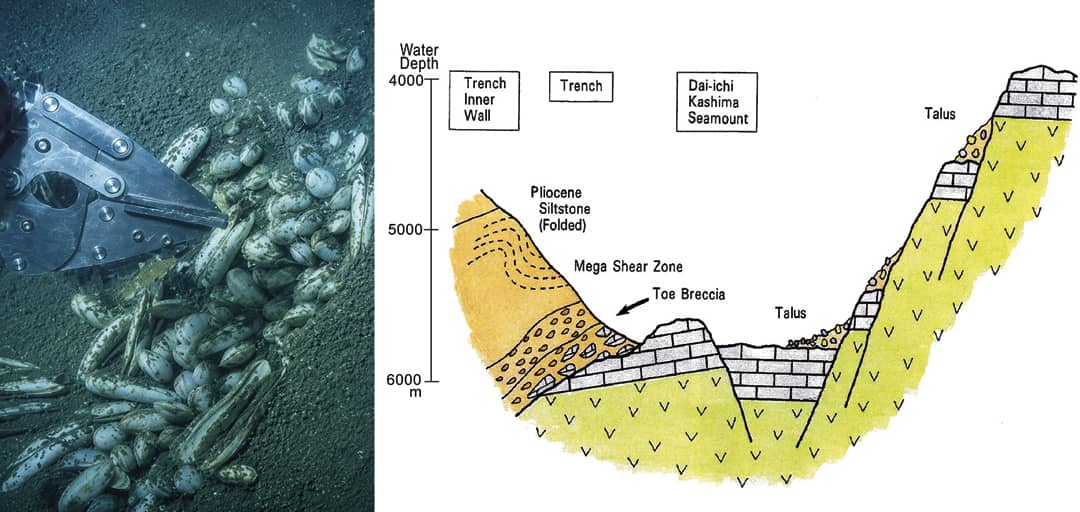
This site is the first, best studied large seamount of Cretaceous age that has collided with and collapsed into the Japan Trench. It is split by normal faults. Bathymetirc and submersible studies revealed the detailed features, rock and sediment ages, process of faulting and type of collapse of the surface both on the continental and oceanic plates. Collided parts of the landward slope are strongly disturbed and formcrescent shape scars of a landslide. Colonies of the large clam Calyptogena colonies occur at a depth of 5640 meters where interstitial waters were squeezed out from landward slopes.
Japan Trench off Honshu, Japan
35°47’60” N, 142°30’00” E
Geological description
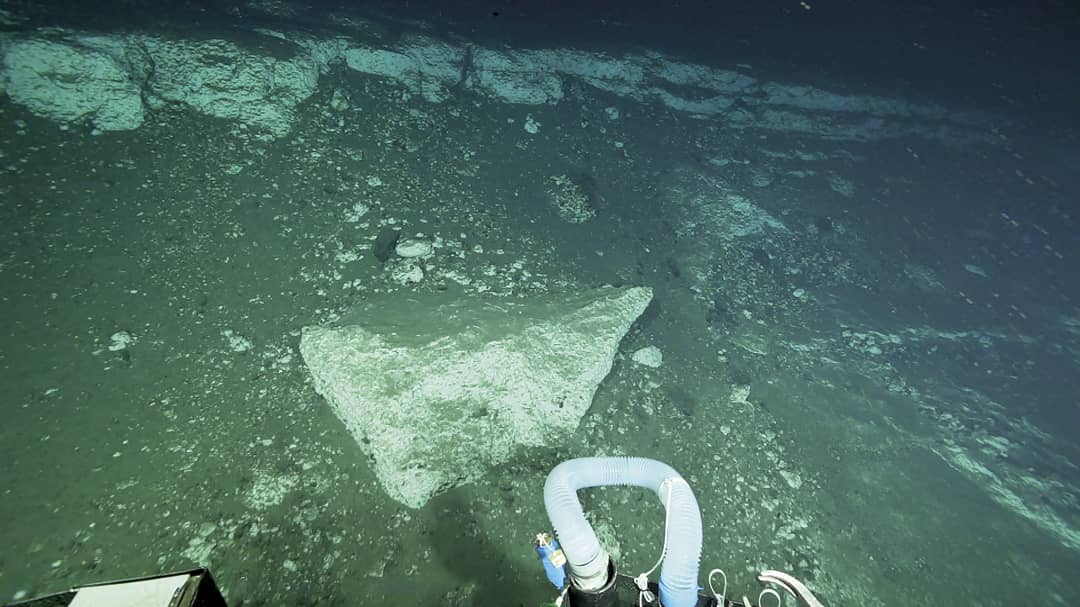
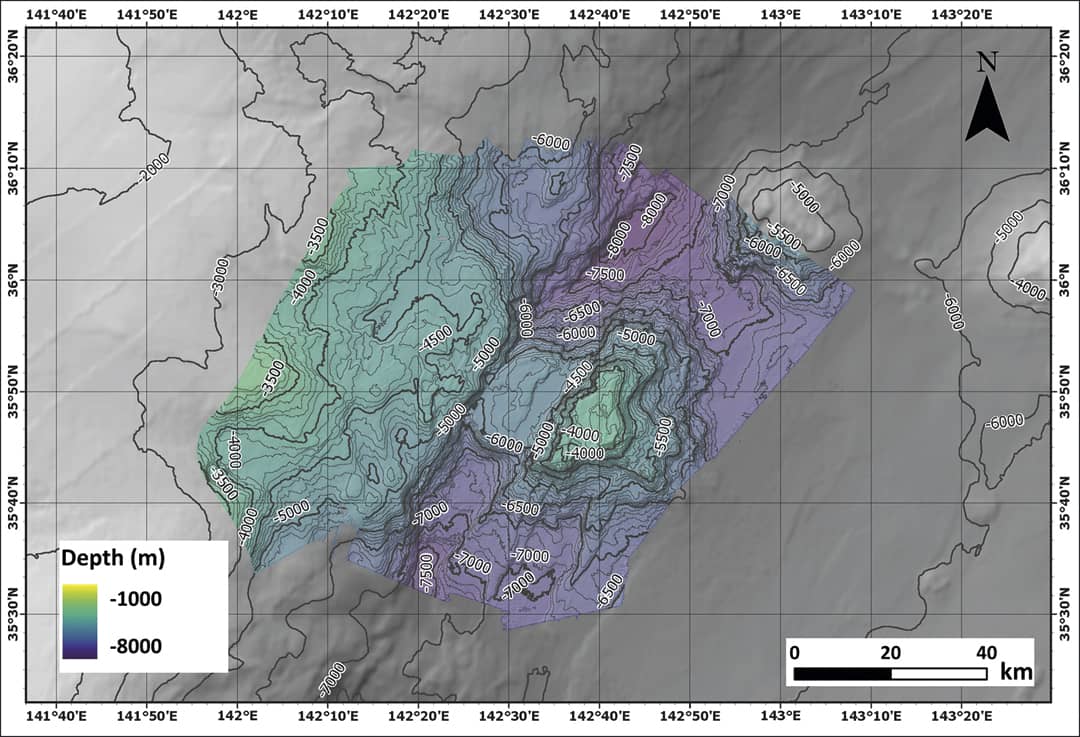
The northwest Pacific hosts one of the World’s oldest oceanic plates. It features systematic magnetic lineations and subparallel faults caused by the flexing and bending of the oceanic plate as it approaches the trench. In 1985, the Japan Hydrographic Department mapped this area and discovered a dissected seamount, 30 kilometers in diameter, that is approaching the Japan Trench on the Pacific plate that migrates east to west. Subsequently, sureys and several dives by the French-Japanese KAIKO project and related surveys in 1980s documented the shape of the collapsed seamount and limestone cap and flank deposits (Kobayashi et al., 1987, 1998; Yamazaki and Okamura, 1989; Nakanishi et al., 2011). Rudist bivalvia fossils in the limestone correlate with the Cretaceous. Manned submersible dives discovered a deep hole at the point of collision and subduction between the Pacific and North America plates . The irregular topographic surfaces and complicated subsurface structures on the landward slope of the trench reflect formation of a chaotic geologic body and related deformation due to the subduction. A colony of the large clam Calyptogena occurs at the foot of seamount along landward slope of the trench axis (Ohta and Laubier, 1987).
Scientific research and tradition
Daiichi Kashima Seamount is the last phase of the seamount that was carried westward on the Pacific plate to where it is subducted in the Japan Trench. Nearby the Daiichi Kashima Seamount, the Katori Seamount shows much younger phase of seamount collision and collapse.
Marine Geology
Tectonics
Reference
KAIKO II Research Group (ed.) (1987) 6000 Meters Deep: A Trip to the Japanese Trenches. Photographic Records of the Nautile Dives in the Japanese Subduction Zones. Tokyo, Japan: University of Tokyo Press.
Kobayashi, K. et al. (1987) “Normal faulting of the Daiichi-Kashima Seamount in the Japan Trench revealed by the Kaiko I cruise, Leg 3,” Earth and Planetary Science Letters, 83(1), pp. 257–266. Available at: https://doi.org/10.1016/0012-821X(87)90070-7.
Kobayashi, K. et al. (1998) “Outer slope faulting associated with the western Kuril and Japan trenches,” Geophysical Journal International, 134(2), pp. 356–372. Available at: https://doi.org/10.1046/j.1365-246x.1998.00569.x.
Nakanishi, M. (2011) “Bending-Related Topographic Structures of the Subducting Plate in the Northwestern Pacific Ocean,” in Y. Ogawa, R. Anma, and Y. Dilek (eds.) Accretionary Prisms and Convergent Margin Tectonics in the Northwest Pacific Basin. Dordrecht: Springer Netherlands, pp. 1–38. Available at: https://doi.org/10.1007/978-90-481-8885-7_1.
Ohta, S. and Laubier, L. (1987) “Deep biological communities in the subduction zone of Japan from bottom photographs taken during ‘nautile’ dives in the Kaiko project,” Earth and Planetary Science Letters, 83(1), pp. 329–342. Available at: https://doi.org/10.1016/0012-821X(87)90075-6.
Yamazaki, T. and Okamura, Y. (1989) “Subducting seamounts and deformation of overriding forearc wedges around Japan,” Tectonophysics, 160(1), pp. 207–229. Available at: https://doi.org/10.1016/0040-1951(89)90392-2.
Author(s)
Yujiro Ogawa.
Tsukuba University, Tsukuba, Ibaraki, Japan
Yoshihiro Fujiwara.
JAMSTEC, Yokosuka, Kanagawa JAPAN
Yakup Niyazi.
Mindloo-UWA Deep-Sea Research Centre, Australia
Alan J. Jamieson.
Mindloo-UWA Deep-Sea Research Centre, Australia
Hiroshi Kitazato.
Tokyo University of Marine Science and Technology, Japan
Kantaro Fujioka.
Shizuoka University, Shizuoka, Japan