
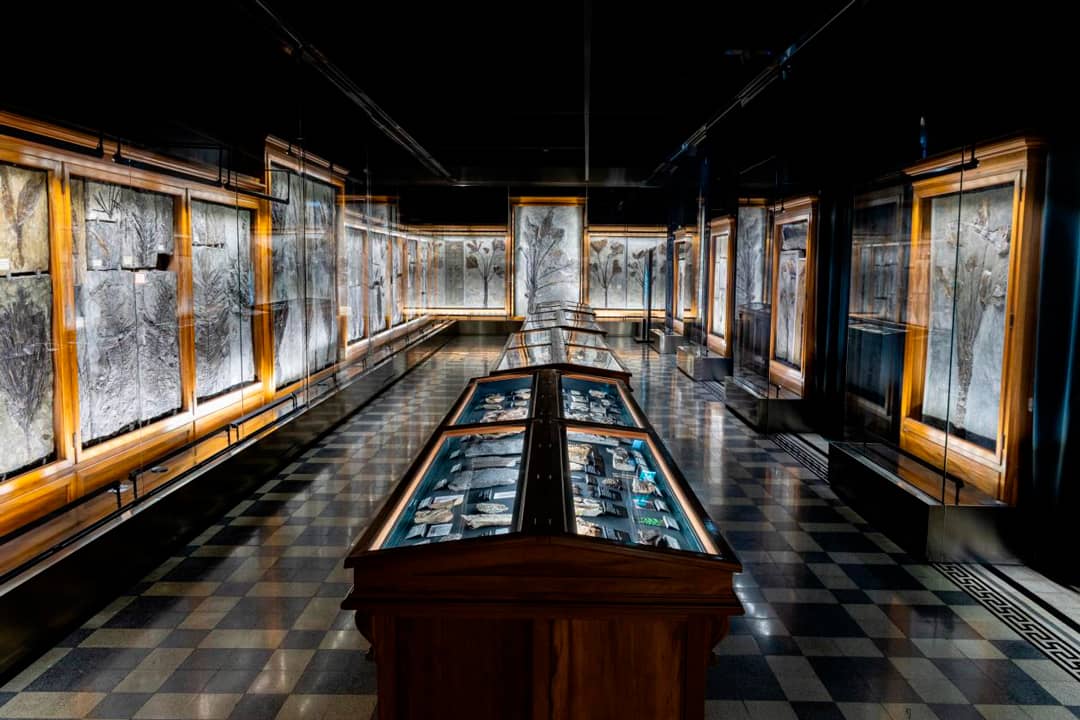
Panoramic view of the Hall of Palms. On the walls, the palm trees, in the center, the showcases with the history of the plants’ evolution.
Museum of Nature and Humankind (MNH)
Corso G. Garibaldi, 39-35121 Padova, Italy
44° 10′ 19.8″ N, 11° 56′ 52.4″ E
Panoramic view of the Hall of Palms. On the walls, the palm trees, in the center, the showcases with the history of the plants’ evolution.
The Paleobotany section of the Museum contains approximately 5000 specimens of fossil plants, mainly from northeastern Italy, some of them more than 400 million years old. This section, completely renovated in 2008 (Del Favero et al. 2012), is called the “Sala delle Palme” (Hall of Palms), due to the dozens of magnificent fossil palms displayed on its walls. The new exhibition preserves the historical display (dating back to the 1930s), at the same time enhancing the fossils with notable lighting effects. The fossil palms displayed in the hall date back to the Eocene-Oligocene, between 50 and 30 Ma, and were mainly found in sites of the Veneto region as the Lagerstatten of Bolca (Verona province) and Chiavon, near Vicenza (De Visiani, 1864; Kustatscher et al., 2016). They include the impressive holotype of Latanites maximiliani, more than 3 meters high. The Hall of Palms also preserves the Pliensbachian flora of Rotzo, one of the most important European Jurassic floras, primarily originating from the Veneto region (Wesley, 1966). The amber drops of Cheirolepidiaceae from the Carnian of the Dolomites, housed in the section, yielded the most ancient microworld preserved in amber so far recovered (e.g., Schmidt et al., 2012).
The University Museum traces its origins back to 1734, when Antonio Vallisneri’s collections—comprising archaeological and natural findings, along with rare and ancient objects—were established. After Vallisneri’s death, his son Antonio Jr. donated the collections to the University of Padua. Over time, these became the foundation of an extensive Museum of Natural History, later divided into several specialized museums. In June 2023, four of these collections—Mineralogy, Geology & Paleontology, Zoology, and Anthropology—were unified to form the Museum of Nature and Humankind (MNH). The collection of paleobotany has a remarkable historical and scientific value, since it includes specimens found in renowned, historical localities during the 19th and early 20th Century and, moreover, numerous type specimens. The exhibition is pivotal to show to general public plant evolution during the Geological Time, from the earliest forms to angiosperms. The impressive Paleogene fossil palms displayed in the Hall provide key evidence of past paleoclimate and paleoenvironment, making them a powerful tool to illustrate how ancient ecosystems and climates of the Italian territory evolved and are reconstructed.
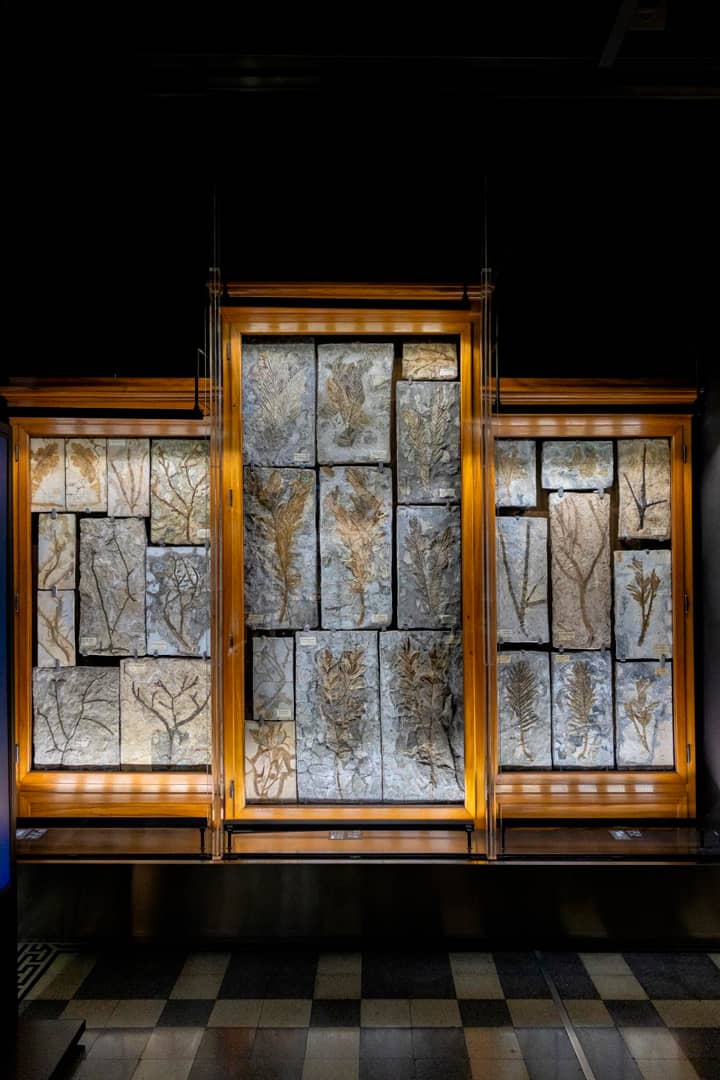
View of a wall of the Hall of Palms showcasing the Lower Jurassic flora of Rotzo and specimens from sites of the Paleogene of Bolca.
Schmidt, Alexander R., et al., 2012. Arthropods in amber from the Triassic Period. Proceedings of the National Academy of Sciences 109(37): 14796-14801. https://www.pnas.org/doi/epdf/10.1073/pnas.1208464109
Wesley A., 1966. The fossil floras of the Grey Limestones of Veneto, Northern Italy, and its relationships to the other European floras of similar age. The Paleobotanist 14: 124-130.