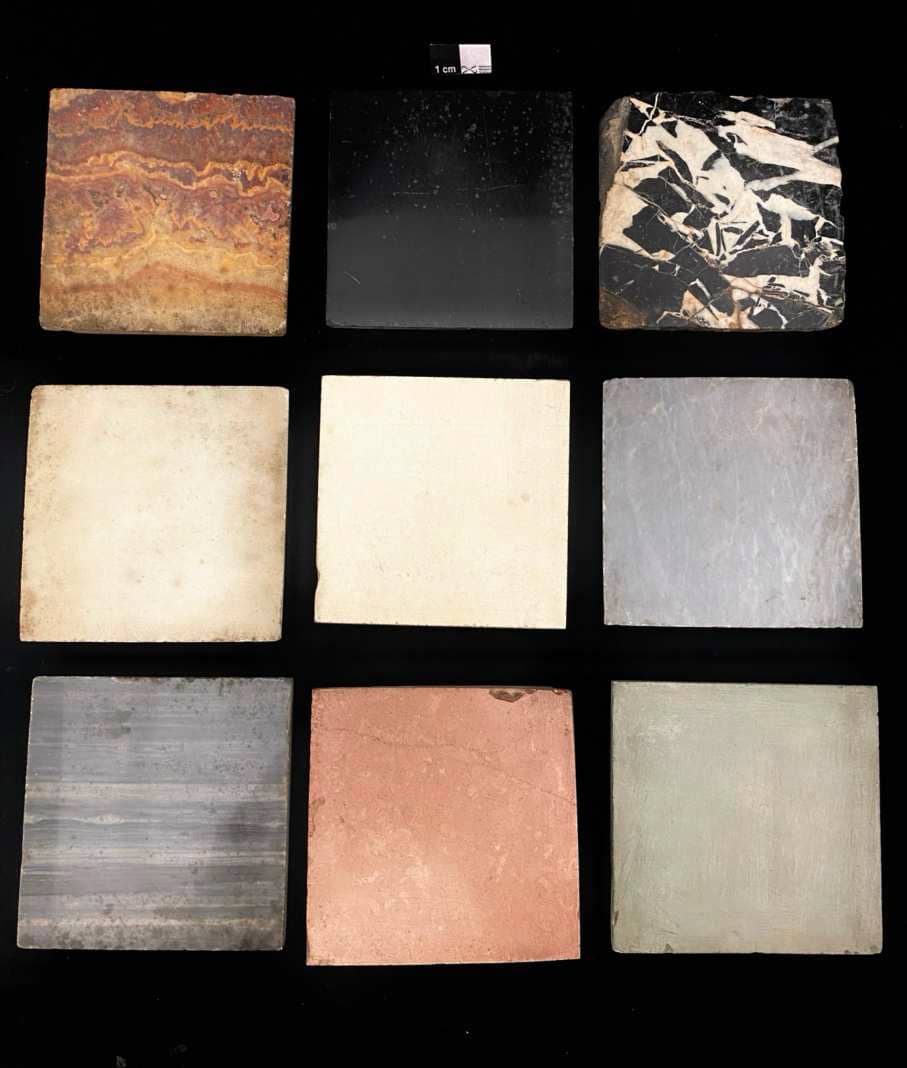
The front side of a selection of Hopetoun-Walker slabs.
The Hopetoun-Walker decorative stone collection uniquely preserves a Linnean-style binomial classification system used for geological specimens between 1750s -1830s.
Geo-collection description
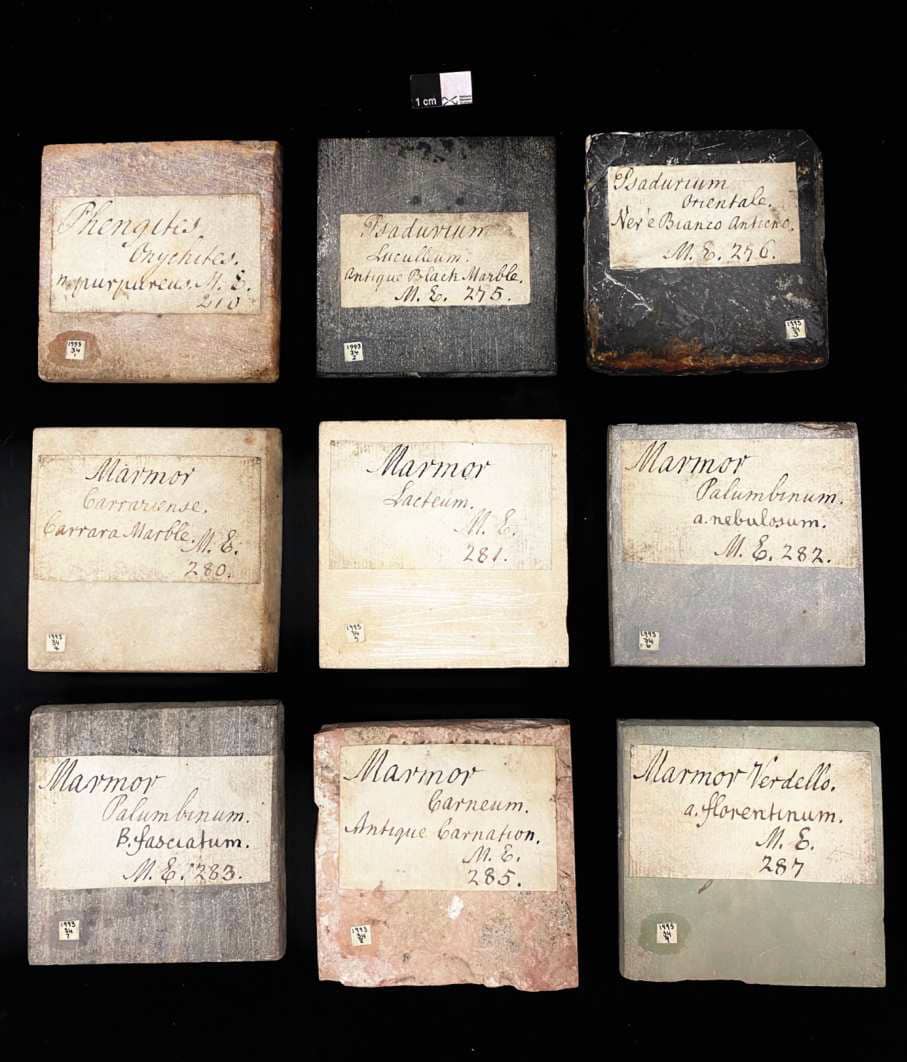
The Hopetoun-Walker collection consists of 116 decorative stone slabs of marble, travertine, sedimentary and igneous rocks (G.1993.34.131123, G.1993.38.7, G.1993.38.38 & G.2005.42.10). Each thin square slab is polished on one side, many are backed with slate for reinforcement, and all carry paper labels on the reverse. These labels record Latin binomial classifications, marked with “M.E.” (Musaeum Edinensis) and have a number identifying their place in Rev. John Walker’s system, an adaptation of Linnaeus’s Systema Naturæ Volume 3 published in 1758.
One hundred marble specimens were acquired in Rome in 1725326 by the Second Earl of Hopetoun during his Grand Tour, while the remainder came from his Scottish estates. The classifications were added in the 1780s by Rev. John Walker (173131803), the second Regius Professor of Natural History at the University of Edinburgh. Although influenced by Linnaeus, with whom he corresponded, Walker rejected reliance on visible traits such as colour and form for classifying “fossils” (then including minerals, rocks, ores, and organic remains). Instead, he based his system on the chemical properties known at the time, marking an important step in mineralogy’s development. The collection is the oldest confirmed suite of geological specimens at National Museums Scotland.
Geo-collection value
Scientific Importance:
These specimens represent a largely forgotten stage in the history of mineralogy. From the 1760s to the 1830s, rocks and minerals were routinely classified using a binomial system of genus, species, and variety, adapted from Linnaeus9s methods for classifying plants, animals and minerals 3 the three kingdoms of nature. While the system proved less effective for minerals, figures such as Rev. John Walker sought to refine it. Ultimately, it was replaced by the chemical3structural system of Dana and others. In the process, most binomially classified collections4including Linnaeus9s own4were destroyed. This appears to be the only surviving collection from that era.
Cultural Importance:
Known as the Hopetoun3Walker slabs, these specimens were gathered in Italy during the Grand Tour of the second Earl of Hopetoun. Many are “antico” stones cut from Roman ruins, popular souvenirs of 18th-century travel.
Educational Importance:
Though Rev. John Walker published little, he is considered one of the earliest teachers of geology and mineralogy. Designating this collection also honors his role in shaping the discipline. The slabs exemplify the scientific process itself4how knowledge evolves through trial, revision, and discovery.
The back side of the selectio, revealing the bionomial classification system used by Rev John Walker (1731-1803).
Reference
Waterston, C. D. 1997 “Collections in Context: The Museum of the Royal Society of Edinburgh and the Inception of a National Museum for Scotland.” Edinburgh: National Museums of Scotland. ISBN 978- 0948636875 3 pgs 21-23
Eddy, Matthew Daniel, 2003 “The ‘Ingenious’ Rev. Dr John Walker: Chemistry, Mineralogy and Geology in Enlightenment Edinburgh, 1740-1800.” PhD thesis, Durham University.
Scott, Harold W.1966 “Lectures on Geology”. University of Chicago Press. pg xxviii.
Connor Bulman, Louisa M., 2002, `Gaetano Piccini, the neatest handed, idlest fellow I ever met with’, Xenia Antiqua, 10, pp. 219-238 (p. 231 and p. 237, note 77).