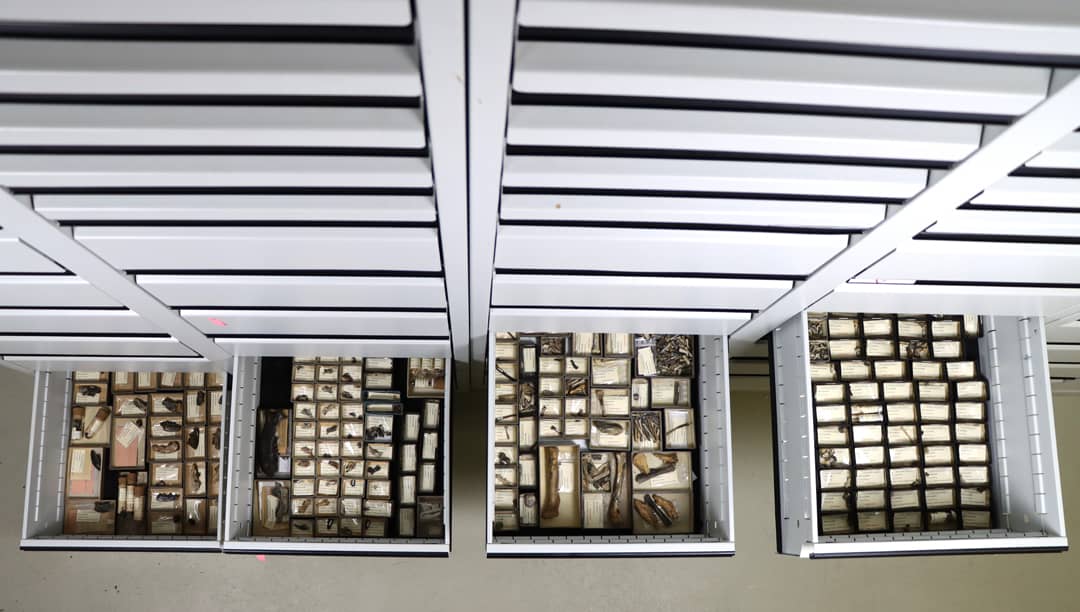
View of some open drawers containing specimens from the Walbeck collection. Photo: Maximilian Albrecht.
Walbeck is one of the few Paleocene vertebrate localities in Europe, and the only one from Germany.
Geo-collection description
The collection includes fossils of mammals, birds, reptiles and amphibians from a middle Paleocene (ca. 60 million years ago) fissure filling in a limestone quarry near Walbeck, western Saxony Anhalt, Germany. The fossiliferous sediments were reworked during the Rupelian Transgression in the Oligocene and deposited in a protected fissure in Triassic limestone (Muschelkalk). The karstic fissure filling was discovered in 1939 and excavated under the direction of Johannes Weigelt (1890–1948), who had already noticed the early Cenozoic age of the faunal assemblage and recognized its scientific value [1]. Nearly 12 m3 of fossiliferous sediments were completely removed, washed and sieved, yielding 44,437 specimens. Today, the Walbeck Collection is part of the Geological and Paleontological Collections of the Central Repository of Natural Science Collections (ZNS) at Martin Luther University Halle-Wittenberg.
Geo-collection value
The Paleocene is one of the most enigmatic epochs in Earth‘s history, largely due to its limited fossil record. Walbeck is the only known Paleocene vertebrate site in Germany and one of the few in Europe. As such, this locality provides rare insights into the evolutionary history of vertebrates following the K-Pg mass extinction. The scientific value of this site had already been recognized by Johannes Weigelt at the time of its discovery in 1939 [1], and, since then, for almost nine decades, this continental vertebrate fauna has been the subject of extensive research. The mammalian fauna encompasses 16 species from seven orders, including the early primate Plesiadapis walbeckensis and the enigmatic Arctocyonidae, and allowed the Walbeck assemblage to be referred to the Mammal Paleogene Zone 5 (Selandian) [2]. Avian specimens were also described and comprise, among other taxa, the earliest fossil record of a gastornithiform — a group of giant, flightless birds — and Berruornis halbedeli — an early relative of owls [3]. More recently, the Walbeck herpetofauna was redescribed [4, 5], encompassing at least three salamanders, three frogs, three lizards, a crocodile and a turtle. These recent studies attest to the scientific importance that the Walbeck Collection still holds today.
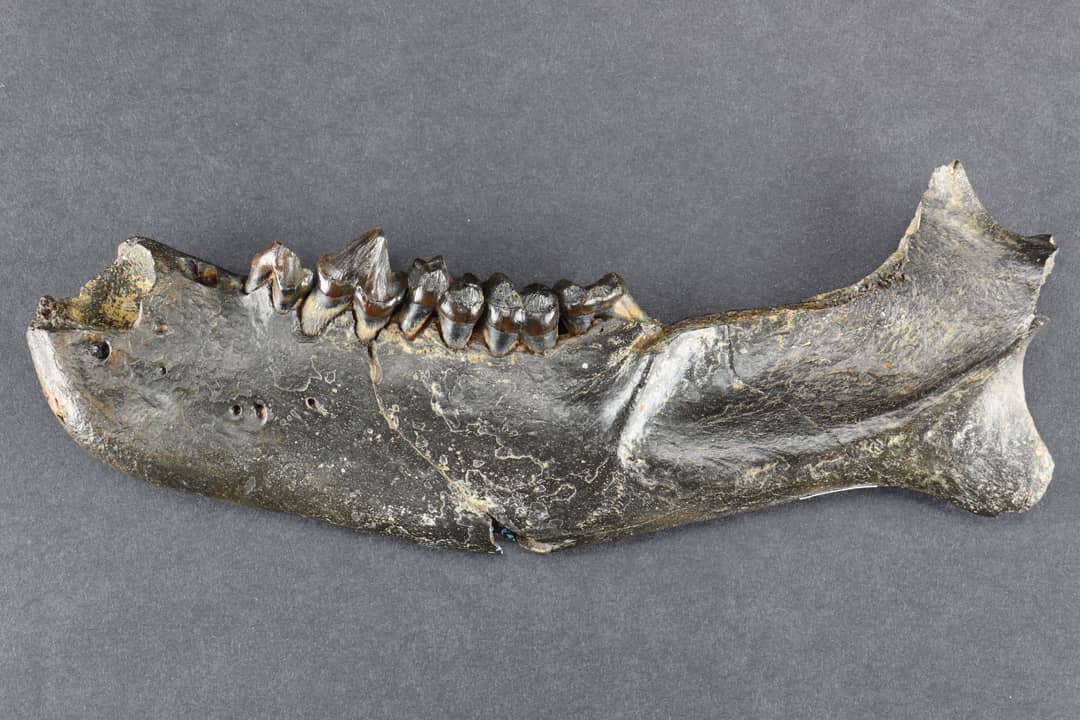
Type specimen of the arctocyonid Mentoclaenodon walbeckensis, the largest animal found at Walbeck. Object length: 14.7 cm. Photo: Maximilian Albrecht.
Reference
Weigelt, J., 1939. Die Aufdeckung der bisher ältesten tertiären Säugetierfauna Deutschlands. Nova Acta Leopoldina, 7, pp.515–528.
De Bast, E., Steurbaut, E. and Smith, T., 2013. New mammals from the marine Selandian of Maret, Belgium, and their implications for the age of the Paleocene continental deposits of Walbeck, Germany. Geologica Belgica, 16/4, pp.236-244.
Mayr, G., 2007. The birds from the Paleocene fissure filling of Walbeck (Germany). Journal of Vertebrate Paleontology 27, 2, pp.394-408.
Čerňanský, A., and Vasilyan, D., 2024. Roots of the European Cenozoic ecosystems: lizards from the Palaeocene (~MP5) of Walbeck in Germany. Fossil Record 27, 1, pp. 159-186.
Vasilyan, D., and Macaluso, L., 2025. Palaeocene herpetofauna of Walbeck (Sachsen‑Anhalt, Germany) with a focus on lissamphibians. Palaeobiodiversity and Palaeoenvironments, 105, pp. 343-375.