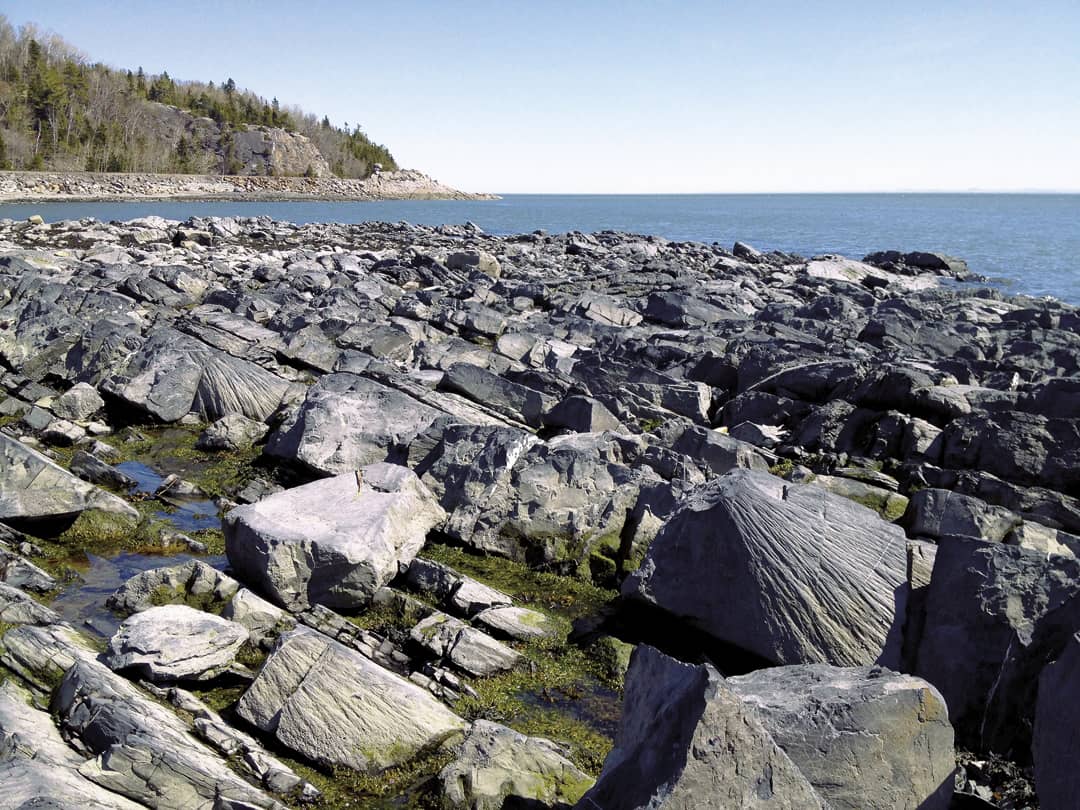
Shattercones in a limestone formation of the St-Lawrence Platform. The outcrop is located 6.5 km from the central peak.
Geological Period
Ordovician (Upper Ordovician) to Ordovician (Upper Ordovician)
Main geological interest
Impact structures and extraterrestrial rocks
Location
Quebec, Canada
47°31’23” N, 70°18’24” W
Shattercones in a limestone formation of the St-Lawrence Platform. The outcrop is located 6.5 km from the central peak.
One of the best preserved ancient complex meteor craters with recognizable rim, central peak and structures in an inhabited area.
Recognized in 1965 by Rondot (1968), the Charlevoix astrobleme is an accessible example of a complex impact crater that exhibits concentric depressions and a central uplift. Five types of impactites occur there: shatter cones, breccia dykes, suevite, pseudotachylite, and impact melt. Planar deformation features in quartz and feldspars confirm high- shock conditions. U–Pb dating of shocked zircon in impact melt indicates an age of 450 ± 20 Ma (Schmieder et al., 2019), consistent with the Ordovician meteorite bombardment linked to the breakup of an L-chondrite parent body in the asteroid belt (Schmitz et al., 2001).
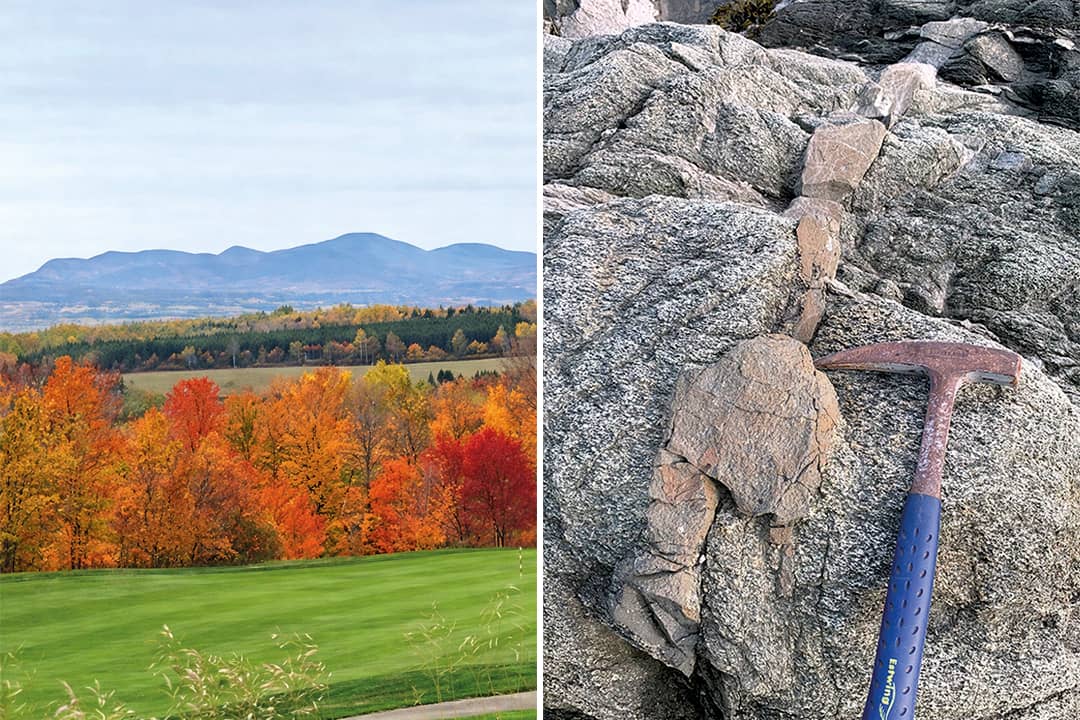
(Left) A view of Mont des Éboulements, the Charlevoix Astrobleme central peak. (Right) Impact breccia dyke in Proterozoic gneissic granite.
Geological description
The 450 +/- 20 Ma Charlevoix astrobleme is located on the north shore of the St. Lawrence Estuary, 80 kilometers northeast of Quebec City. Although eroded during 450 million years by ice, wind and water, this complex impact structure still shows a recognizable central peak and annular depression.
The astrobleme lies mostly in the Mesoproterozoic Grenville province, part of the Canadian Shield and on the unconformably overlying Paleozoic sedimentary rocks of the St. Lawrence Platform. Some of it can be observed today in an annular depression in the astrobleme. Evidence for an impact include shatter cones (Rondot, 1989), polymictic clastic matrix breccia forming autochthonous dykes, rare remnants of melt-bearing impactites and ejecta material (suevite), pseudotachylite and planar deformation features in quartz (Robertson, 1975).
The apparent diameter of the structure is 54 kilometers. But the distribution of the shatter cones from the impact center that spans 16.5 kilometers implying an original crater diameter of approximately 82 kilometers, an estimate larger than the 70 kilometers previously proposed.
The Charlevoix region is also an important seismic zone and is the site of many landslides, hence the name of the astrobleme’s central peak: “Mont des Éboulements” (Landslide Mountain).
Scientific research and tradition
Since its discovery in the mid-Sixties, the astrobleme has been the subject of research because of its proximity and uniqueness. Geochronology studies as well as impactite characterization have been and still are the focus of research in the area.
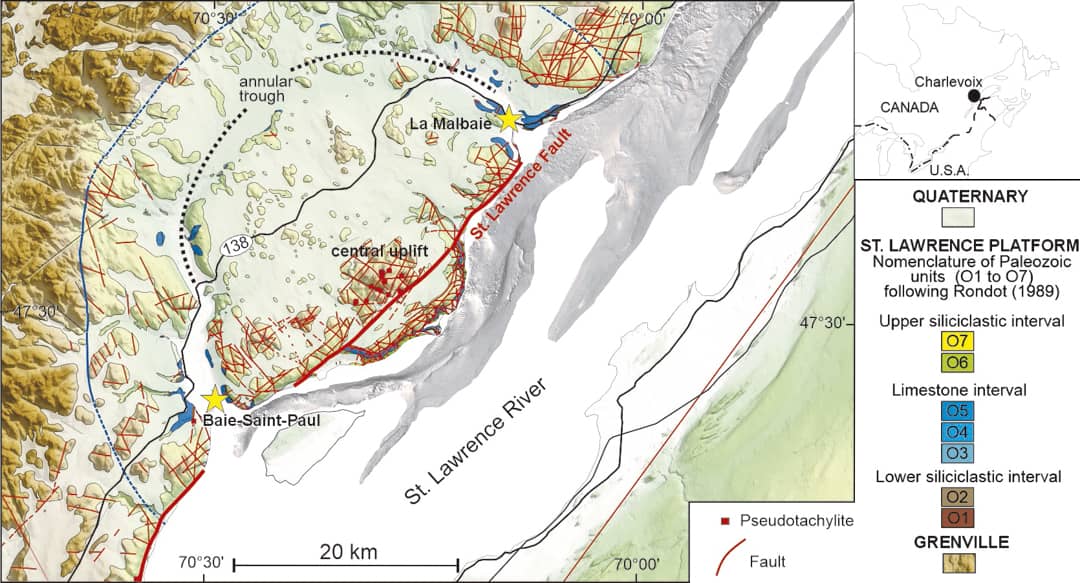
Relief map of Charlevoix showing the main astrobleme structures and pseudotachylite occurrences.
Reference
Gastonguay, J.-M. et al. (2026) “Charlevoix meteorite impact revisited: New shatter cones point to an Ordovician giant,” St John’s Abstract Compilation. GAC-MAC 2026, St. John’s NL, p. A42.
Osinski, G.R. and Ferrière, L. (2016) “Shatter cones: (Mis)understood?,” Science Advances, 2(8), p. e1600616. Available at: https://doi.org/10.1126/sciadv.1600616.
Rondot, J. (1968) “Nouvel impact météoritique fossile? La structure semi-circulaire de Charlevoix,” Canadian Journal of Earth Sciences, 5, pp. 1305–1317. Available at: https://doi.org/10.1139/e68-128.
Rondot, J. (1989) Géologie de Charlevoix. MB 89-21. Ministère des Richesses naturelles, Quebec, p. 606 pages–19 plans.
Schmieder, M. et al. (2019) “In situ U–Pb analysis of shocked zircon from the Charlevoix impact structure, Québec, Canada,” Meteoritics & Planetary Science, 54(8), pp. 1808–1827. Available at: https://doi.org/10.1111/maps.13315.
Schmitz, B., Tassinari, M. and Peucker-Ehrenbrink, B. (2001) “A rain of ordinary chondritic meteorites in the early Ordovician,” Earth and Planetary Science Letters, 194(1), pp. 1–15. Available at: https://doi.org/10.1016/S0012-821X(01)00559-3.
Author(s)
Pierre Verpaelst.
Charlevoix Aspiring Geopark, Canadian Geoparks Network, Québec, Canada
Jean-Michel Gastonguay.
Centre d’études collégiales en Charlevoix, Charlevoix Aspiring Geopark