Buldhana District, Maharashtra, India
19°58’35” N, 76°30’30” E
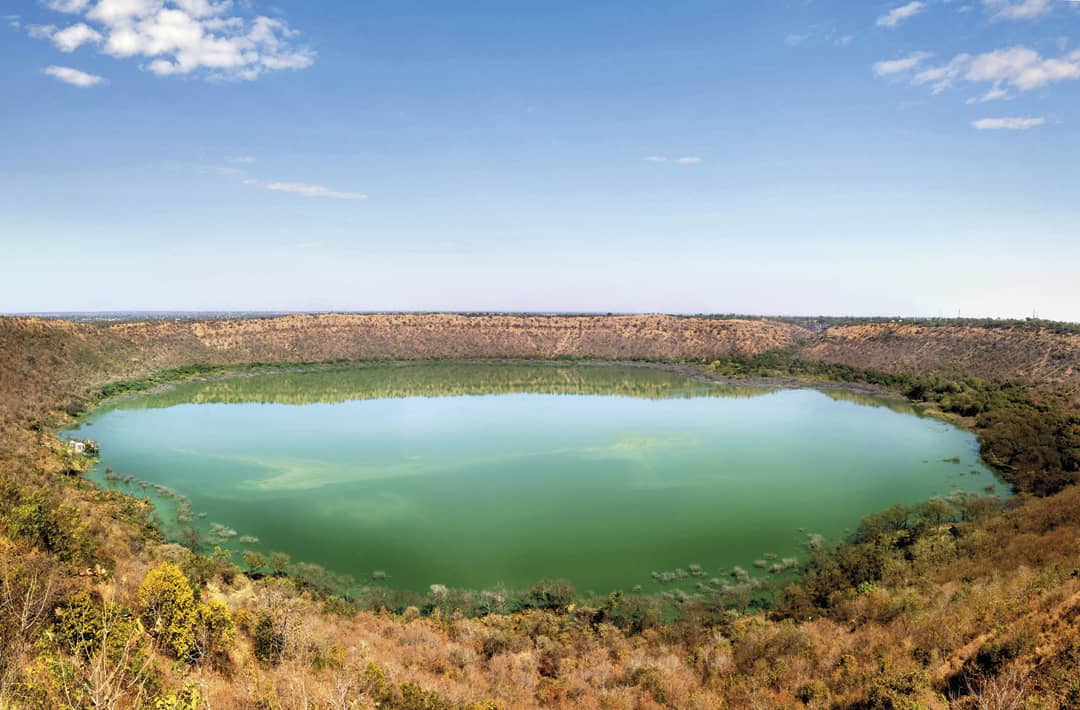
Panoramic view of the crater (Photo: GSI).
One of the youngest and well-preserved hypervelocity impact crater in a basaltic target.
Lonar Crater is one of the five hypervelocity meteorite impact craters on Earth formed in basalt. Its distinct features make it a valuable analog for studying impact craters on other planetary bodies like the Moon and Mars, highlighting its global scientific importance. Over the years, the origin of the Lonar structure has risen from volcanism, subsidence, and cryptovolcanism to an authentic meteorite impact crater. In addition, the lake was officially designated as a Ramsar Wetland of International Importance in 2020, a recognition that highlights the need for stronger conservation measures to address threats such as pollution, encroachment, invasive species, and unregulated tourism.
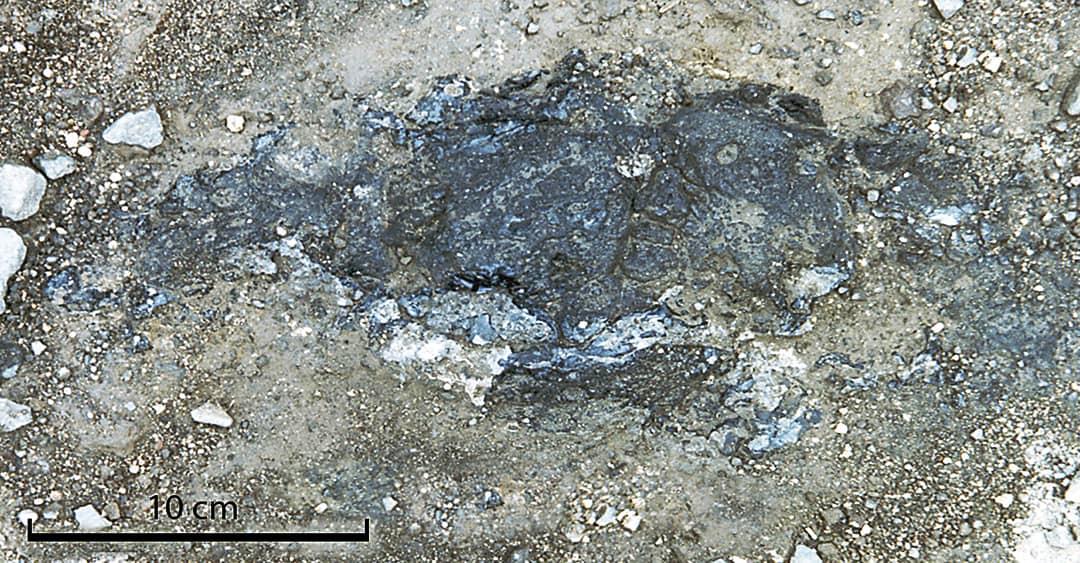
Spindle-shaped impact melt glass; Location: north of Lonar crater (Photo: GSI).
Geological description
Lonar Crater, India, is one of the youngest (~12 ka) well-preserved, bowl-shaped, simple impact structures on Earth. The crater has a diameter of approximately 1.88 kilometers and is emplaced onto the extensive tholeiitic continental flood basalts (~65 Ma), the Deccan Traps.
At its center lies a saline-alkaline lake, 1830 meters wide at the rim and 1220 meters at the current water level and with a depth of about 137 meters from the rim (Maloof et al., 2010).
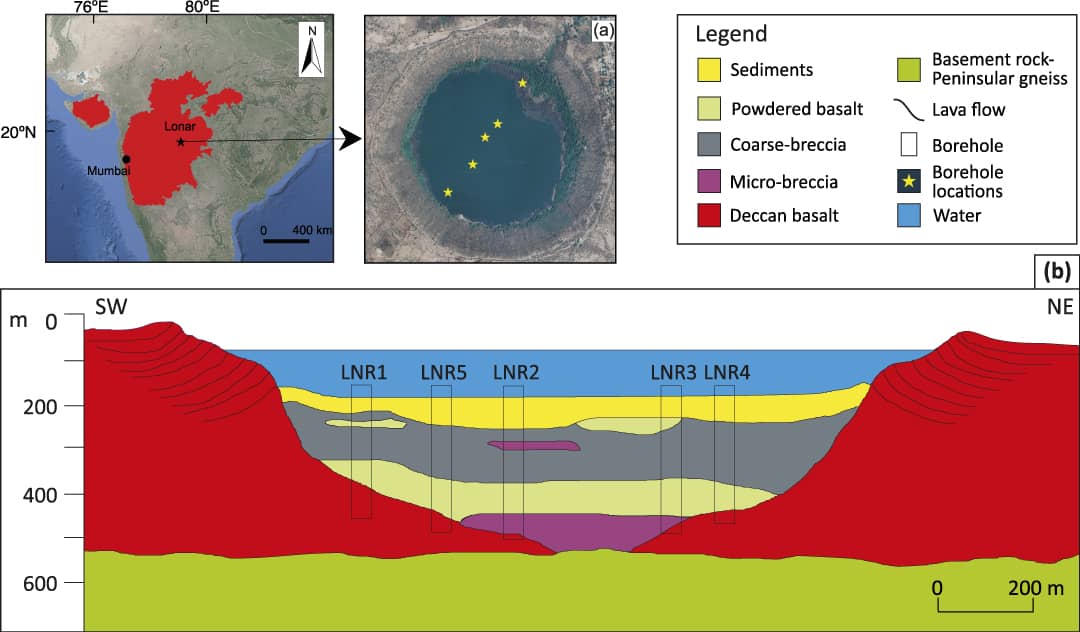
The geology of the crater is unique. It exposes a series of basaltic flows along its inner slopes. The crater’s circular shape, depth-to-diameter ratio, brecciated subsurface rocks, and outward dipping country rocks, along with debris mounds and an ejecta blanket of fragmented breccia and suevite extending 1350 meters, support its impact origin.
Geochemical analysis of Deccan basalt and impactites –impact glass, spherules, and melt rocks– exhibits minimal differentiation from target rocks. Studies suggest that impact reached the Archean basement at an estimated depth of 522–570 meters and enrichment of Co, Ni, Cr in certain impactites indicates a chondritic body as the likely impactor (Chandran et al., 2023).
Lonar’s geology offers insights into valuable planetary impact processes.
Scientific research and tradition
Lonar Lake, a rare basaltic impact crater, serves as a natural lab for studying impact geology, extremophile life and lake ecology. However, the saline-alkaline lake restricts access to shocked basalt and breccias, preserving crucial impact evidence. Ancient temples and mythological associations further enhance its combined scientific and cultural significance.
(a) Drill hole locations in Lonar crater (b) Cross-section of the subsurface layers of Lonar crater (Chandran et al., 2023).
Reference
Bodas, M.S. and Sen, B. (2014) “The Lonar Crater: The Best Preserved Impact Crater in the Basaltic Terrain,” in V.S. Kale (ed.) Landscapes and Landforms of India. Dordrecht: Springer Netherlands, pp. 223–230. Available at: https://doi.org/10.1007/978-94-017-8029-2_24.
Chandran, S.R. et al. (2022) “Lonar Impact Crater, India: the Best-Preserved Terrestrial Hypervelocity Impact Crater in a Basaltic Terrain as a Potential Global Geopark,” Geoheritage, 14(4), p. 130. Available at: https://doi.org/10.1007/s12371-022-00767-9.
Chandran, S.R. et al. (2023) “A compendium of the best-preserved terrestrial hypervelocity impact crater in a basaltic terrain: The Lonar, India,” Earth-Science Reviews, 243, p. 104508. Available at: https://doi.org/10.1016/j.earscirev.2023.104508.
Jourdan, F. et al. (2011) “40Ar/39Ar age of the Lonar crater and consequence for the geochronology of planetary impacts,” Geology, 39(7), pp. 671–674. Available at: https://doi.org/10.1130/G31888.1.
Maloof, A.C. et al. (2010) “Geology of Lonar Crater, India,” GSA Bulletin, 122(1–2), pp. 109–126. Available at: https://doi.org/10.1130/B26474.1.
Sengupta, D. and Bhandari, N. (1988) “Formation Age of the Lonar Crater.” 19th Lunar and Planetary Science Conference, Houston, Texas: Lunar and Planetary Institute, pp. 1059–1060.
Author(s)
Kaushik Rajbanshi.
Geological Survey of India
Snigdha Ghatak.
Geological Survey of India
Amitabha Bhattacharyya.
Geological Survey of India