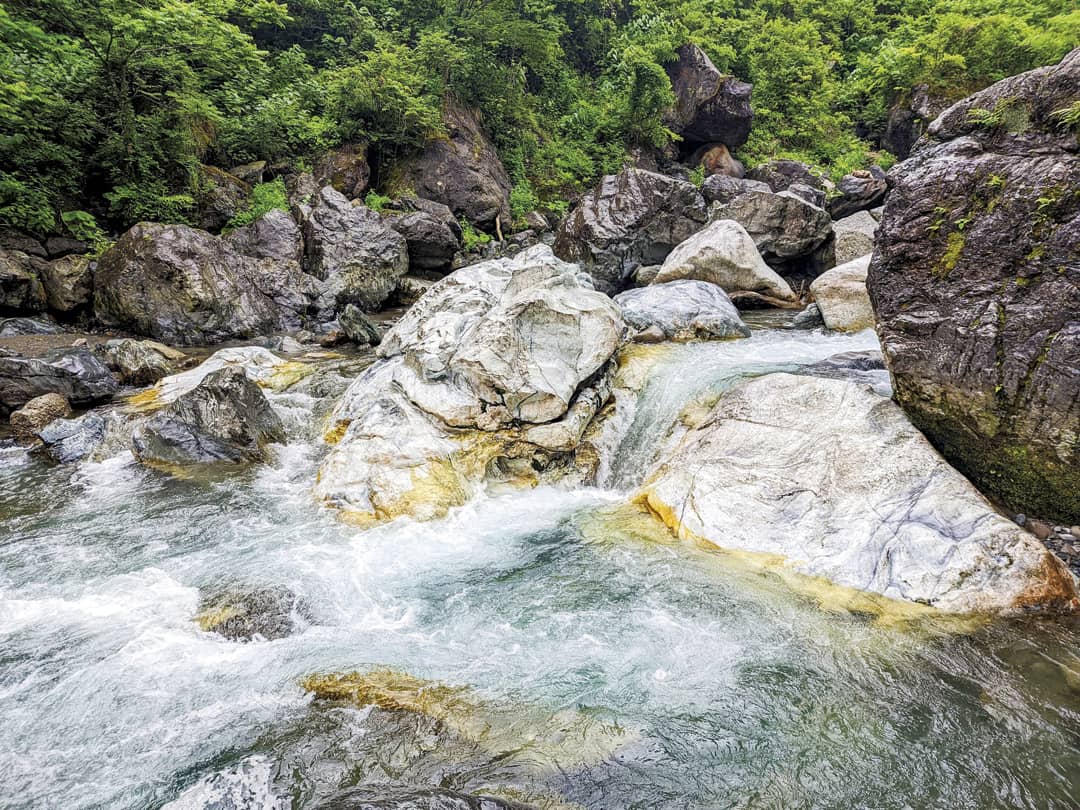
Early Paleozoic jadeitite boulders within the Kotakigawa River gorge, Itoigawa. A national natural monument showcasing rocks formed deep within an ancient subduction zone.
Geological Period
Cambrian (Terreneuvian) to Ordovician (Middle Ordovician)
Main geological interest
Mineralogy
Igneous and Metamorphic petrology
Location
Itoigawa, Niigata, Japan
36°55’34” N, 137°49’19” E
Early Paleozoic jadeitite boulders within the Kotakigawa River gorge, Itoigawa. A national natural monument showcasing rocks formed deep within an ancient subduction zone.
A plate tectonic gemstone that connects deep Earth history with human culture.
The Itoigawa jadeitite is one of the world’s rare natural occurrences of jadeite jade, accompanied by various rare minerals such as itoigawaite (Sr analogue of lawsonite), ohmilite and rengeite. It formed in a proto-Japan subduction zone during the Early Paleozoic and offers a unique natural laboratory to study high-pressure, fluid-driven mineralization. These rocks were later uplifted through the formation of the Northern Japan Alps. Used by people for more than 6,500 years, this site holds immense geological as well as cultural significance. Therefore, It is well protected, actively studied, and strongly supported by public outreach through Itoigawa City.
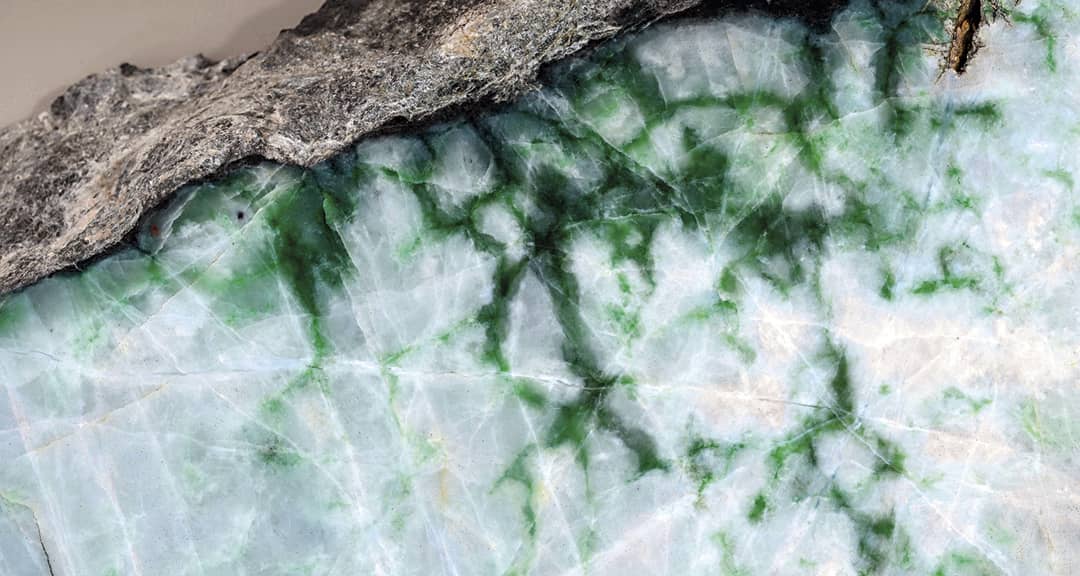
Gem-quality jadeitite from Itoigawa, Japan (approximately 15 centimeters wide). Its characteristic vibrant color is typically caused by iron in the associated mineral omphacite.
Geological description
The jade of Itoigawa, Japan tells a story that connects deep Earth history with human culture. This type of jade is jadeitite: a rare rock made almost entirely of jadeite (NaAlSi2O6), which formed around 520 Ma in the cold mantle wedge of a subduction zone (Miyajima, 2017; Tsujimori and Harlow, 2017; Harlow et al., 2015). As one tectonic plate slid beneath another, fluids were generated and moved upward through the mantle wedge under high pressure, forming jadeitite. Around 350 Ma, the Itoigawa area experienced another tectonic event. New high-pressure rocks, such as eclogite, formed alongside older jadeitite and serpentinite derived from ancient oceanic lithosphere. While these deep-formed rocks remained buried within the Earth for hundreds of millions of years, they were eventually brought to the surface through the opening of the Japan Sea, the formation of the Fossa Magna, and the uplift of the Northern Japanese Alps. Today, they are exposed in the mountains around Itoigawa. Jadeitite reveals the nature of fluids deep in subduction zones, which contain more methane than carbon dioxide—providing energy for deep underground microbes (Peverelli et al., 2025). Itoigawa is one of the few places where tectonic power and ancient creativity meet in a single stone.
Scientific research and tradition
Scientific research on Itoigawa jadeitite began with the formal identification of jadeitite by Kawano (1939). Lots of novel geological and archaeological studies have examined its formation, age, and cultural use, establishing the site as a key reference for understanding both deep Earth processes and early human engagement with jade.
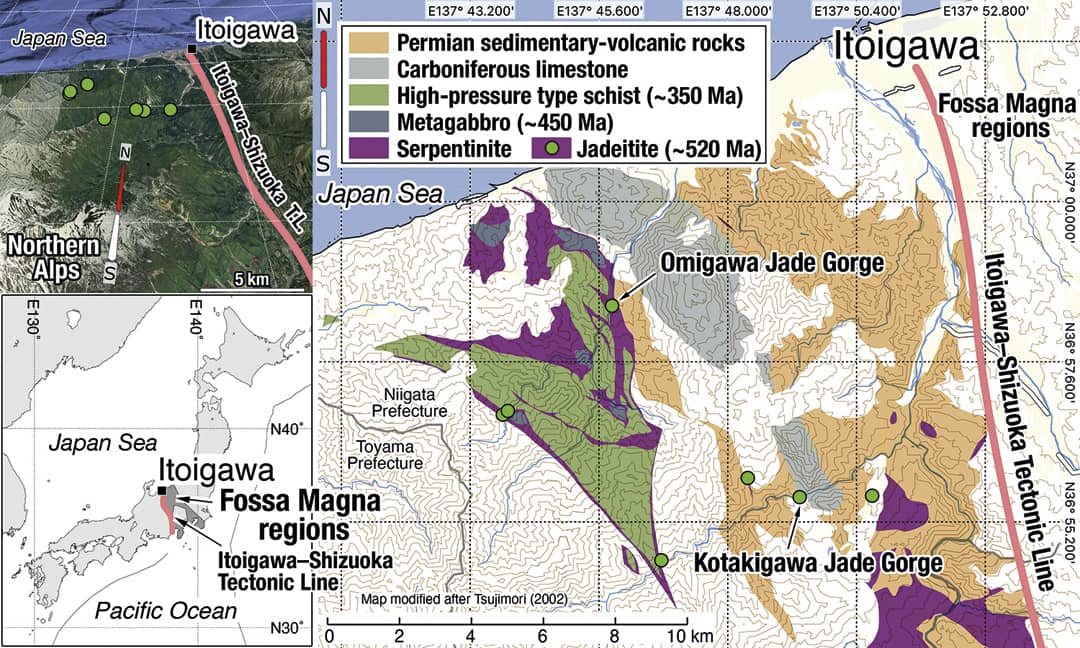
The geological map of pre-Jurassic basement rocks shows the jadeitite localities. A separate oblique bird’s-eye view based on Google Earth satellite imagery is also provided.
Reference
Harlow, G.E., Tsujimori, T. and Sorensen, S.S. (2015) “Jadeitites and Plate Tectonics,” Annual Review of Earth and Planetary Sciences, 43(1), pp. 105–138. Available at: https://doi.org/10.1146/annurev-earth-060614-105215.
Kawano, Y. (1939) “A new occurrence of jade (jadeite) in Japan and its chemical properties,” Journal of the Japanese Association of Mineralogists, Petrologists and Economic Geologists, 22, pp. 195–201. Available at: https://doi.org/10.2465/ganko1929.22.219.
Miyajima, H. (2017) “Jadeitite from Itoigawa, Niigata Prefecture, central Japan,” Journal of Mineralogical and Petrological Sciences, 112, pp. 227–236. Available at: https://doi.org/10.2465/jmps.170521.
Peverelli, V. et al. (2025) “Cold-subduction biogeodynamics boosts deep energy delivery to the forearc,” Geochimica et Cosmochimica Acta, 388, pp. 195–207. Available at: https://doi.org/10.1016/j.gca.2024.10.004.
Tsujimori, T. (2002) “Prograde and Retrograde P-T Paths of the Late Paleozoic Glaucophane Eclogite from the Renge Metamorphic Belt, Hida Mountains, Southwestern Japan,” International Geology Review, 44(9), pp. 797–818. Available at: https://doi.org/10.2747/0020-6814.44.9.797.
Tsujimori, T. and Harlow, G.E. (2017) “Jadeitite (jadeite jade) from Japan: History, characteristics, and perspectives,” Journal of Mineralogical and Petrological Sciences, 112(5), pp. 184–196. Available at: https://doi.org/10.2465/jmps.170804.