Messinian stratigraphic section at Vena del Gesso Romagnola
Italy
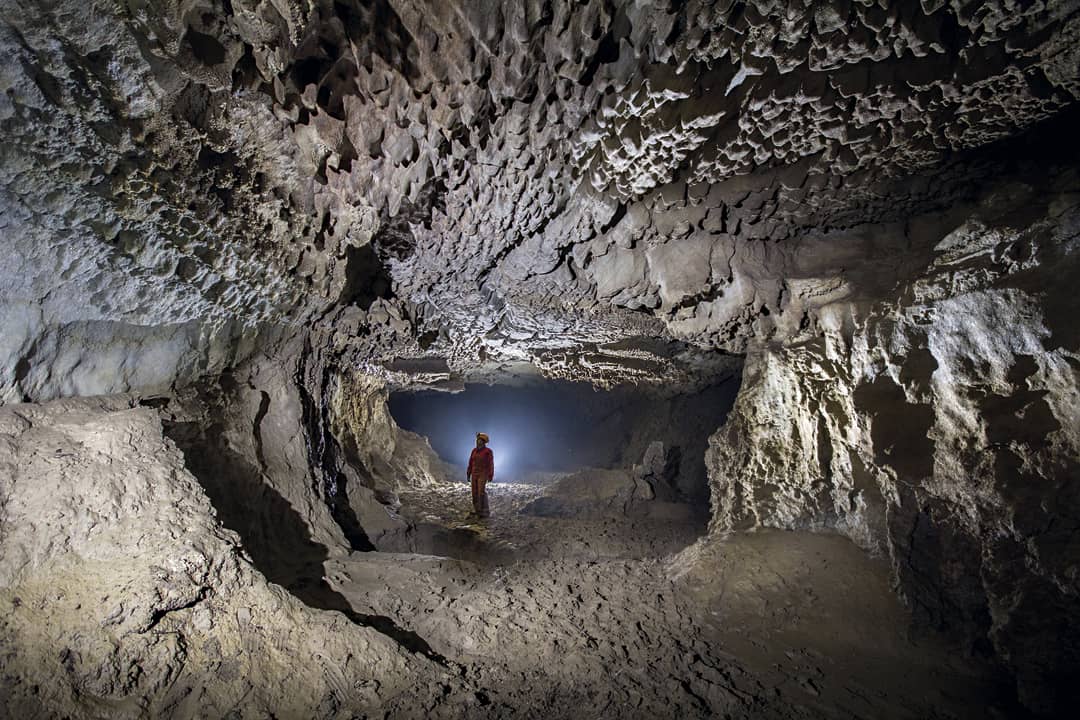
Conduit of the Ca’ Castellina Cave, Monte Mauro, Vena del Gesso Romagnola. Antigravitational pendant and vault channels (Photo: Piero Lucci).
Geological Period
Neogene (Miocene)
Main geological interest
Stratigraphy and sedimentology
Paleontology
Location
Emilia-Romagna Region, Italy
44°15’42” N, 11°37’46” E
Conduit of the Ca’ Castellina Cave, Monte Mauro, Vena del Gesso Romagnola. Antigravitational pendant and vault channels (Photo: Piero Lucci).
An outstanding witness of the Messinian mediterranean salinity crisis, hosting peculiar karst evolution processes and landforms.
The Vena del Gesso Romagnola is the only place in the entire Mediterranean basin where gypsum strata show the evidence of exposure with the development of ancient intra-Messinian karst features containing the world’s most important Late Miocene continental fauna.
The ancient karst phase was sealed by Pliocene sediments, a second phase started over 500 000 years ago and is still ongoing.
Here the discipline of evaporites speleology was born.
This is one of the component sites of the “Evaporitic Karst and Caves of Northern Apennines” included since 2023 September within the UNESCO World Heritage List (Decision 45 COM 8B.32).
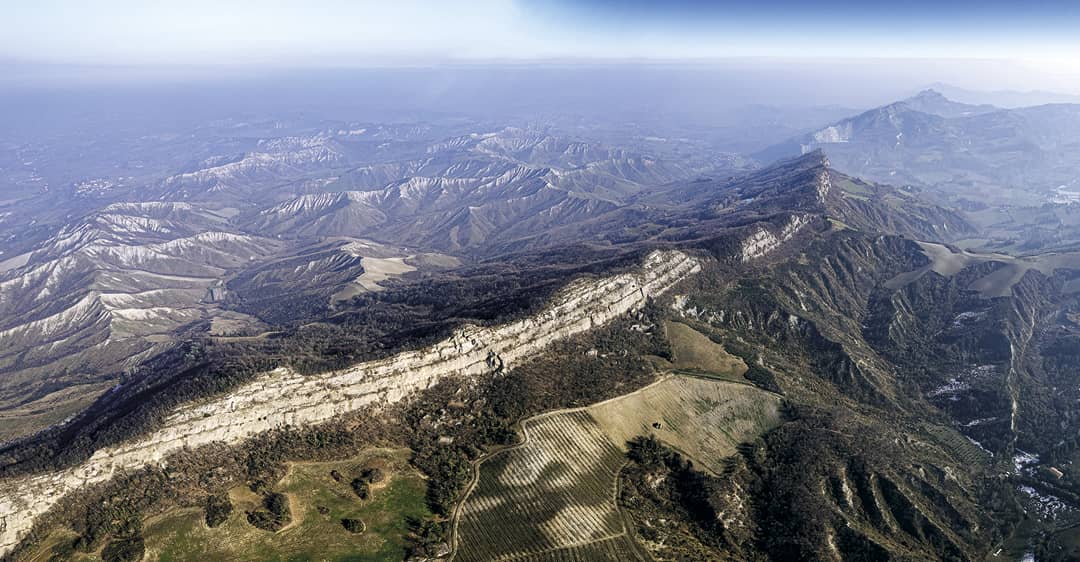
The gypsum ridge near Tossignano, Vena del Gesso Romagnola (Photo: Piero Lucci).
Geological description
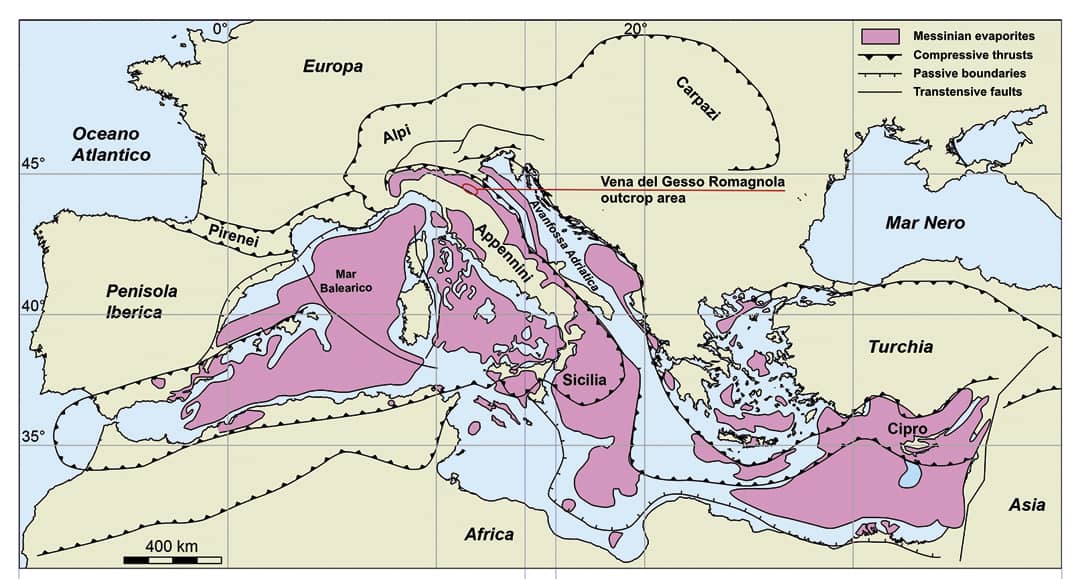
The geosite, belonging to Gessoso-Solfifera Fm., represents the spectacular result of the ecological catastrophe that struck the Mediterranean Sea (5,97 – 5,60 million years ago) and turned it into a giant salina, almost devoid of life (Roveri et al., 2014).
The gypsum cliffs is approximately 200 meters thick and consists of 16 thick gypsum beds separated by thin layers of clay. Each cycle was deposited over a period of 23 000 years and reflects the climatic effects (dry/wet periods) resulting from the precession of astronomical cycles (Lugli et al., 2010). Gypsum crystals show a very rare world-famous example of fossilization: the “spaghetti-like” filaments, representing possible cyanobacteria and/or sulfide-oxidizing bacteria (Panieri et al., 2010).
The landscape of the Vena del Gesso Romagnola is extensively shaped by superficial karst forms some of which of remarkable size like dolines, sinkholes and blind valleys; there are also other epigean phenomena due to rock dissolution and erosion such as “candles”, karrens, and “tumuli”. To date, over 200 cavities have been explored and mapped for a total length of over 40 km (Emilia-Romagna Region, 2022).
2000 years ago Romans used giant secondary transparent crystals (Lapis specularis) in windows building instead of glass (Ercolani et al., 2015).
Scientific research and tradition
This geosite has been studied since the 16th century and represents the best known karst area in the world. Many of modern scientific theories about evaporitic karst were born here.
The caves of the Messinian evaporites contain prehistoric archaeological remains, whose study allowed the birth of the Italian palaeoethnology.
The evaporites in the Mediterranean basin deposited during the Messinian salinity crisis (Stefano Lugli).
Reference
Emilia-Romagna Region (ed.) (2022) Evaporitic Karst and Caves of Northern Apennines. Nomination Dossier for Inscription on the UNESCO Natural World Heritage List. Bologna: REG / MITE, p. 222. Available at: https://www.ekcna.it/en.
Lugli, S. et al. (2010) “The Primary Lower Gypsum in the Mediterranean: A new facies interpretation for the first stage of the Messinian salinity crisis,” Palaeogeography, Palaeoclimatology, Palaeoecology, 297(1), pp. 83–99. Available at: https://doi.org/10.1016/j.palaeo.2010.07.017.
Panieri, G. et al. (2010) “Ribosomal RNA gene fragments from fossilized cyanobacteria identified in primary gypsum from the late Miocene, Italy,” Geobiology, 8(2), pp. 101–111. Available at: https://doi.org/10.1111/j.1472-4669.2009.00230.x.
Roveri, M. et al. (2014) “The Messinian Salinity Crisis: Past and future of a great challenge for marine sciences,” Marine Geology, 352, pp. 25–58. Available at: https://doi.org/10.1016/j.margeo.2014.02.002.