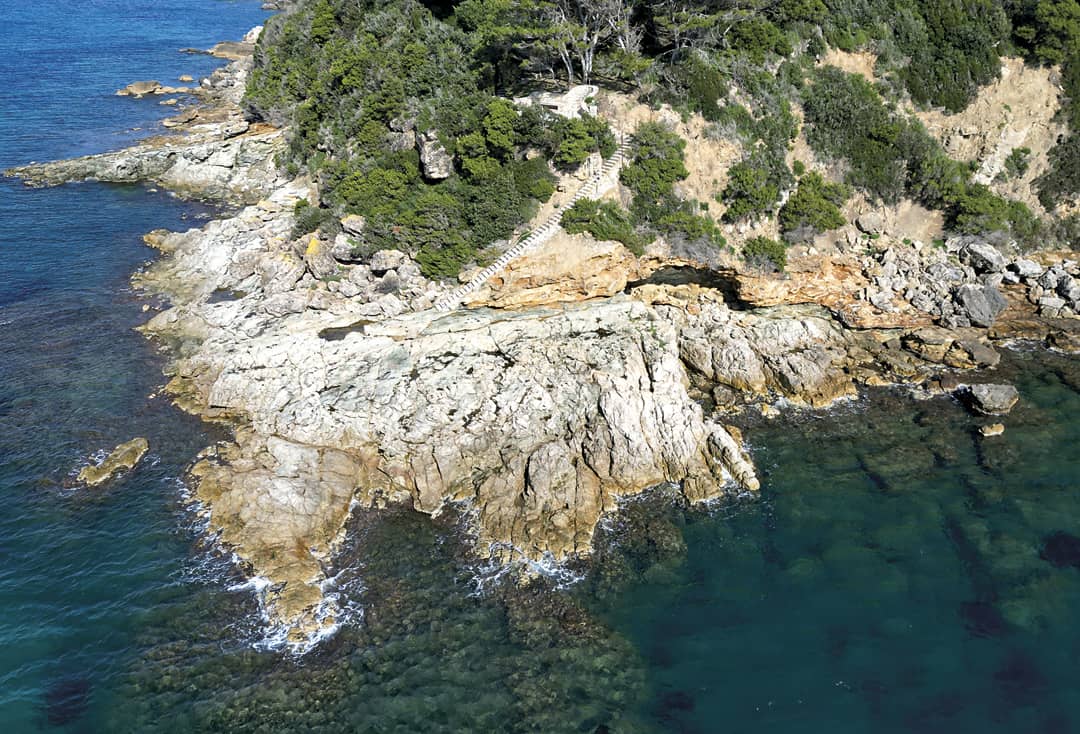
Panoramic view of the Zuccale Fault exposed at the Punta Zuccale promontory, showing the juxtaposition of Paleozoic Continental Units in the footwall and Mesozoic Oceanic Units in the hanging wall.
Geological Period
Neogene (Miocene) to Neogene (Pliocene)
Main geological interest
Tectonics
History of geosciences
Location
Tuscany (Tuscan Archipelago), Italy
42°45’08” N, 10°21’26” E
Panoramic view of the Zuccale Fault exposed at the Punta Zuccale promontory, showing the juxtaposition of Paleozoic Continental Units in the footwall and Mesozoic Oceanic Units in the hanging wall.
The best exposure of a crustal extensional shear zone in the western Mediterranean area.
In a nearly continuous exposure extending for several tens of kilometres, the Zuccale Fault offers a rare opportunity to study a crustal detachment that was active at mid- to upper-crustal levels during the opening of the northern Tyrrhenian Basin and was progressively exhumed over approximately 1 Ma. The entire exposure shows ductile fabrics overprinted by brittle structures. Evidence of syntectonic fluid flow is provided by the occurrence of hydrothermal minerals along the fault zone, which promoted strain softening. The Zuccale Fault therefore represents one of the best case studies to understanding fault nucleation and growth during extensional tectonics.
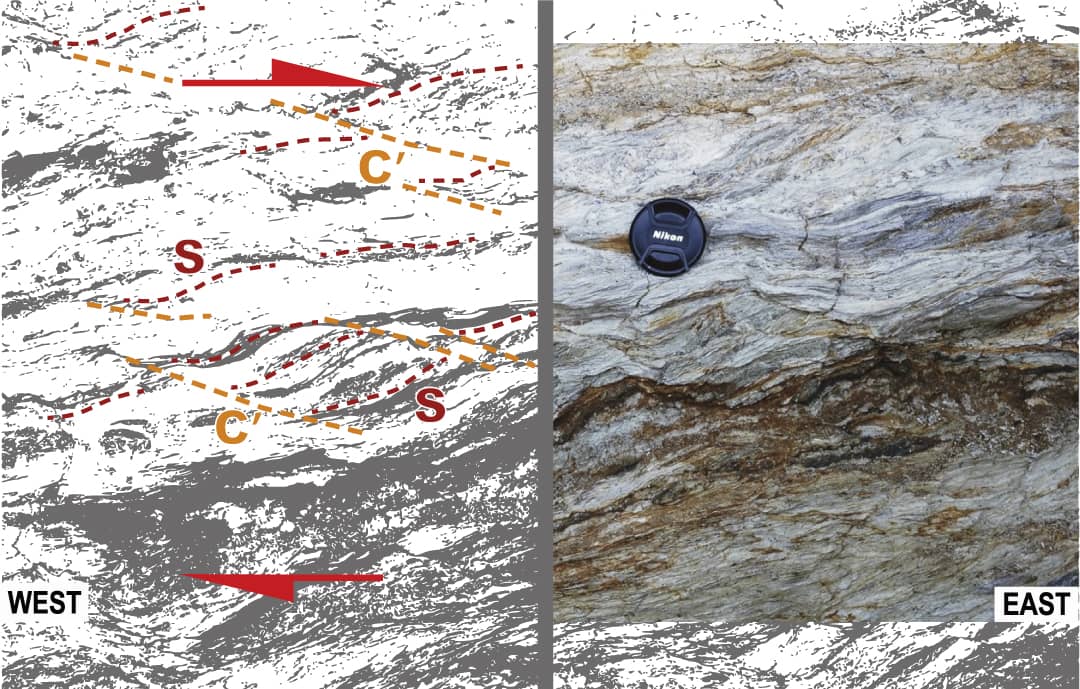
Sketch (on the left) of a redrawn photo (on the right) indicating top-to-the-east S-C’ structures developed within talc-tremolite-bearing phyllonite.
Geological description
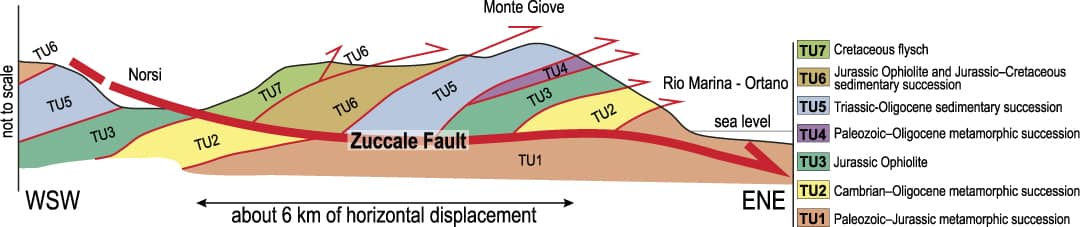
Since the Burdigalian, Neogene extensional tectonics in the Northern Apennines have driven the opening of the northern Tyrrhenian Basin. This process resulted in the formation of shear zones in response to a stretching exceeding 160%, which thinned the crust and the lithosphere down to 20 and 40 kilometres, respectively. The Zuccale low-angle normal fault, cropping out on the eastern Elba Island (Italy), is the best example of exhumed extensional shear zones associated with this geodynamic setting. This fault juxtaposes oceanic unit in the hanging wall with continental unit in the footwall, corresponding to the uppermost and lowermost nappes of the Northern Apennines, respectively. The fault zone exhibits a sub-horizontal attitude with a horizontal displacement of up to 6 kilometres and an average thickness of 3 metres. It contains a variety of well-exposed fault rocks, including phyllonite, cataclasite and fault gouge. A pervasive planar mylonitic fabric is characterized by west-dipping foliation, defined by neoformational phyllosilicates and amphiboles. The latter formed through synkinematic fluid infiltration, which promoted the development of talc-tremolite-bearing phyllonite, thereby weakening the shear zone. S-C-C’ fabrics were overprinted by cataclasite, with centimeter-thick gouge layers developed during fault exhumation. Slickensides and slickenfibers are associated with fine-grained foliated cataclasite and gouge.
Scientific research and tradition
The Zuccale Fault, the first sub-horizontal normal fault identified in the inner Northern Apennines, has attracted considerable scientific interest since the 1950s. It was extensively investigated in relation to Fe-ore mining activities. As a result, numerous studies have been devoted to its structural and petrological features.
Conceptual not-to-scale geological section showing the main Tectonic Units of continental and oceanic pertinence, separated by tectonic contacts and dissected by the Zuccale low-angle normal fault.
Reference
Collettini, C. et al. (2009) “Fault zone fabric and fault weakness,” Nature, 462(7275), pp. 907–910. Available at: https://doi.org/10.1038/nature08585.
Collettini, C. and Holdsworth, R.E. (2004) “Fault zone weakening and character of slip along low-angle normal faults: insights from the Zuccale fault, Elba, Italy,” Journal of the Geological Society, 161(6), pp. 1039–1051. Available at: https://doi.org/10.1144/0016-764903-179.
Duranti, S. et al. (1992) “Geological evolution and metamorphic petrology of the basal sequences of eastern Elba (complex II),” Acta Vulcanologica, 2, pp. 213–229.
Keller, J. and Pialli, G. (1990) “Tectonics of the Island of Elba: a reappraisal,” Bollettino Della Societa Geologica Italiana, 109, pp. 413–425.
Liotta, D. et al. (2015) “Coexistence of low-angle normal and high-angle strike- to oblique-slip faults during Late Miocene mineralization in eastern Elba Island (Italy),” Tectonophysics, 660, pp. 17–34. Available at: https://doi.org/10.1016/j.tecto.2015.06.025.
Smith, S.A.F., Holdsworth, R.E. and Collettini, C. (2011) “Interactions between low-angle normal faults and plutonism in the upper crust: Insights from the Island of Elba, Italy,” GSA Bulletin, 123(1–2), pp. 329–346. Available at: https://doi.org/10.1130/B30200.1.
Author(s)
Martina Zucchi.
Department of Earth and Geoenvironmental Sciences, University of Bari, Italy
Andrea Brogi.
Department of Earth and Geoenvironmental Sciences, University of Bari, Italy
Rodolfo Carosi.
Department of Earth Sciences, University of Turin, Italy
Salvatore Iaccarino.
Department of Earth Sciences, University of Turin, Italy
Domenico Liotta.
Department of Earth and Geoenvironmental Sciences, University of Bari, Italy
Chiara Montomoli.
Department of Earth Sciences, University of Turin, Italy