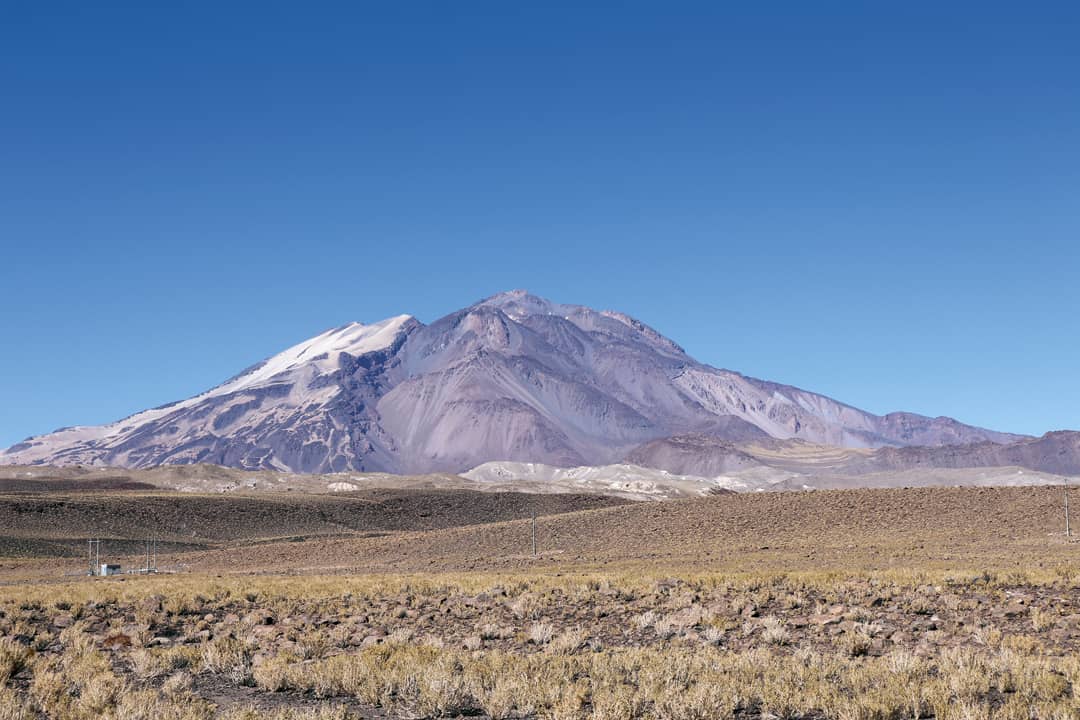
Panoramic photograph of Socompa edifice, showing the pre-collapse edifice, collapse scar, and post-collapse edifice. Viewed from northeast.
Geological Period
Quaternary (Holocene)
Main geological interest
Volcanology
Geomorphology and active geological processes
Location
South of Salar de Atacama, northern Chile, Chile
24°23’39” S, 68°14’41” W
Panoramic photograph of Socompa edifice, showing the pre-collapse edifice, collapse scar, and post-collapse edifice. Viewed from northeast.
One of the most spectacular and best-preserved volcanic debris-avalanche deposits worldwide, among the largest in continental arc settings.
The hyperarid climate of the Atacama Desert provides exceptional conditions for the preservation and exposure of the debris avalance deposit, making it an ideal setting for scientific research and education. The Socompa deposit is one of the most spectacular and best-preserved debris avalanche deposit on Earth and is one of the largest known volcanic avalanches in continental arc settings. The Socompa region was inhabited by the Lickan-antai (Atacameño) people, includes the active Socompa volcano, an aquifer (Monturaqui-Tilopozo-Negrillar), two monogenetic volcanic fields, and mining facilities.
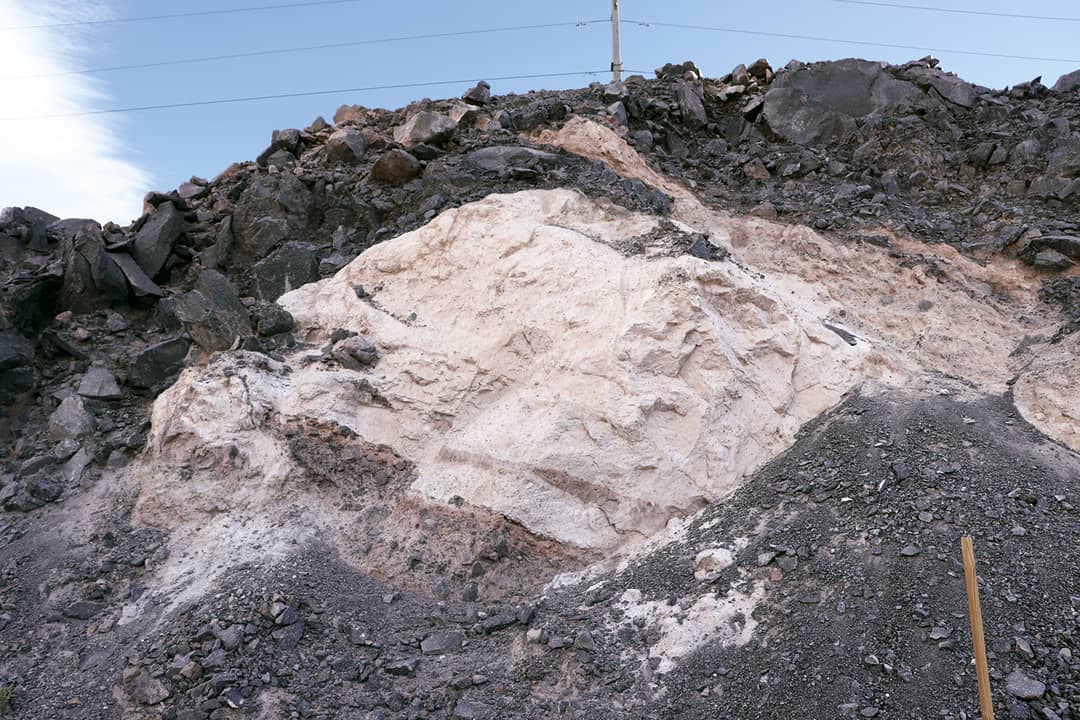
Section of the Socompa debris avalanche deposit, showing hummucks with faulted blocks incorporated from the substrate, breccia zone, and caothic blocks.
Geological description
Socompa is an active Holocene stratovolcano located in the southern segment of the Central Andes, south of the Salar de Atacama basin and straddling the Chile-Argentina border. Its edifice displays a conspicuous landslide scar open towards the NNW (Francis et al., 1985; Ramírez, 1988), produced by a sector collapse that occurred at 5.5-6.5 ka (Grosse et al., 2022). This collapse formed one of the largest known volcanic debris avalanche deposits in continental arc settings on Earth. It reached a distance of 40 kilometers, has an average thickness of 50 meters, and covers an area of 500 square kilometers (van Wyk de Vries et al., 2001; Grosse et al., 2022). The deposit partially covers and separates two monogenetic volcanic fields (Aguirre et al., 2026). The collapse involved (i) the debris avalanche deposit with ridges and elongated hummocks, (ii) massive kilometer-scale slide blocks (torevas) lodged at the mouth of the collapse scar, and (iii) detached blocks that remained in the upper part of the scar (Wadge et al., 1995; van Wyk de Vries et al., 2001). The avalanche deposit is composed of volcanic material from the edifice and of ignimbrite and sedimentary deposits from the underlying substrate (Wadge et al. 1995; van Wyk de Vries et al., 2001). The estimated volume is 25.7 cubic kilometers (Wadge et al., 1995), substrate material composes 80% of the volume, and edifice material composed 20% (van Wyk de Vries et al., 2001).
Scientific research and tradition
The Socompa deposit was initially considered a nuée ardente or ignimbrite associated with a collapse caldera (Deruelle, 1978). It was later recognized as a debris avalanche deposit (Francis et al., 1985; van Wyk de Vries et al., 2001; Grosse et al., 2022) and subsequently studied in detail in several works focusing on sedimentology, structural geology, geochronology, hydrology, geomorphology, numerical and analog modeling, and petrology of monogenetic and polygenetic systems.
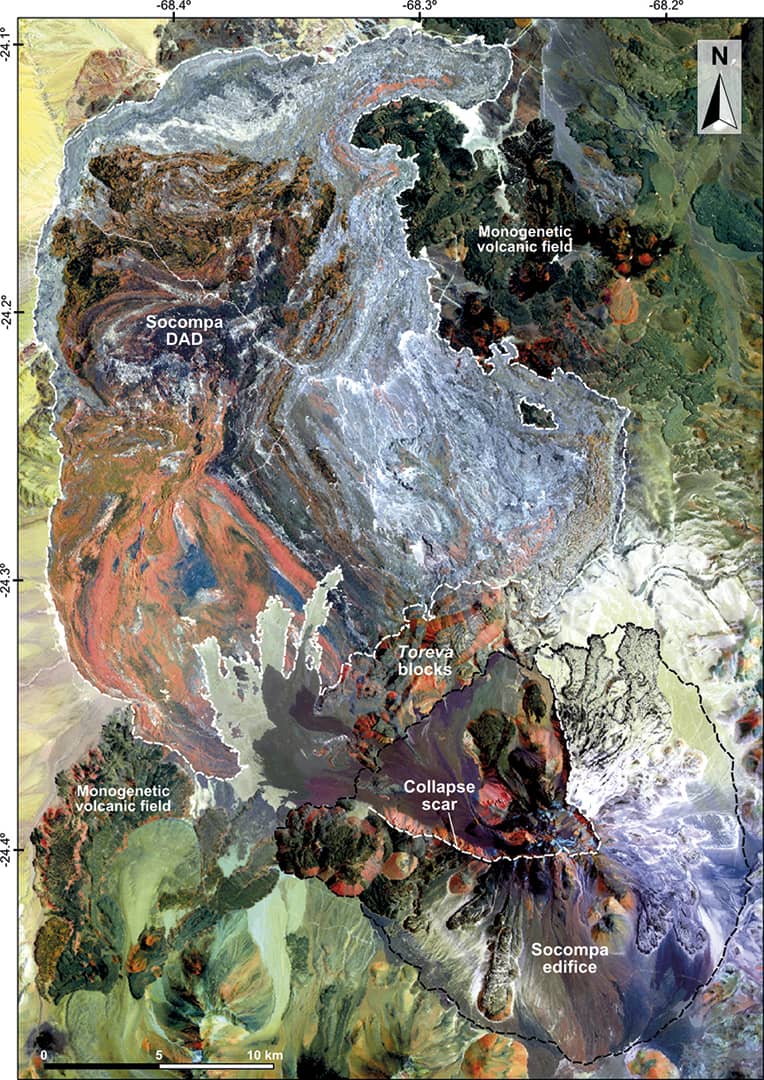
Landsat7 image of Socompa volcano and its debris avalanche deposit, showing collapse scar and avalanche deposit outlines, toreva-blocks’s location, and other possible post-collapse features.
Reference
Aguirre, F. et al. (2026) “Insight into building a classification sequence for defining monogenetic volcanic field allocations: The case of Negros de Aras and El Negrillar in northern Chile,” Geology. Available at: https://doi.org/10.1130/G54086.1.
Deruelle, B. (1978) “The Negros de Aras Nuée Ardente deposits: a cataclysmic eruption of Socompa volcano (Andes of Atacama, Chile),” Bulletin Volcanologique, 41(3), pp. 175–186. Available at: https://doi.org/10.1007/BF02597221.
Grosse, P. et al. (2022) “Holocene collapse of Socompa volcano and pre- and post-collapse growth rates constrained by multi-system geochronology,” Bulletin of Volcanology, 84(9), p. 85. Available at: https://doi.org/10.1007/s00445-022-01594-0.
Wadge, G., Francis, P.W. and Ramirez, C.F. (1995) “The Socompa collapse and avalanche event,” Journal of Volcanology and Geothermal Research, 66(1), pp. 309–336. Available at: https://doi.org/10.1016/0377-0273(94)00083-S.
van Wyk de Vries, B. et al. (2001) “A gravitational spreading origin for the Socompa debris avalanche,” Journal of Volcanology and Geothermal Research, 105(3), pp. 225–247. Available at: https://doi.org/10.1016/S0377-0273(00)00252-3.
Author(s)
Gabriel Ureta.
Universidad Andrés Bello, Santiago (Chile); Millennium Institute on Volcanic Risk Research – Ckelar Volcanoes (Chile); Centro de Investigación para la Gestión Integrada del Riesgo de Desastres (CIGIDEN), Chile
Pablo Grosse.
Consejo Nacional de Investigaciones Científicas y Técnicas (CONICET), Argentina; Fundación Miguel Lillo (Argentina)
José Pablo Sepúlveda.
Universidad Andrés Bello, Viña del Mar (Chile); Millennium Institute on Volcanic Risk Research – Ckelar Volcanoes (Chile)
Felipe Aguilera.
Universidad Andrés Bello, Santiago (Chile); Millennium Institute on Volcanic Risk Research – Ckelar Volcanoes (Chile)
Gary Michelfelder.
Department of Geography, Geology and Planning, Missouri State University (USA)
Ivana Torres.
University of Missouri Kansas City (USA); Millennium Institute on Volcanic Risk Research – Ckelar Volcanoes (Chile)
Rodrigo González.
Universidad Andrés Bello, Santiago (Chile); Millennium Institute on Volcanic Risk Research – Ckelar Volcanoes (Chile)
Francisca Aguirre.
Universidad Católica del Norte (Chile); Millennium Institute on Volcanic Risk Research – Ckelar Volcanoes (Chile)
Alfredo Esquivel.
Millennium Institute on Volcanic Risk Research – Ckelar Volcanoes (Chile)