Welded block-and-ash pyroclastic flow deposit at Cerro Bravo Volcano
Colombia
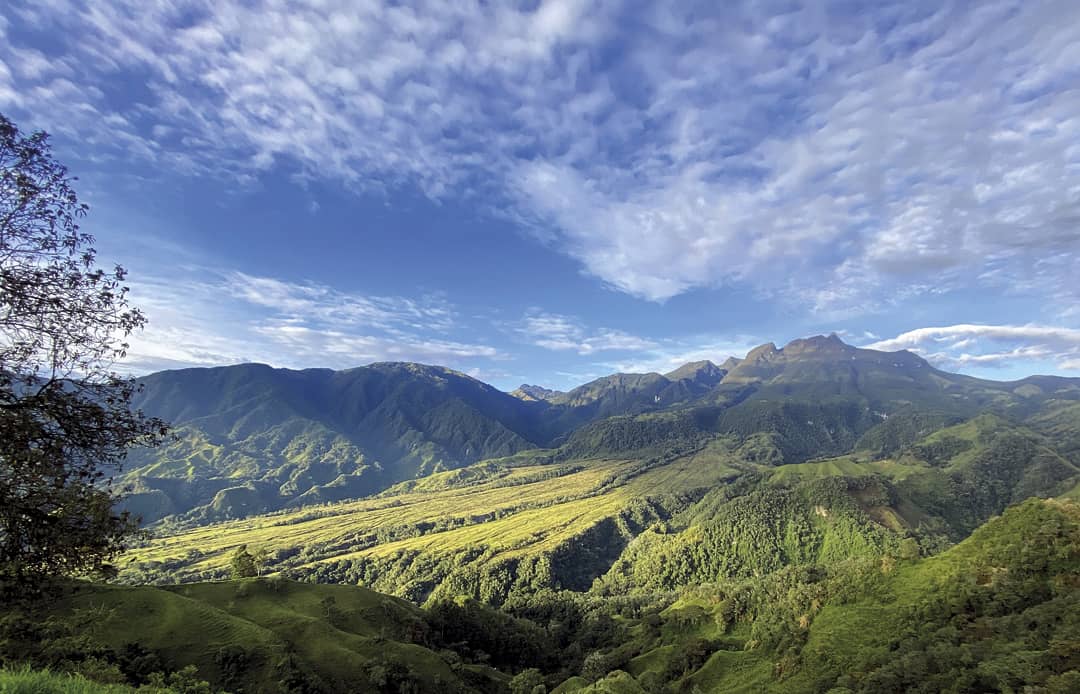
Alluvial fan-like geoform linked to pyroclastic density currents formed by the Cerro Bravo volcano eruptions. The welded deposit is the base of the geoform.
Geological Period
Quaternary (Holocene)
Main geological interest
Volcanology
Geomorphology and active geological processes
Location
Northern Andes, Colombia
5°5’15” N, 75°15’08” W
Alluvial fan-like geoform linked to pyroclastic density currents formed by the Cerro Bravo volcano eruptions. The welded deposit is the base of the geoform.
One of the exceptionally rare welded block-and-ash pyroclastic flow deposit on Earth.
Concentrated pyroclastic density currents originate from explosive eruptions and flow under the influence of gravity due to their relative densities. The resultant deposits are also known as pumice flow or block-and-ash flow deposits. Although pumice deposits are often welded, block-and-ash deposits do not usually undergo welding because of their relatively lower emplacement temperatures (Michol et al., 2008). These temperatures often remain below the glass transition temperature threshold, which is the value at which the density current deposits experience sintering and cause vitreous fragments to behave like a viscous material (Grunder et al., 2005). Therefore, welded block-and-ash pyroclastic flow deposits are exceptionally rare on Earth.
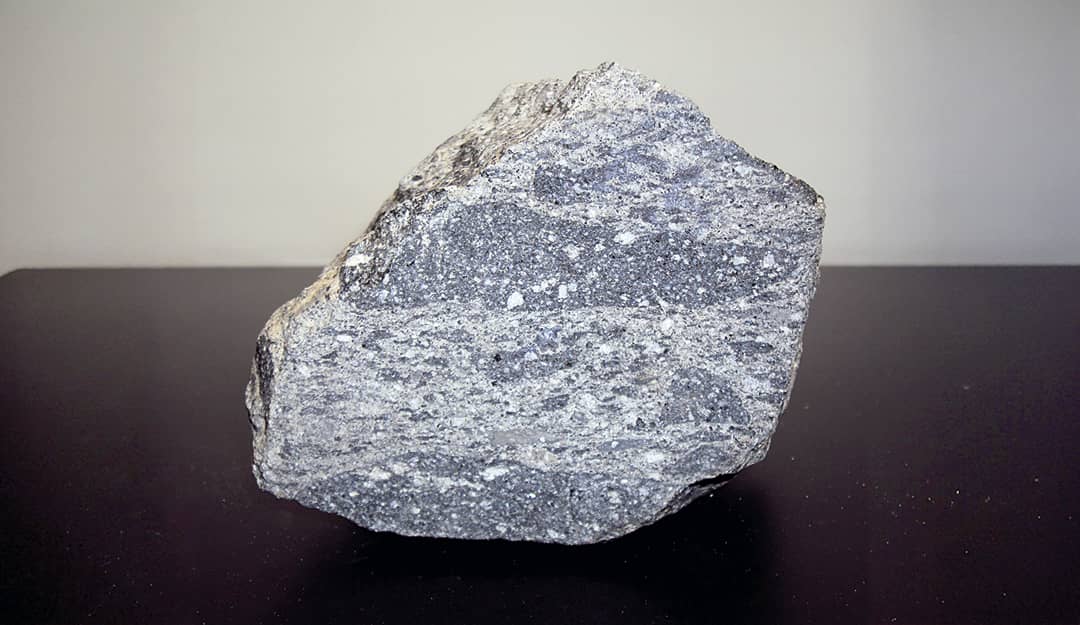
Hand sample from the welded block-and-ash pyroclastic flow deposit. Note the fiammes formed by the dark volcanic lithics. (The hand sample measures approximately 11 cm in length from side to side).
Geological description
Bracketed between 7 and 2.9 ka, a high-temperature (~600 °C) pyroclastic density current was emplaced as a 50 meter thick deposit within a river valley along a mountainous terrain in the northern Andes. During emplacement, the hot flow allowed upward water diffusion associated with the wet ground linked to the rainy and humid highlands located at nearly 3500 meters above sea level. This process lowered the glass transition temperature of the deposit within 5-6 days, promoting compaction and reducing its thickness by 7-15 meters. As a result, juvenile volcanic lithics, which were incorporated into the flow after an eruptive event destroyed a growing endogenous dome, flattened into fiammes. These conditions led to the formation of an uncommon welded block-and-ash pyroclastic flow deposit with a eutaxitic texture. The fiammes consist of dark volcanic lithics; light and spheric fragments represent incorporated preexisting cold fragments. This deposit is the base of a scenic 7 square kilometer alluvial fan-like geoform shaped by eruptions of Cerro Bravo volcano, one of the most explosive volcanoes in central Colombia. The geoform is confined between Triassic metamorphic and Paleocene plutonic rocks. Above the welded deposit are two current pyroclastic deposits that formed less than 2.4 ka ago.
Scientific research and tradition
This deposit had been previously described as lithified or hardening (Lescinsky, 1990; SGC, 1991). However, its induration was never considered to be related to welding. It was not until 2016 that the deposit was recognised as welded, triggering scientific interest. The deposit was studied by Alarcón et al. (2020) and has been visited in the eighth editions of the International Volcanology Course, Colombia (https://curvolcolombia.wordpress.com/).
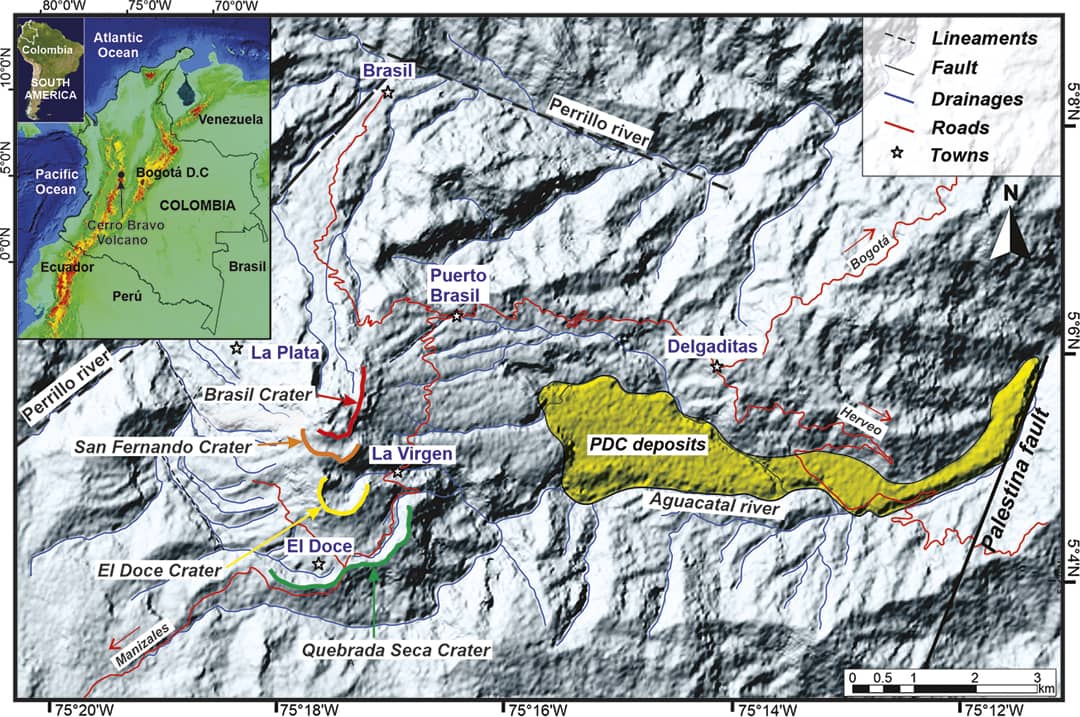
Cerro Bravo volcano area. The yellow polygon highlights the pyroclastic density current deposits. Modified from Bustos et al. (2023).
Reference
Alarcón, E. et al. (2020) “Evidence for welding of a block and ash pyroclastic flow deposit: the case of Cerro Bravo Volcano, Colombia,” Bulletin of Volcanology, 82(1), p. 1-14. Available at: https://doi.org/10.1007/s00445-019-1334-5.
Bustos, E. et al. (2023) “Volcanic evolution through geomorphological mapping: A case study of Cerro Bravo volcano (Colombia),” Journal of South American Earth Sciences, 128, p. 104472. Available at: https://doi.org/10.1016/j.jsames.2023.104472.
Grunder, A.L., Laporte, D. and Druitt, T.H. (2005) “Experimental and textural investigation of welding: effects of compaction, sintering, and vapor-phase crystallization in the rhyolitic Rattlesnake Tuff,” Journal of Volcanology and Geothermal Research, 142(1), pp. 89–104. Available at: https://doi.org/10.1016/j.jvolgeores.2004.10.018.
Lescinsky, D. (1990) Geology, volcanology, and petrology of Cerro Bravo, a young, dactic, stratovolcano in West-Central Colombia. MSc Thesis. Lousiana State University. USA. 244 p. Available at: https://doi.org/10.31390/gradschool_disstheses.8232.
Michol, K.A., Russell, J.K. and Andrews, G.D.M. (2008) “Welded block and ash flow deposits from Mount Meager, British Columbia, Canada,” Journal of Volcanology and Geothermal Research, 169(3), pp. 121–144. Available at: https://doi.org/10.1016/j.jvolgeores.2007.08.010.
SGC (Servicio Geológico Colombiano) (1991) Mapa preliminar de amenaza volcánica del volcán Cerro Bravo. Instituto de Investigación en Geociencias Minería y Química. 130 p.
Author(s)
Hugo Murcia.
Universidad de Caldas, Colombia
Marcelo Arnosio.
Universidad Nacional de Salta, Argentina
Susana Osorio.
Universidad de Caldas, Colombia
Alvaro Botero.
Universidad de Caldas, Colombia
Laura Sánchez.
Universidad de Caldas, Colombia
Károly Németh.
Saudi Geological Survey, Kingdom of Saudi Arabia