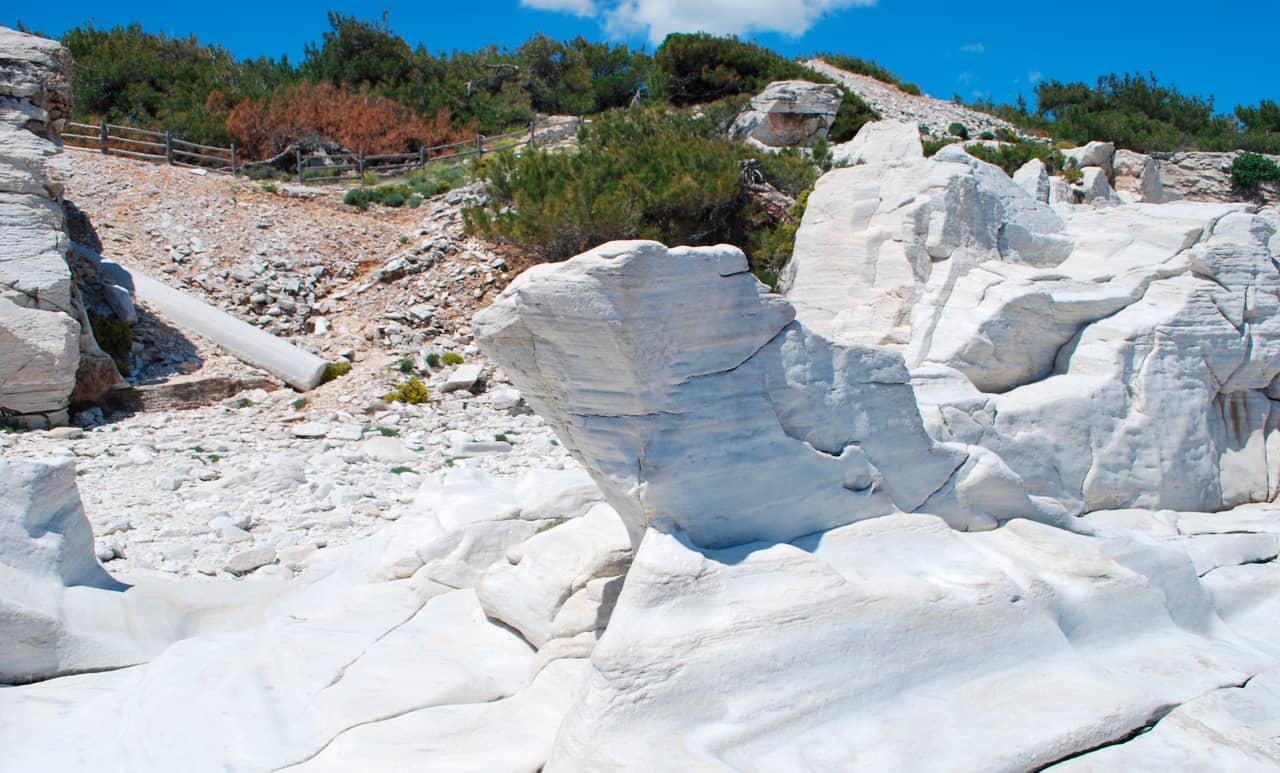
Alyki marble appears as medium to coarse crystalline white to white-grey beds, locally exhibiting banding enriched in organic matter or silicate minerals, with minor dolomite content. Petrographically, it consists of approximately 97% calcite and displays a polygonal crystaloblastic texture with interlocking grain boundaries, triple junctions, polysynthetic twinning and rhombohedral cleavage.
Aesthetics
Bright white to white-grey coloration, medium to coarse crystalline texture, high durability and suitability for sculptural and architectural applications.
Geological settings
It is part of the Pangeon Unit/Thracia Terrane, comprising Permo-Carboniferous orthogneisses overlain by massive marbles. It correlates with Triassic–Jurassic carbonate sequences characterized by the upper‑greenschist metamorphic phase and includes marbles interlayered with mica schists, gneisses and amphibolites.
Location
Alyki marble occurs in SE Thassos within the Astrida thrust slice of the Lower Tectonic Unit of the Rhodope Massif. Ancient quarries at Alyki and Cape Fanari preserve extensive evidence of extraction both on land and underwater.
Ancient quarries in Alyki 2.
Alyki Marble – A culturally significant marble of the Eastern Mediterranean.
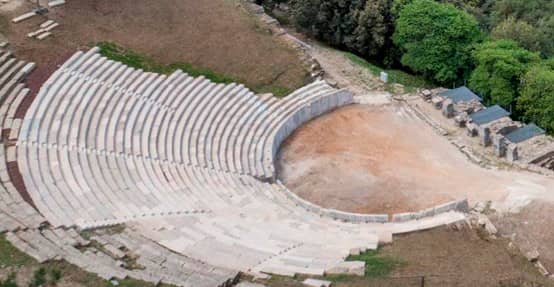
Alyki Marble played a major role in Classical, Hellenistic, Roman, and Early Christian architecture. It was widely distributed across the Mediterranean and identified in monuments such as the Kasta Tomb in Amphipolis, the ancient theatre of Thassos, the Early Christian basilicas of Alyki, major structures in Samothrace (including the Sanctuary of the Great Gods), and Roman sarcophagi from Thessaloniki. It was commonly used in façades, columns, capitals, door and window frames, staircases, public fountains and wells, reflecting its value as a high‑quality local building material. The combination of aesthetic excellence, workability, durability and historical prestige has ensured that Alyki marble remains a culturally significant stone.
Basilicas in Alyki Thassos 2.
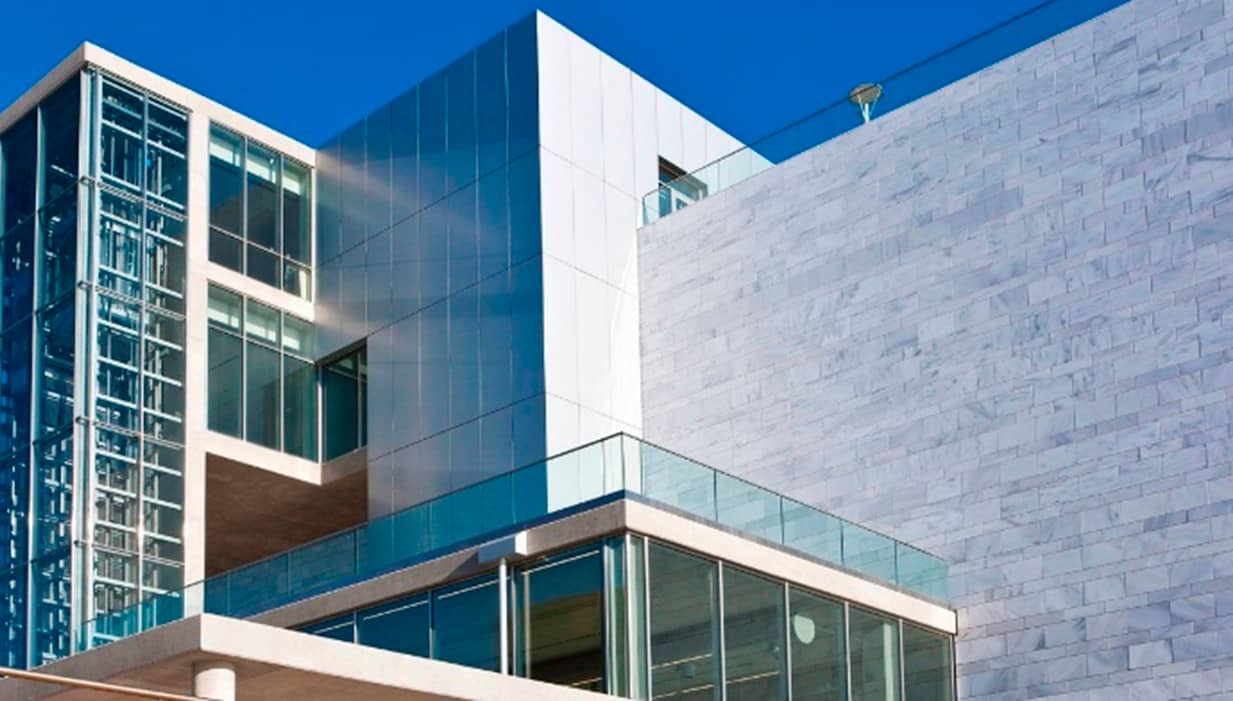
Thessaloniki Concert Hall.
Main publication
Barbin et al. (2015); Maniatis et al. (2010); Maniatis et al. (2009).