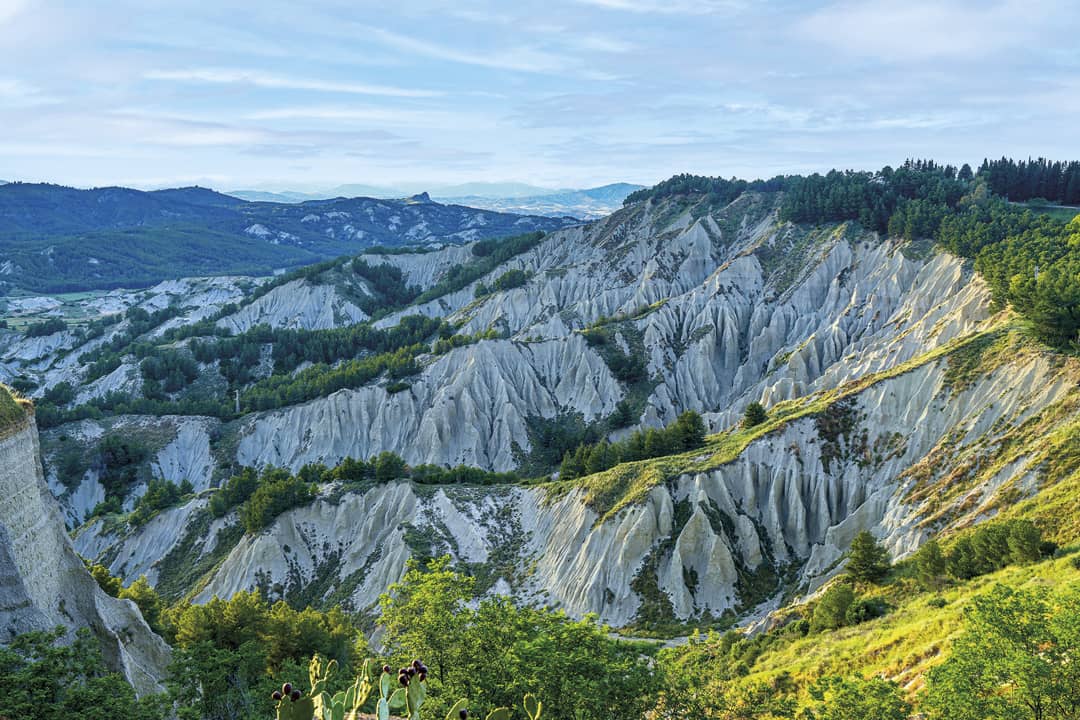
Panoramic view of the Montalbano Jonico badlands showing the upper portion of the 450 m thick marine succession, with the interbedded tephra layers V5-V9.
Geological Period
Quaternary (Lower-Middle Pleistocene)
Main geological interest
Stratigraphy and sedimentology
Paleontology
Location
Basilicata, Italy
40°17’30” N, 16°33’11” E
Panoramic view of the Montalbano Jonico badlands showing the upper portion of the 450 m thick marine succession, with the interbedded tephra layers V5-V9.
The most studied and detailed paleoclimatic record across the Lower-Middle Pleistocene boundary.
The Montalbano Jonico section (MJ) is a unique exposure of marine astronomically-tuned succession deposited between 1.24 and 0.64 Ma. Located in the “Special Natural Reserve of the Montalbano Jonico badlands”, it represents an exceptional marine sedimentary archive of world-wide significance (Nomade et al., 2019; Marino et al., 2024). MJ includes the Ideale section (IS), which provides key evidences of the Earth’s climate history across the Lower-Middle Pleistocene transition. The IS has been designated as a Standard Auxiliary Boundary Stratotype (SABS) for the Middle Pleistocene Subseries (Subcommission on Quaternary Stratigraphy, July 9, 2023; Marino et al., 2024).
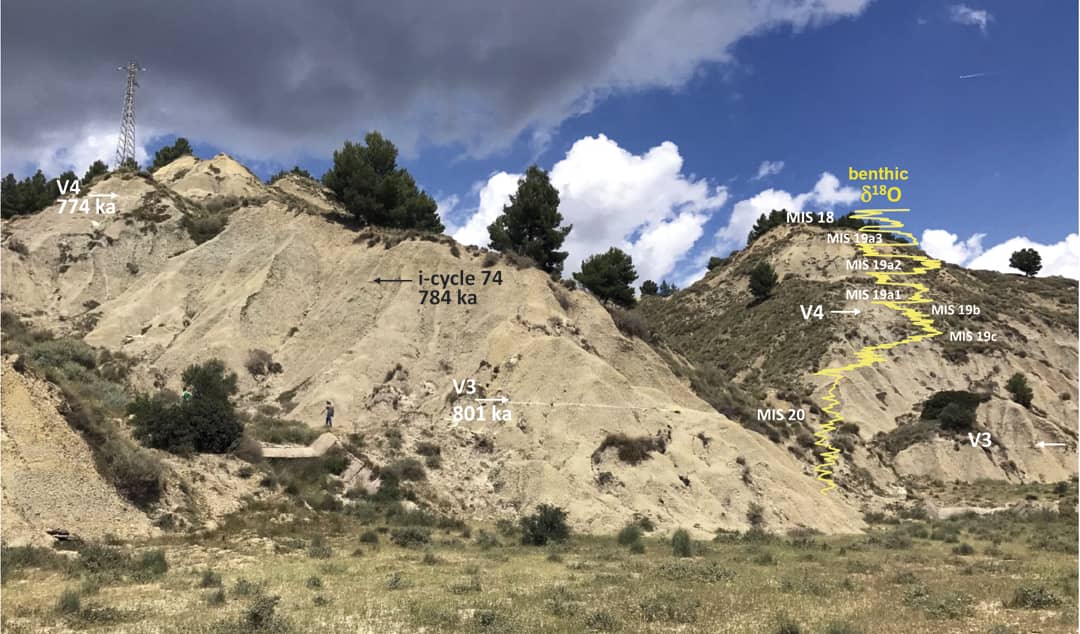
Ideale section outcrop showing tephra layers V3 and V4, their 40Ar/39Ar ages, sapropel i-cycle 74, oxygen isotope record, and Marine Isotope Stages (MIS) and sub-stages.
Geological description
The Montalbano Jonico clayey marine succession (MJ) is part of the spectacular landscape exposed in the Special Nature Reserve of Montalbano Jonico badlands (Basilicata region, Southern Italy) and represents the shelf-slope depositional environments of the Pliocene-Pleistocene Southern Apennines Foredeep. The MJ is 450m thick, includes nine tephra (V1-V9), and six sapropel layers (Ciaranfi et al., 2010; Petrosino et al., 2015; Maiorano et al., 2016). The section contains a rich documentation of well-preserved, diversified marine micro and macro-invertebrate, and terrestrial microfossils. The multi-proxy dataset provides evidence that the succession extends from about 1.24 to 0.64 Ma, covering numerous glacial-interglacial cycles. The MJ includes the “Ideale section” (IS), one of the best exposures of marine sedimentary records encompassing the Lower-Middle Pleistocene boundary. Based on high-resolution multiproxy analyses (oxygen and carbon isotopes, alkenone-SST, pollen, calcareous plankton, micro- and macro-benthic invertebrates), precise 40Ar/39Ar ages of two tephra layers, and on estimation of the atmospheric 10Be overproduction associated with the Matuyama-Brunhes boundary (Simon et al., 2017), the IS represents a remarkable and chronologically well-constrained record of the paleoclimate evolution across the Lower-Middle Pleistocene transition. The IS has been designated as the Standard Auxiliary Boundary Stratotype (SABS) for the Middle Pleistocene Subseries (Marino et al., 2024).
Scientific research and tradition
The MJ has been the subject of a number of international scientific papers since 1994 and is an extraordinary example of integrated stratigraphic research. MJ-badlands are visited by scientists from all over the world and are of interest for geologists, students and visitors to learn Earth climate history.
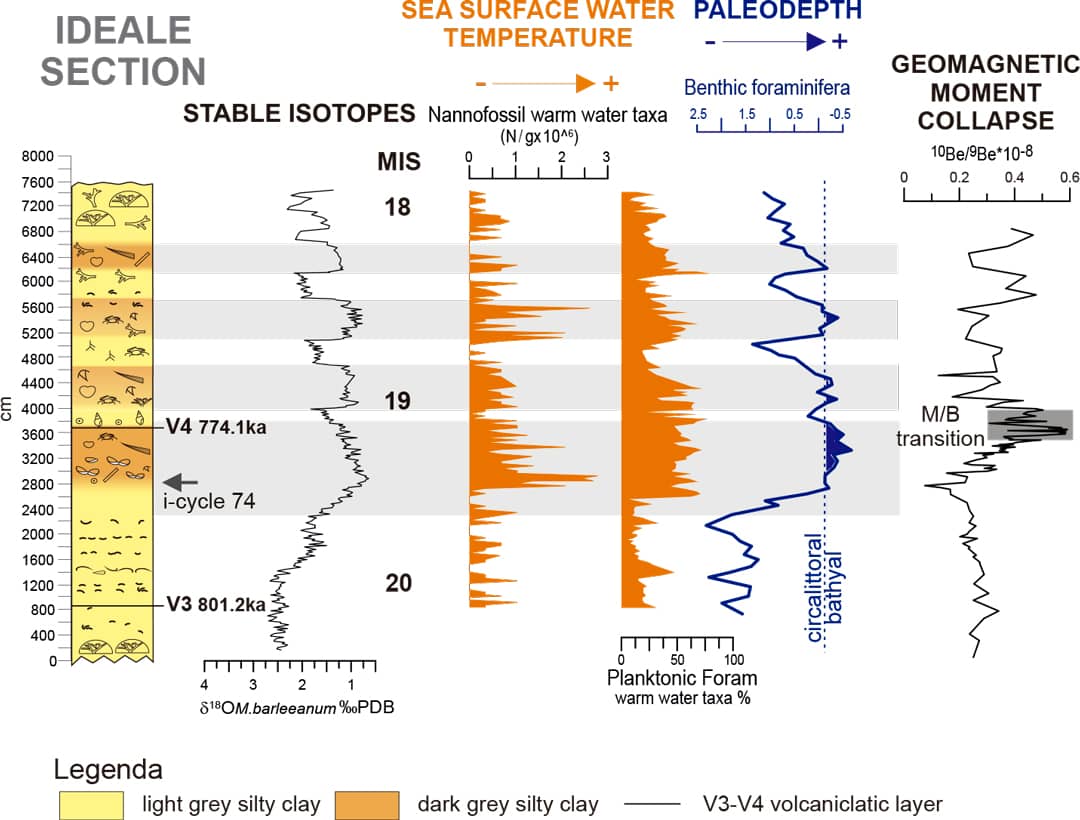
Main strati-graphic and paleoenvironmental features of the Ideale section.
Reference
Ciaranfi, N. et al. (2010) “Integrated stratigraphy and astronomical tuning of lower-middle Pleistocene Montalbano Jonico section (southern Italy),” Quaternary International, 219, pp. 109–120. Available at: https://doi.org/10.1016/j.quaint.2009.10.027.
Maiorano, P. et al. (2016) “Climate signatures through Marine Isotope Stage 19 in the Montalbano Jonico section (Southern Italy): A land–sea perspective,” Palaeogeography, Palaeoclimatology, Palaeoecology, 461, pp. 341–361. Available at: https://doi.org/10.1016/j.palaeo.2016.08.029.
Marino, M. et al. (2024) “The Ideale section at Montalbano Jonico (southern Italy): a Standard Auxiliary Boundary Stratotype (SABS) for the Middle Pleistocene Subseries of the Quaternary System,” Episodes Journal of International Geoscience, 47(1), pp. 121–146. Available at: https://doi.org/10.18814/epiiugs/2023/023022.
Nomade, S. et al. (2019) “High-resolution foraminifer stable isotope record of MIS 19 at Montalbano Jonico, southern Italy: A window into Mediterranean climatic variability during a low-eccentricity interglacial,” Quaternary Science Reviews, 205, pp. 106–125. Available at: https://doi.org/10.1016/j.quascirev.2018.12.008.
Petrosino, P. et al. (2015) “The Montalbano Jonico marine succession: An archive for distal tephra layers at the Early–Middle Pleistocene boundary in southern Italy,” Quaternary International, 383, pp. 89–103. Available at: https://doi.org/10.1016/j.quaint.2014.10.049.
Simon, Q. et al. (2017) “Authigenic 10Be/9Be ratio signature of the Matuyama–Brunhes boundary in the Montalbano Jonico marine succession,” Earth and Planetary Science Letters, 460, pp. 255–267. Available at: https://doi.org/10.1016/j.epsl.2016.11.052.
Author(s)
Maria Marino.
Dipartimento di Scienze della Terra e Geoambientali, Università degli Studi di Bari Italy
Patrizia Maiorano.
Dipartimento di Scienze della Terra e Geoambientali, Università degli Studi di Bari Italy
Angela Girone.
Dipartimento di Scienze della Terra e Geoambientali, Università degli Studi di Bari Italy
Salvatore Gallicchio.
Dipartimento di Scienze della Terra e Geoambientali, Università degli Studi di Bari Italy
Neri Ciaranfi.
Dipartimento di Scienze della Terra e Geoambientali, Università degli Studi di Bari Italy