One of the world's oldest, largest, best-preserved, and most economically significant impact structures.
The Sudbury Impact Structure is a global reference and one of the jewels of planetary geoscience due to the abundance, degree of preservation, and quality of exposures. In the 1970s, NASA conducted field exercises for Apollo 16 and 17 astronauts because of the similarities with lunar impact features. Over the past 140 years, it has been the premiere natural research and educational laboratory for understanding impact-related shock-metamorphic, contact-metamorphic, and igneous processes. It is home to Canada’s largest mining camp that follows more than a century of mining activities, and it continues to contribute to advance our knowledge of Ni-Cu-PGE deposits worldwide.
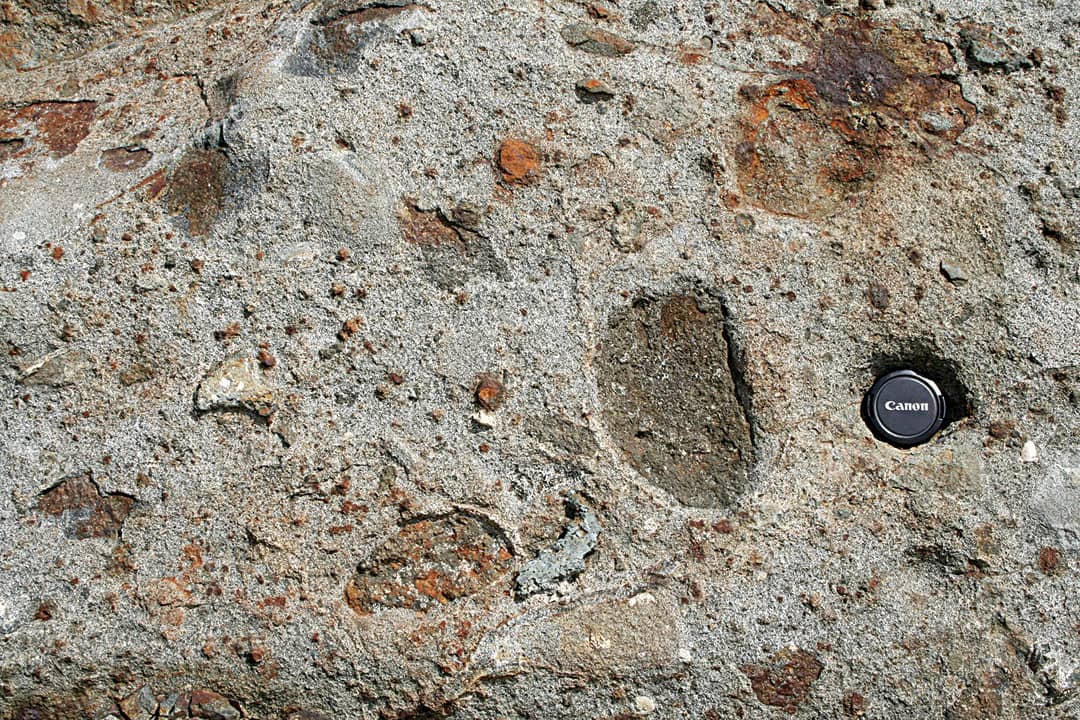
Magmatic breccia containing anteliths, local xenoliths, and exotic mid-crustal xenoliths in a matrix of norite and Fe-Ni-Cu sulfides, Whistle Embayment, Sudbury (photo: CM Lesher).
Geological description
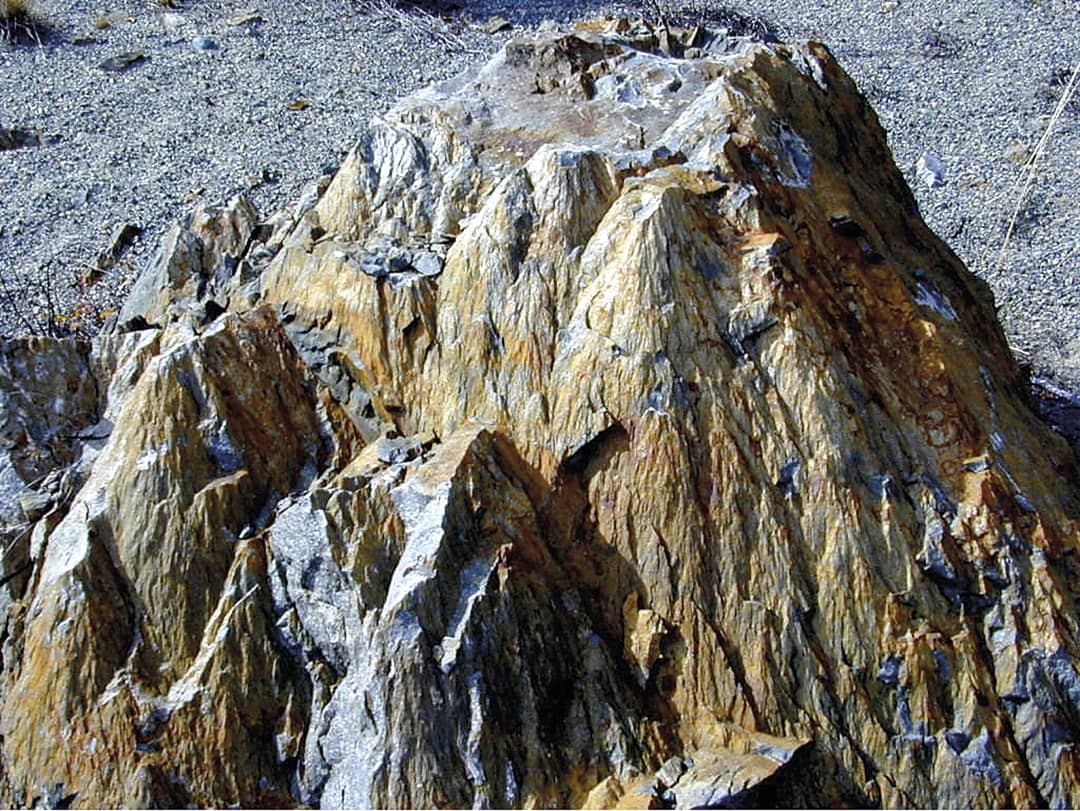
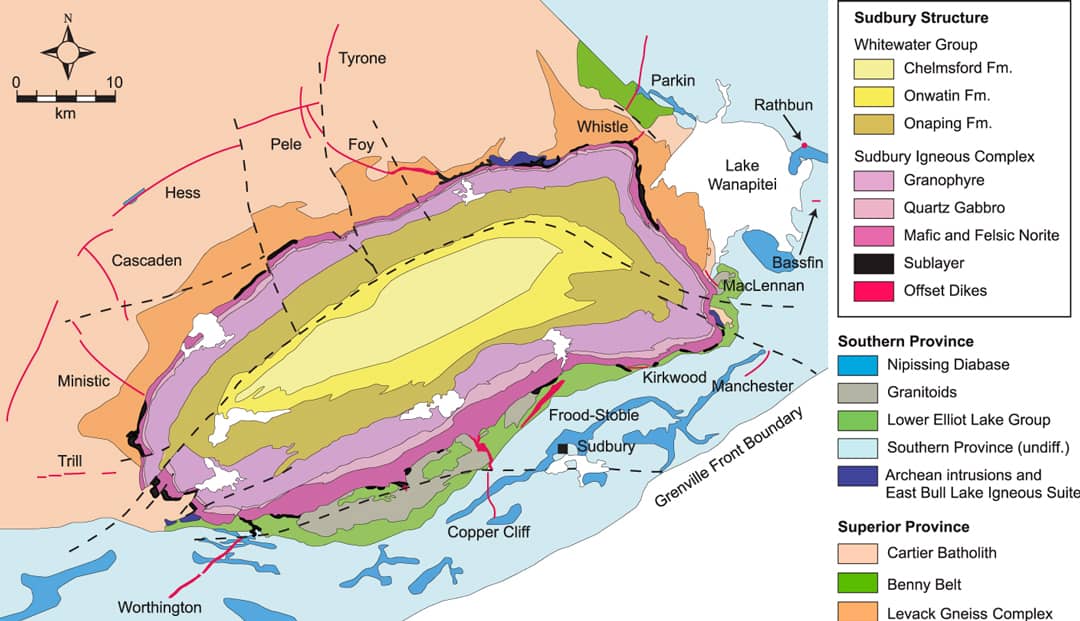
The 1849 Ma Sudbury Structure has a diameter of 260 kilometers and is one of the world’s oldest, largest, best-exposed, best-preserved, and best-studied impact sites, containing one of the world’s largest magmatic Ni-Cu-PGE accumulations (e.g., Dietz, 1964; Pye et al., 1984; Grieve and Therriault, 2000; Lesher and Thurston, 2002; Spray et al., 2004; Lightfoot, 2017). It contains spectacular glacially polished and mechanically and hydraulically cleaned exposures of: 1) impact-shocked and -brecciated target rocks such as pseudotachylite breccia, shatter cones, shock isotropism, and high-P mineral phases; 2) the world’s largest (60 x 30 x 2-5 kilometers) preserved differentiated impact melt sheet composed of mafic norite\felsic norite\gabbro\granophyric granite; 3) associated multi-phase radial and concentric dikes extending at least 20 kilometers from the contact; 4) marginal magmatic and anatectic breccias; and 5) a thick (1.2 kilometer) sequence of overlying fallback\suevite\phreatic breccias and basin-fill sedimentary rocks. Ni-Cu-PGE mineralization formed by incorporation of sulfides from the target rocks with no apparent contribution from the vapourized impactor, and it occurs in embayments in marginal breccias, in proximal footwall veins, and in associated dikes. The structure was tectonized during several orogenic events, but many parts are not penetratively deformed, and the tectonism preserved much of the melt sheet and exposed different levels of the structure for study.
Scientific research and tradition
Sudbury is one of the most intensively-studied impact sites on Earth (more than 72,000 Google Scholar citations). It has been the topic of several books and journal special issues, and it is regularly visited by researchers who continue to make new discoveries that have applications to other impact sites and other scientific disciplines.
Simplified geological map of the Sudbury Structure (modified from Lightfoot, 2017).
Reference
Dietz, R.S. (1964) “Sudbury Structure as an Astrobleme,” The Journal of Geology, 72(4), pp. 412–434. Available at: https://doi.org/10.1086/626999.
Grieve, R. and Therriault, A. (2000) “Vredefort, Sudbury, Chicxulub: Three of a Kind?,” Annual Review of Earth and Planetary Sciences, 28, pp. 305–338. Available at: https://doi.org/10.1146/annurev.earth.28.1.305.
Lesher, C.M. and Thurston, P.C. (eds.) (2002) “A Special Issue Devoted to the Mineral Deposits of the Sudbury Basin,” Economic Geology, 97(7), pp. 1373-1606. Available at: https://doi.org/10.2113/gsecongeo.97.7.1373.
Pye, E.G., Naldrett, A.J. and Giblin, P.E. (eds.) (1984) The Geology and ore deposits of the Sudbury structure /. Toronto, Ont. : Ministry of Natural Resources, (Special volume (Ontario Geological Survey), 1). 603 p. Available at: https://www.geologyontario.mines.gov.on.ca/publication/SV01.
Spray, J.G., Butler, H.R. and Thompson, L.M. (2004) “Tectonic influences on the morphometry of the Sudbury impact structure: Implications for terrestrial cratering and modeling,” Meteoritics & Planetary Science, 39(2), pp. 287–301. Available at: https://doi.org/10.1111/j.1945-5100.2004.tb00341.x.
Author(s)
C. Michael Lesher.
Laurentian University (Retired)
David F. Wood.
David F. Wood Consulting
Ruth L. Debicki.
Ontario Geological Survey (Retired)