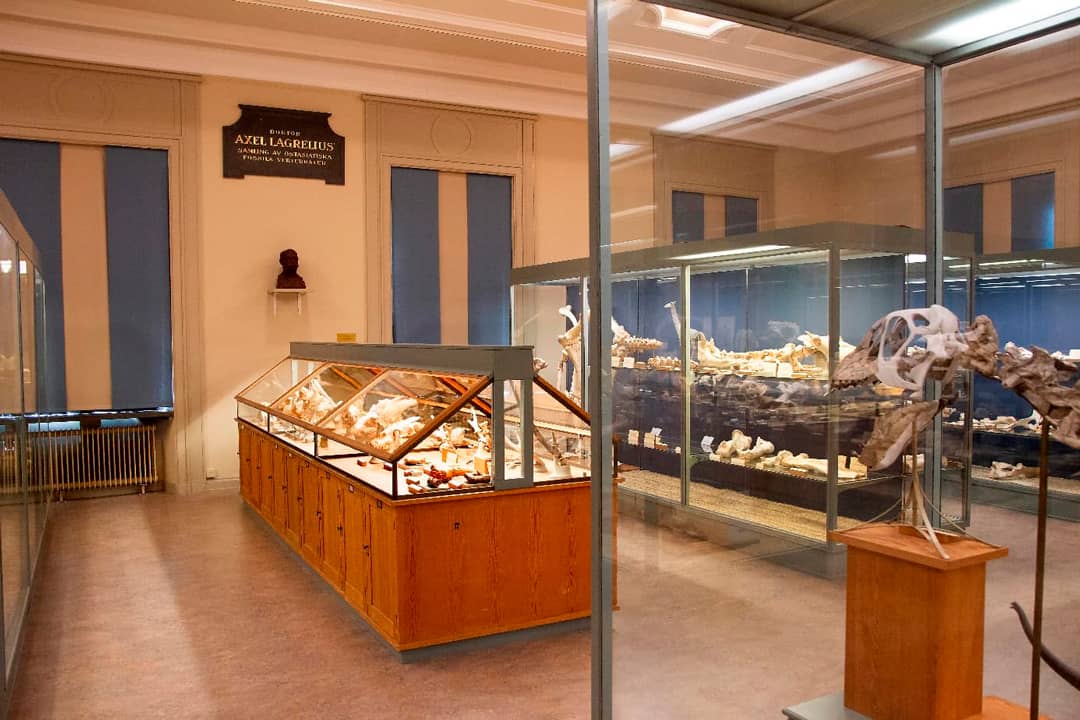
The main exhibit, displaying Chinese mammals and the dinosaur Euhelopus of the Lagrelius collection, which is honoured by a plaque on the wall.
The Lagrelius collection: the largest Chinese fossil vertebrate collection held outside of China from the pioneering age of scientific discoveries.
Geo-collection description
The Lagrelius collection contains ~6000 Chinese fossils comprising Pleistocene and Neogene mammals from ~1 to 9 million years ago, and Cretaceous dinosaurs, turtles and fish from 73 to 140 million years ago. The fossils came to Uppsala University in the early 1920’s through a unique Sino-Swedish collaboration. It is today the largest collection of Chinese fossil vertebrates held outside of China under a permanent bilateral government agreement. It is preserved at the Museum of Evolution, the natural history museum of Uppsala University, in a building that was purpose built in 1932 and hailed as a Temple for the fossils! Field work was part of the scientific collaboration between China and Sweden under the leadership of Johan Gunnar Andersson, a Swedish geologist hired 1914 as mining adviser to the Republican Chinese Government, and Ding Wenjiang the director of the Geological Survey. Between 1918-1923 more than 800 crates of fossils were shipped to Uppsala for study. The results were published in a new scientific journal started in China with the help of Swedish funding. The Lagrelius collection was named in honour of the industrialist and appointee to the Swedish Royal Court, Axel Lagrelius, who secured funding and royal patronage for the endeavour.
Geo-collection value
The Lagrelius collection (LC) contains mostly type fossils of which many are holotypes (Mateer & Lucas 1985). We have the first two Chinese dinosaur fossils ever described. The fossil mammals are from the so-called Hipparion fauna, that was widespread in Eurasia, from ~1 to 9 million years ago, and scientifically documented in numerous monographs. The LC have four original teeth of Peking Man. They come from Zhoukoudian, a UNESCO world heritage site, and were discovered in 1921 just when everyone was searching for the origin of early man in Asia. Thus, they represent our most important fossils, historically, culturally and scientifically (Sun 2024). The Sino-Swedish collaboration in the 1920’s is unique in both nations research history in that it came about as a bilateral government agreement, with exchange of fossils, research, training of Chinese students in Sweden, a new scientific journal, Paleontologica Sinica, that was founded in China at the time, and the development of a governmental institution and museum under the auspice of the Chinese geological survey and J.G. Andersson, backed up with Swedish funding through Lagrelius (Romgard 2018; Ebbestad & Romgard 2021). Today the LC is one of Sweden’s greatest paleontological assets in research and teaching terms.
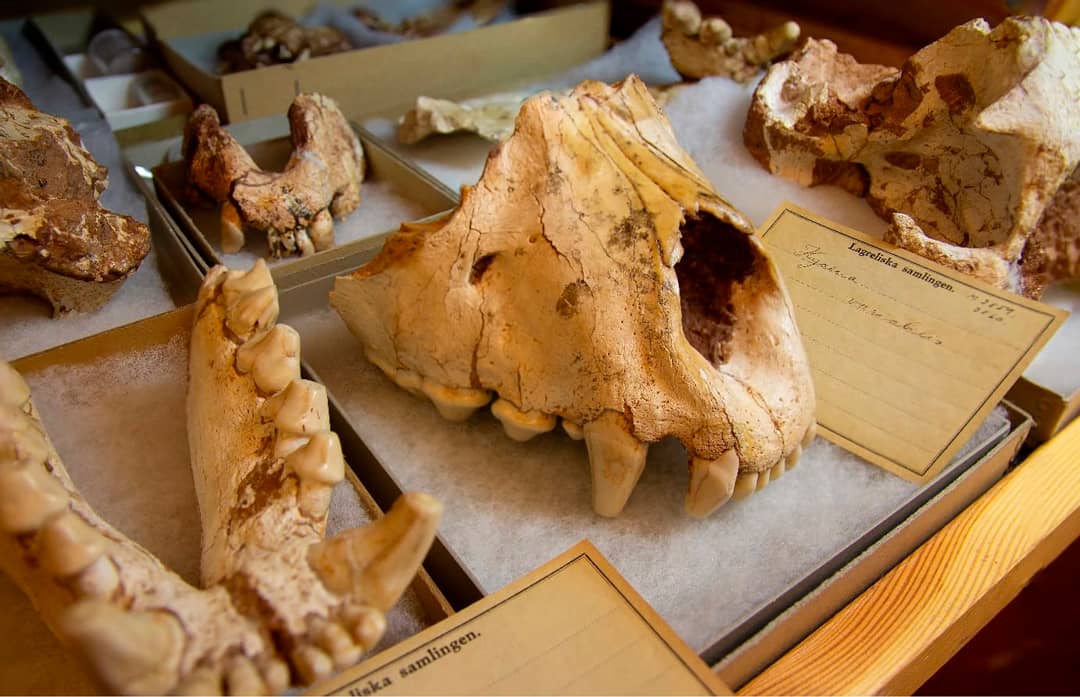
Drawer with specimens of Chinse carnivorous mammals stored in the Lagrelius collection cabinets.
Reference
Mateer, N.J. & Lucas, S.G. 1985. Swedish vertebrate palaeontology in China: A history of the Lagrelius collection. Bulletin of the Geological Institutions of the University of Uppsala 11, 1–24.
Romgard, J. 2018. Polarforskaren som strandade i Kina: Johan Gunnar Andersson och de svenska Asien expeditionerna. Stockholm: Fri Tanke förlag, 410 pp. Translated abstract from Swedish:
In 1914, polar explorer Johan Gunnar Andersson became an advisor to the Chinese government. Together with leading Chinese scientists, he took up the hunt with the great powers to solve the great mysteries of the time about the country’s natural history and archaeology. To achieve his goal, he created one of Sweden’s first and largest scientific collaborations with a country outside Europe. Despite world wars, great power intrigues and domestic political drama, the Swedish-Chinese teams made revolutionary discoveries of dinosaurs, traces of pre-humans, primitive stone tools and painted clay pots from a prehistory that no one in China had heard of before. What were they really looking for? How did Swedes participate in China’s scientific modernization, and why did China want to collaborate with them?
Ebbestad, J.O.R. & Romgard, J. 2021. Otto Zdansky: the scientist who discovered Peking Man and explored China’s fossil past. Acta Universitatis Upsaliensis, 248 pp.
Sun, C. 2024. Zhoukoudian: the birthplace of palaeoanthropology and the stimulus for Paleolithic archaeology in China. In Clary et al. (eds) Geology’s Significant Sites and their contributions to Geoheritage. Geological Society, London, Special Publications 543, 343–356. https://doi.org/10.1144/sp543-2022-272.