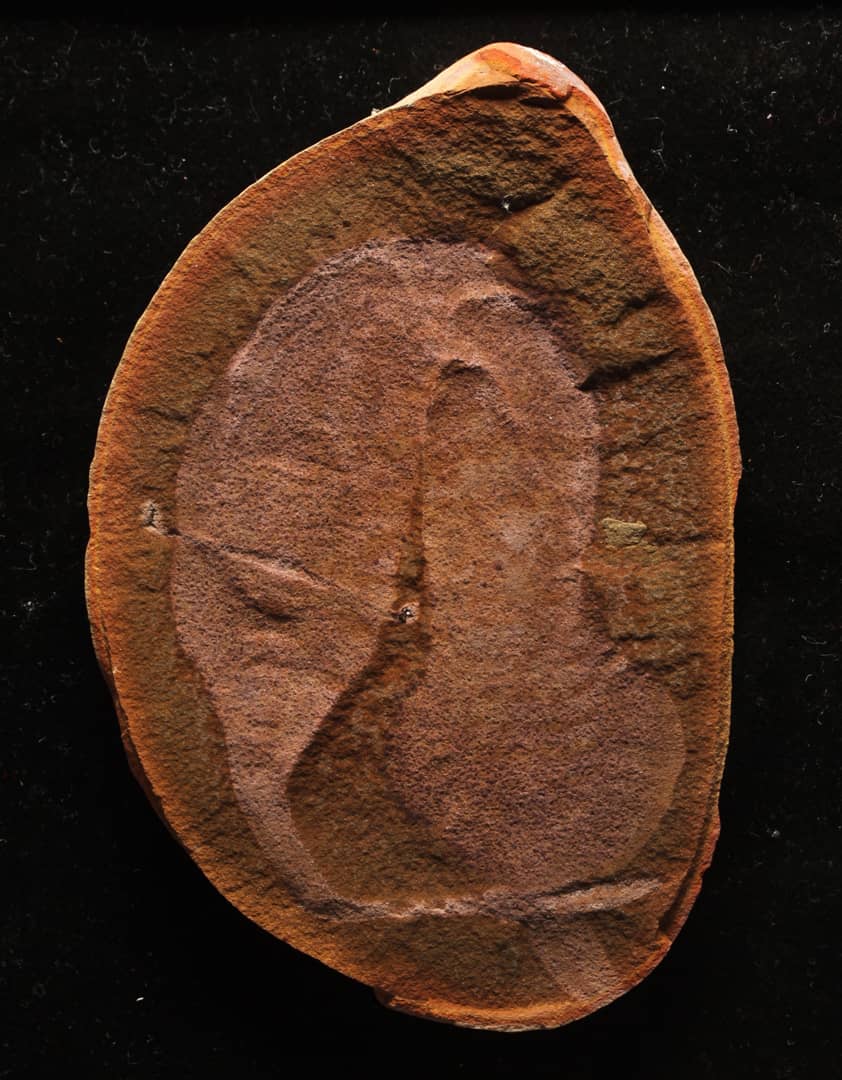
The official state fossil of Illinois, Tullimonstrum gregarium, a soft-bodied animal from the Mazon Creek region that has historically defied classification.
Housing institution
Field Museum of Natural History
Location
The Field Museum, 1400 S. DuSable Lake Shore Drive, Chicago, IL 60605, USA
The official state fossil of Illinois, Tullimonstrum gregarium, a soft-bodied animal from the Mazon Creek region that has historically defied classification.
The Field Museum's Mazon Creek collection is the definitive resource for researchers ,educators and the general public for these rare and exceptional fossils.
Geo-collection description
Mazon Creek fossils are exceptionally well-preserved remains of Carboniferous (~308 million years old) animals and plants that lived along a tropical swampy coastline in what is now northeastern Illinois. The fossils are preserved in siderite concretions in the Francis Creek Shale Member of the Carbondale Formation. There are over 512 fossil animal species from 14 phyla described from this fauna and over 130 biological species of plants (Shabica & Hay, 1997; Wittry, 2020). Many Mazon Creek fossils are unique and found nowhere else in the world.
The Field Museum collection has nearly 65,000 Mazon Creek specimens in total with 41,362 specimens in Fossil Invertebrates including 221 type specimens, 21,728 specimens in Paleobotany including 21 type specimens, and 1,785 specimens in Vertebrate Paleontology including 18 holotypes and 3 paratypes. This is a very active collection with seven scientific publications using Mazon Creek specimens from our collection published this year (Tripp et al., 2025; Byrnes et al., 2025; Schiffbauer et al., 2025; D’Antonio et al., 2025; Lhéritier et al., 2025; Braddy et al., 2025; and McCoy et al., 2025).
Geo-collection value
The initial discoveries of plants and associated arthropods and amphibians were made in the mid-nineteenth century. Collecting activities and the number of localities increased dramatically with the era of strip-mining in Illinois from 1928 to 1974. During this period, large numbers of taxa were discovered and described (Johnson and Richardson, 1966) culminating in the 1980s with a large, detailed Mazon Creek census program (Baird et al. 1985). Afterwards there was a gradual decline in collecting due to the end of strip mining and the loss of many collecting localities. However many large private collections were donated. The Museum transformed this series of private, research, and census collections into a single, well-curated, systematic collection of Mazon Creek fossils fully available to the research community (Coorough et al., 2024).
Today the Field Museum’s collection of Mazon Creek fossils is the definitive resource for researchers studying the Mazon Creek, and is the most accessed collection in Fossil Invertebrates and Paleobotany. Researchers are using new technologies including Raman microspectroscopy, synchrotron radiation, conducted x-ray microcomputed tomography, and energy-dispersive X-ray spectroscopy, to tease out more information from these fossils in the fields of diagenesis and taphonomy, systematics, and paleoecology (Herrera et al, 2023; Coorough et al., 2024).
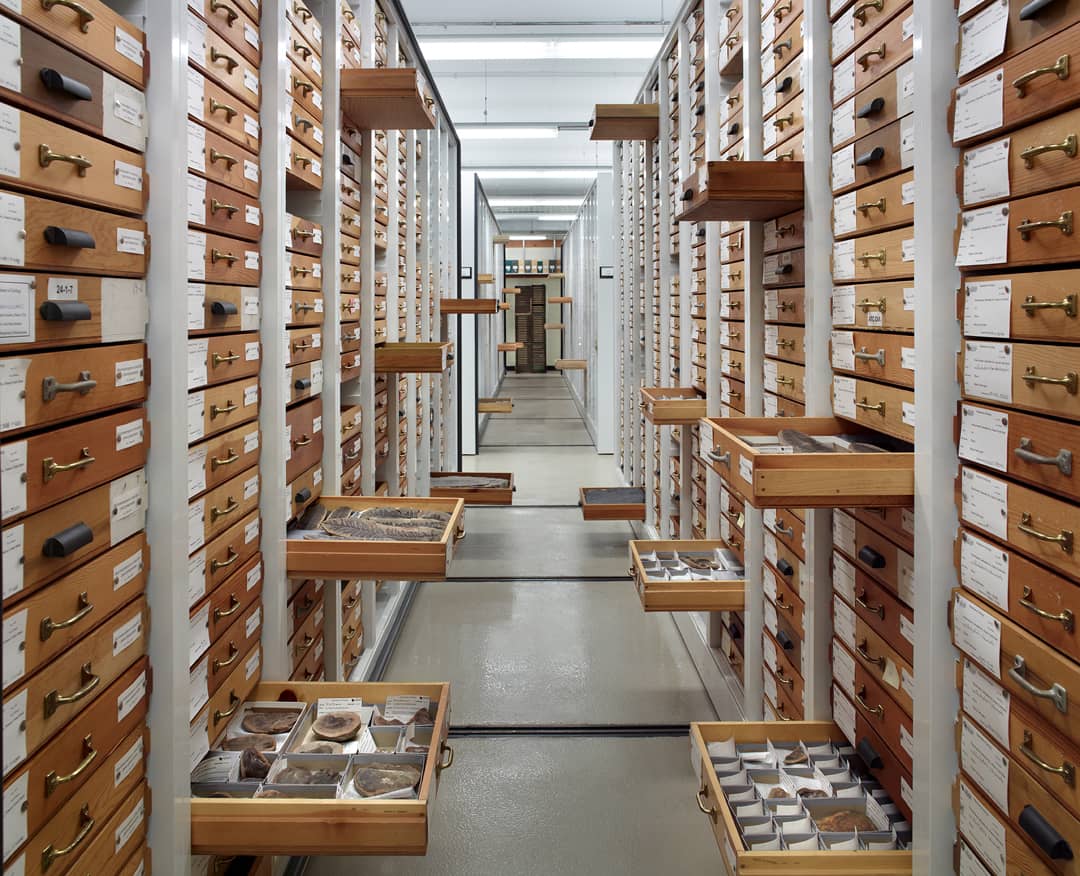
Field Museum’s Mazon Creek fossil collection in the Paleobotany Collection Range. No more than 25 Words.
Reference
Johnson, R. G. and Richardson Jr., E. S. 1966. A Remarkable Pennsylvanian Fauna from the Mazon Creek Area, Illinois. The Journal of Geology 74:5, Part 1, 626-631.
Baird, G., Sroka, S., Shabica, C., Beard, T., Scott, A. & Broadhurst, F. 1985. Mazon Creek-Type fossil assemblages in the US Midcontinent Pennsylvanian: their recurrent character and palaeoenvironmental significance [and discussion]. Philosophical Transactions of the Royal Society of London, Series B, 311, 87–99.
Shabica, C.W. & Hay, A. (eds.) 1997. Richardson’s guide to the fossil fauna of Mazon Creek. Northeastern Illinois University, Chicago, IL.
Wittry, J., 2020. A comprehensive guide to the fossil flora of Mazon Creek. Earth Science Club of Northern Illinois (ESCONI).
Coorough, P. & Mayer, P., & McCoy, V. 2023. Mazon Creek Fossils Brought to You by Coal, Concretions, and Collectors. Geological Society, London, Special Publications. 543. 10.1144/SP543-2022-317.