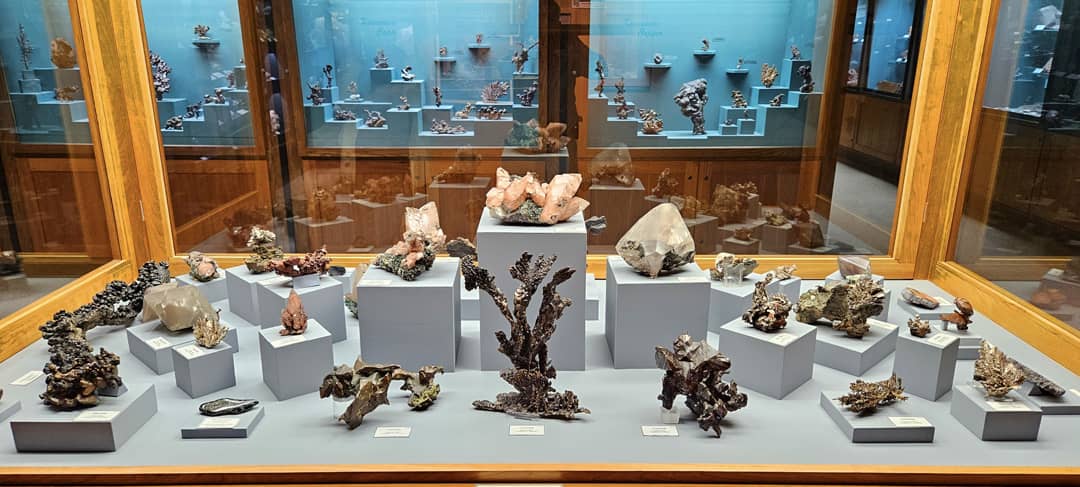
Exhibit highlighting the best specimens from the native copper mines of Michigan’s Keweenaw Peninsula, including native copper, native silver, copper-included calcite, powellite, pumpellyite, and datolite.
Housing institution
A. E. Seaman Mineral Museum
Location
1404 E. Sharon Ave., Houghton, Michigan 49931, USA
Exhibit highlighting the best specimens from the native copper mines of Michigan’s Keweenaw Peninsula, including native copper, native silver, copper-included calcite, powellite, pumpellyite, and datolite.
Historic and comprehensive mineral and gem collection emphasizing the finest mineral specimens from the North American Great Lakes region.
Geo-collection description
The collection houses minerals, gemstones, fossils, meteorites, and mining artifacts. Acquisition of specimens began shortly after founding of the Michigan Mining School (now Michigan Tech) in 1885 following the historic native copper metal-mining boom that started in the 1940s. Professor A.E. Seaman founded the museum in 1902, but was purchasing and exhibiting minerals beforehand, including exhibiting a large collection at the 1900 Paris Exposition. The museum was named in Seaman’s honor in 1932. The Michigan Tech mineral collection contains the world’s finest collection of crystallized native copper specimens, originating from Michigan’s Keweenaw Peninsula and the Lake Superior Copper district. It also has a comprehensive world-class collection of minerals from the Upper Peninsula of Michigan and the Lake Superior iron mining district. Since 1992 the museum has been the official Mineralogical Museum of Michigan and is also a heritage site cooperating with the Keweenaw National Historical Park.
In addition to worldwide and systematic collections, special collections also include minerals from the southern Illinois fluorite district; Merelani, Tanzania gem mines; Yukon Territory, Canada phosphate district; and the USA-Canada Great Lakes region. Strong holdings also include native elements, and mineral suites from Mexico, Arizona, and Franklin and Sterling Hill New Jersey.
Geo-collection value
The lava flows and native copper deposits of North American Midcontinent rift are unique around the world for the enormous quantity and the production of native copper and associated mineral specimens of spectacular quality. Perhaps as early as 8,000 years ago, the Native Peoples mined copper and traded it with groups across the continent. From the 1840s until the 1990s, the Lake Superior Native Copper Mining District produced over 5 billion kilograms of native copper. The museum’s extensive collections of minerals from this district are used for permanent public exhibit, historic and scientific research, and future reference. Likewise, the museum exhibits and curates an extensive collection of minerals from the Lake Superior iron mining district, as well as collections of minerals and suites of minerals from around the world. The collections are used for public exhibit, education, outreach, research, and publications. Specific publications include the museum and its most famous specimen [1], significance of the Copper-Country collection [1-3], and the Lake Superior iron-mining district (Refs. 4-5].
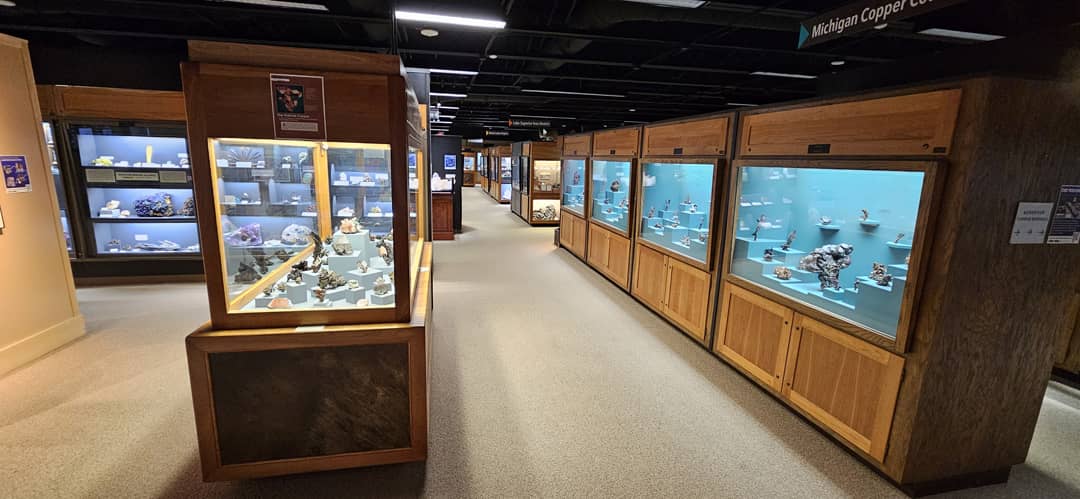
View down the main aisle: regional galleries, mineral treasures, and fluorescent minerals on the right, and mineral formation environments and systematic minerals on the left.
Reference
Jaszczak, J.A. and Francis, C.A. “Signature Specimen: The Gabriel Copper at the A. E. Seaman Mineral Museum of Michigan Technological University.” Rocks & Minerals 99, 448-452 (2024). DOI: 10.1080/00357529.2024.2348960
Stefano, C.J., editor. “Copper Country” Mineralogical Record. 54:1 (2023). Featuring five articles on Keweenaw County (Michigan) native copper fissure mines, by C.J. Stefano and P. Persson; includes over 100 images of specimens from the Michigan Tech collection.
Stefano, C. J. “The Montreal mine, Iron County, Wisconsin.” The Mineralogical Record, 51, 413-455 (2020).
Gale, A. and Cordua, W. S., “The Cuyuna Range, Crow Wing County, Minnesota.” The Mineralogical Record 56, 461-489 (2025).